Residential electrical service - Phoenix, Arizona
Lighting Installation in Phoenix, AZ: Fixtures, Under-Cabinet and Outdoor Lights (2026 Guide)
Where the City of Phoenix draws the permit line, how to choose light output in lumens, why LEDs suit a hot kitchen, and what the outdoor lighting rules require.
Quick answer
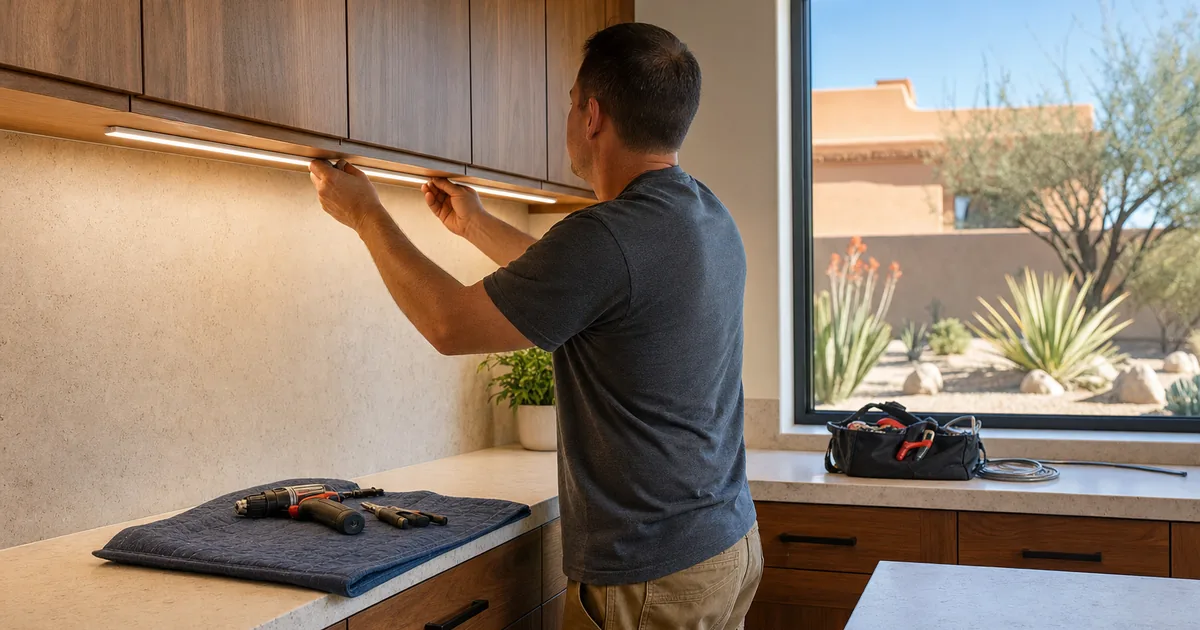
Lighting installation in a Phoenix home covers new and replacement fixtures, recessed downlights, under-cabinet task lighting and outdoor lights. Changing a bulb needs no permit, but a City of Phoenix handout states that replacing an existing fixture with a new one does, as does wiring work outside the fixture. LED fixtures are the usual choice because the U.S. Department of Energy says they use at least 75% less energy than incandescent lighting and give off very little heat. Outdoor fixtures must be shielded so light does not shine onto neighboring homes.
New lighting changes how a room works more than almost any other electrical job: a kitchen counter that can finally be seen clearly, a hallway that is no longer dim, a patio that is usable after dark. It is also a job where the line between a homeowner task and permitted electrical work is easy to cross without noticing. Swapping a bulb is one thing. Taking down a fixture and wiring up a new one is another.
This guide covers what lighting installation in a Phoenix home includes, where the City of Phoenix draws the permit line, how to choose light output now that bulbs are sold by lumens, why LED fixtures suit a hot kitchen, what the City's outdoor lighting rules ask of patio and yard lights, and which recent fixture recalls are worth checking before anything goes up on a ceiling.
Key takeaways
- A City of Phoenix Planning and Development Department handout states that replacing an existing light fixture with a new one requires a permit, while work kept entirely inside an existing listed fixture is exempt.
- The 2024 Phoenix Building Construction Code exempts minor repair work, including the replacement of lamps, from permit.
- ENERGY STAR says brightness is measured in lumens, not watts, and gives a minimum of 800 lumens as the match for a 60-watt incandescent bulb.
- The U.S. Department of Energy says incandescent bulbs release 90% of their energy as heat and CFLs about 80%, while LEDs emit very little heat.
- The City of Phoenix Zoning Ordinance requires outdoor lighting fixtures in any district to be arranged and shielded so light does not shine onto adjoining residential property.
- Phoenix City Code section 23-100 has prohibited new mercury vapor outdoor light fixtures since January 1, 1985.
What does lighting installation in a Phoenix home include?
Lighting installation is a family of jobs rather than one job, and the differences between them decide how long the work takes, what it involves and whether a permit is needed.
- Replacing a fixture. An old ceiling light, pendant, chandelier or wall sconce comes down and a new one goes up on the existing box and wiring.
- Adding a fixture. A light goes where there was none, which means a new box, new cable from a power source and usually a new switch.
- Recessed downlights. Lights set into the ceiling, either as new installations or as LED retrofits of existing cans.
- Under-cabinet task lighting. Lights mounted beneath kitchen wall cabinets to light the counter, plug-in or hard-wired.
- Outdoor lighting. Wall lights by doors and garages, eave and patio lights, and security lighting, all exposed to sun, heat and storms.
Ceiling fans with light kits and landscape lighting are close relatives and have their own pages: see ceiling fan installation and landscape lighting.
The most useful distinction for a homeowner is between work on existing wiring and work that adds wiring. Replacing a fixture where one already hangs is usually a contained job at one box. Adding lights means planning a route for new cable, and in a single-story Phoenix home that route usually runs through the attic. Crews doing this work find that the attic is the deciding factor on many ceiling-lighting jobs: how much clearance there is above the ceiling, where the ducts and framing run, and how hot it gets by mid-morning.
Does replacing a light fixture in Phoenix need a permit?
Often it does, and that surprises people. Two City of Phoenix documents speak to it, and they are best read together.
The 2024 Phoenix Building Construction Code, in its Chapter 1 amendments, lists the work that is exempt from permit. Among the electrical work it exempts is "minor repair work, including the replacement of lamps or the connection of approved portable electrical equipment." Changing a bulb is not permitted work, and neither is plugging in a lamp.
A City of Phoenix Planning and Development Department handout, "Work Exempt from Permit" (TRT/DOC/00618, revised July 2014), goes further on fixtures. It explains that "the replacement of an existing luminaire with a new luminaire does require a permit." The same handout says replacing ballasts or lamps inside an existing listed luminaire, or installing a listed retrofit kit where all of the work stays inside the luminaire, is exempt. But "if work is to be performed to the wiring, etc. anywhere outside of the luminaire; a permit would be required."
The handout is older than the current code, and the 2024 exemption list does not mention luminaires at all. The careful reading is the handout's: work that stays inside the fixture is exempt, while replacing the fixture or touching the wiring beyond it is permitted work. Adding a fixture where none existed is plainly on the permitted side. The City's online permits handout says residential permits allow residents and contractors to do minor electrical remodel work, including adding or extending circuits.
Where a particular job is unclear, the City offers a residential field consultation permit, which lets a resident meet an inspector on site to ask technical questions or get advice about work done without a permit. On any permitted lighting job, the electrician should tell you who is obtaining the permit and when the inspection is expected.
How many lumens does a new light need compared with an old bulb?
For decades bulbs were chosen by watts, and many people still think in terms of a 60-watt or a 100-watt light. Watts measure the energy a bulb uses, not the light it gives. ENERGY STAR puts it plainly: brightness "is measured in lumens (not watts)." Because an LED produces the same light for far less power, the wattage printed on an LED package says little about how bright it is. The number to read is lumens.
ENERGY STAR publishes the minimum lumens that match each familiar incandescent wattage, shown in the chart and table below.
| Old incandescent bulb | Minimum light output (lumens) |
|---|---|
| 40 watts | 450 |
| 60 watts | 800 |
| 75 watts | 1,100 |
| 100 watts | 1,600 |
| 150 watts | 2,600 |
How we got this table. The values are copied from the ENERGY STAR page Learn About Brightness (undated; read November 25, 2026). They are published minimum equivalents, not measurements of any particular product. Check the lumen figure on the package of the bulb or fixture you are buying.
In practice this matters most when a room's lighting is being redesigned rather than swapped. A kitchen that had one bright fixture in the middle of the ceiling may be relit with several recessed downlights and a run of under-cabinet lights. Adding up the lumens of the new layout, and putting them where the work happens, is how a room ends up evenly lit instead of glaring in one spot and dim at the counter.
Why are LED fixtures the usual choice for Phoenix homes?
The first reason is efficiency. The U.S. Department of Energy says residential LEDs, especially ENERGY STAR rated products, use at least 75% less energy and last up to 25 times longer than incandescent lighting. SRP's 2026 summer energy guide gives the same 75% figure. APS says LED bulbs use up to 90% less energy and emit 90% less heat than traditional bulbs. The figures differ because they compare against different baselines, but they point the same way.
The second reason is heat, and that is the part that matters here. DOE notes that LEDs emit very little heat, while incandescent bulbs release 90% of their energy as heat and CFLs about 80%. In a kitchen during a Phoenix summer, every light that turns most of its power into heat adds to the warmth the air conditioning is already fighting. A row of old incandescent downlights over a counter is, in effect, a small heater in the ceiling.
For perspective, the U.S. Energy Information Administration reports that lighting accounted for about 6% (81 billion kilowatthours) of U.S. home electricity use in 2020. That is a national figure, and it shows lighting is a modest share of household use. Switching to LED is a sensible step, not a cure for a high summer bill. The longer life matters as much as the savings for fixtures that are awkward to reach, such as lights on high ceilings and under exterior eaves.
It also helps to know what kind of LED product a job uses. Some are bulbs that screw into an existing socket. Some are retrofit kits that fit inside an existing fixture. Some are complete fixtures with the LED built in. As the permit section above explains, a listed retrofit kit with all of the work inside the existing fixture sits on a different side of the City handout's line than a new fixture does.
Where an existing dimmer is kept, it should suit LED loads. A dimmer that does not suit the lamp is one of the most common reasons a new LED light flickers or hums, and it is worth checking before the new fixtures go up rather than after.
What should you know about under cabinet lighting in a Phoenix kitchen?
Under-cabinet lighting puts light on the counter, where a ceiling fixture behind you casts your own shadow over the work. DOE says that because LEDs are small and directional, they are ideal for lighting tight spaces such as countertops, and that their directionality makes them more efficient for task lighting. Their low heat output is a further advantage in the narrow space under a cabinet, in a kitchen that is already warm for much of the year.
There are three broad ways to do it. Plug-in units run from an outlet and are the simplest. Hard-wired fixtures are fed from a circuit inside the wall and controlled by a switch. Low-voltage LED tape lighting runs from a power supply or interface that is itself connected to household power. The choice decides where the wiring goes, where the switch sits and where any power supply is housed, and those decisions are easier to make before the backsplash is finished than after.
On permits, there is a gap worth being honest about. No City of Phoenix document we found addresses under-cabinet or low-voltage LED tape lighting specifically. The 2024 code's exemption for certain low-voltage circuits is worded for control and signal circuits, not lighting power, so it should not be read as covering under-cabinet lighting. Hard-wiring new lights means wiring outside any existing fixture, which the City handout's rule places on the permit side. Whether a specific installation needs a permit is a question to settle with the contractor, or with the City through a field consultation.
Under-cabinet work often sits next to the counter outlets, and the two are sometimes planned together. For the outlet side, see outlet installation and repair.
How are recessed downlights added to a Phoenix home?
Recessed downlights are among the most common lighting upgrades. DOE estimates there are more than 600 million recessed downlights installed in U.S. homes and businesses, commonly in residential kitchens, hallways and bathrooms, and notes that the directional light of LEDs makes them more efficient for this use. Those are national figures.
There are two routes. Where cans already exist, an LED retrofit can replace the old lamp, and the City handout treats a listed retrofit kit with all work inside the existing fixture as exempt. Where new downlights are wanted, the ceiling is cut, the fixtures are set between the framing, and new cable is run from a power source to a switch and from light to light. That is new wiring, and it falls on the permitted side.
In a single-story Phoenix home the attic above the ceiling governs the layout: where the framing runs, where the ducts are, and where existing wiring can be reached. A good layout is planned from the attic as well as from the room. The details, including spacing and retrofit choices, are on the recessed lighting installation page.
What do Phoenix outdoor lighting rules require?
Phoenix regulates outdoor lighting in two places, and both are aimed at the neighbors.
The City of Phoenix Zoning Ordinance, section 704.A, requires outdoor lighting fixtures in any district to be arranged and shielded so that light does not shine onto adjoining residential property. Phoenix City Code section 23-100, the outdoor lighting section, states its aim as controlling outdoor light "so that its use does not interfere with reasonable use and enjoyment of adjacent property." It requires shielding of certain types of outdoor fixtures unless the light has an automatic shutoff and is not used from 11:00 p.m. until sunrise, and it has prohibited new mercury vapor outdoor fixtures since January 1, 1985.
The Zoning Ordinance refers to lighting standards adopted by City Council and kept on file with the Planning and Development Department. Those standards were not available online when this page was written, and we found no published brightness limits, so this page does not state any. The practical approach that follows from the rules is straightforward: choose shielded fixtures, aim light down and onto your own property rather than across a wall or into a neighbor's window, and put lights that do not need to run all night on a timer or automatic shutoff. APS also recommends timers for outside lights as an energy-saving step.
Outdoor fixtures in Phoenix face more than the rules. Direct sun ages plastic lenses and gaskets, and during the monsoon wind-driven rain and dust reach fixtures and boxes whose seals have aged. Crews replacing patio and wall lights routinely find that the old fixture failed at its seal or at the connection behind it, which is why the box and its cover are checked whenever an outdoor fixture is replaced. Garden and path lighting is covered on the landscape lighting page.
Which recent light fixture recalls should Phoenix homeowners check?
Light fixtures are recalled like any other product, and a recall can apply to something already on your ceiling or in a box waiting to be installed. Three recent U.S. Consumer Product Safety Commission recalls involve residential lighting.
- LED tape light power interfaces. In June 2025 the CPSC announced a recall of about 1,944 Lutron hard-wired power interfaces for LED tape lights, model LU-PH3-B, also sold in kits RRL-MTK-RT-IN and HWL-MTK-RT-IN. The CPSC says the power interface can fail during a significant power surge, creating a shock hazard if the tape lights are touched. The remedy is a free replacement, and no incidents were reported.
- Chandeliers. On July 16, 2026 the CPSC announced a recall of about 447 Currey & Company Nottaway chandeliers, which it says lack proper electrical grounding, posing a risk of serious injury or death from electrocution.
- Pendant fixtures. On May 14, 2026 the CPSC announced a recall of about 170 Minka Bardon Series pendant fixtures because the frame can detach from the downrod during installation.
The tape-light recall is a reminder that low-voltage lighting still connects to household power somewhere. The chandelier and pendant recalls are reminders that grounding and secure mounting are not details. Before a new fixture is installed, it is worth checking the model against the CPSC recall listings.
What happens during a lighting installation visit?
A lighting job that goes well follows a predictable order, and knowing it helps you judge the work.
- The plan. What light is needed where: overall light for the room, task light at the counter or desk, accent light, or security light outside. This is where lumens and fixture types are settled.
- The existing wiring. The circuit feeding the location, the box the fixture will hang from and what that box is fastened to, the switch and any dimmer. A heavier new fixture may need better support than the light it replaces.
- The permit question. Whether the job stays inside an existing fixture or involves a new fixture or new wiring, and if it is permitted work, who obtains the permit.
- The installation. Power off at the breaker and confirmed dead, the fixture mounted securely, connections made, and the fixture grounded.
- The test. The light switched on and off, any dimmer run through its full range, and a check for flicker or hum.
You should come away knowing what was installed, whether anything about the existing wiring or box was changed, and whether an inspection is still to come.
What are the common mistakes with lighting installation in Phoenix?
- Choosing by watts. An LED's wattage says little about its brightness. Compare lumens, using the ENERGY STAR equivalents above as a guide.
- Treating a fixture swap as permit-free. A City of Phoenix handout states that replacing an existing luminaire with a new one requires a permit.
- Hanging a heavier fixture on an unchecked box. A chandelier or large pendant needs support that matches its weight, and the CPSC pendant recall shows how much depends on secure mounting.
- Keeping a dimmer that does not suit LEDs. Flicker and hum after an upgrade usually trace back to the control, not the new light.
- Aiming outdoor lights at the neighbors. Phoenix's Zoning Ordinance requires outdoor fixtures to be shielded so light does not shine onto adjoining residential property.
- Skipping the recall check. Recent CPSC recalls cover a chandelier, a pendant and an LED tape light power interface; a quick check before installation is worthwhile.
If a newly installed light flickers, buzzes or runs warm at the switch or box, treat it as a fault and have it traced; the electrical repair page explains how.
Who installs lighting requested through Your Phoenix Electrician?
Arizona licenses electrical contractors through the Registrar of Contractors. The Arizona Administrative Code describes the R-11 Electrical classification as allowing the licensee to install and repair residential electrical systems. Ask for the license number and classification before work begins.
Lighting installation requested through Your Phoenix Electrician is performed by Alvey Electric LLC, Arizona Registrar of Contractors license ROC 364723, R-11 Electrical (residential). The work is residential only.
Frequently asked questions
Do I need a permit to replace a light fixture in Phoenix?
Usually yes. A City of Phoenix Planning and Development Department handout, Work Exempt from Permit, states that replacing an existing luminaire with a new luminaire requires a permit. The same handout says work kept entirely inside an existing listed fixture, such as replacing lamps or installing a listed retrofit kit, is exempt, but wiring work outside the fixture requires a permit. If a job is unclear, the City offers a residential field consultation permit to ask an inspector.
Can I change a light bulb or install an LED retrofit kit without a permit in Phoenix?
Changing a bulb needs no permit. The 2024 Phoenix Building Construction Code exempts minor repair work, including the replacement of lamps. A City of Phoenix handout also says installing a listed retrofit kit is exempt when all of the work stays inside the existing luminaire. Once the work reaches wiring outside the fixture, the handout says a permit would be required.
Does under cabinet lighting in Phoenix need a permit?
No City of Phoenix document we found addresses under-cabinet or low-voltage tape lighting specifically, so this page does not say it is exempt. Hard-wiring new lights involves wiring outside any existing fixture, which a City handout places on the permit side. Plug-in units are a different matter. Settle the question for your installation with the contractor, or with the City through a field consultation permit.
How many lumens do I need to replace a 60 watt bulb?
ENERGY STAR says a 60-watt incandescent bulb equals a minimum of 800 lumens. Its other equivalents are 450 lumens for 40 watts, 1,100 for 75 watts, 1,600 for 100 watts and 2,600 for 150 watts. ENERGY STAR stresses that brightness is measured in lumens, not watts, so read the lumen figure on an LED package rather than its wattage.
Do LED lights really run cooler than incandescent bulbs?
Yes. The U.S. Department of Energy says LEDs emit very little heat, while incandescent bulbs release 90% of their energy as heat and CFLs about 80%. APS says LED bulbs emit 90% less heat than traditional bulbs. In a Phoenix kitchen in summer, that means less heat from the ceiling and under the cabinets adding to what the air conditioning has to remove.
What do Phoenix outdoor lighting rules require?
The City of Phoenix Zoning Ordinance requires outdoor lighting fixtures in any district to be arranged and shielded so light does not shine onto adjoining residential property. Phoenix City Code section 23-100 requires shielding of certain outdoor fixture types unless the light has an automatic shutoff and is not used from 11:00 p.m. until sunrise. We found no published brightness limits, so choose shielded fixtures aimed onto your own property.
Can I use a mercury vapor light outside my house in Phoenix?
Not as a new fixture. Phoenix City Code section 23-100 has prohibited new mercury vapor outdoor light fixtures since January 1, 1985. If you are replacing an old yard or security light, choose a different type of shielded fixture. LED fixtures are a common choice because the U.S. Department of Energy says they use at least 75% less energy than incandescent lighting.
How do I know if my light fixture has been recalled?
Check the model number against the recall listings of the U.S. Consumer Product Safety Commission. Recent lighting recalls include about 1,944 Lutron power interfaces for LED tape lights announced in June 2025, about 447 Currey and Company Nottaway chandeliers announced in July 2026 for lacking proper grounding, and about 170 Minka Bardon Series pendants announced in May 2026 because the frame can detach from the downrod.
How much does lighting installation cost in Phoenix?
This page does not quote a price, because no public source sets one and the cost depends on the job. The main drivers are whether a fixture is replaced on existing wiring or added with new cable and a switch, how many fixtures are involved, attic access and ceiling height, the support a heavy fixture needs, and whether a permit applies. Ask for the scope and the price together.
How much energy can switching to LED lighting save?
The U.S. Department of Energy says residential LEDs, especially ENERGY STAR rated products, use at least 75% less energy than incandescent lighting and last up to 25 times longer. SRP gives the same 75% figure, and APS says up to 90% less. For context, the U.S. Energy Information Administration reports lighting was about 6% of national home electricity use in 2020.
Who does lighting installation requested through Your Phoenix Electrician?
Lighting installation requested through Your Phoenix Electrician is performed by Alvey Electric LLC, Arizona Registrar of Contractors license ROC 364723, R-11 Electrical (residential). The Arizona Administrative Code describes the R-11 Electrical classification as allowing the licensee to install and repair residential electrical systems. The work is residential only.
The short version
Decide first whether your lighting job stays inside an existing fixture or replaces or adds one, because that choice sets both the scope of the work and the City of Phoenix permit question. Choose new lights by lumens and placement, favor LED where heat matters, and shield every outdoor fixture so its light stays on your own property. Check any fixture against the CPSC recall listings before it goes up.
This page is general information about residential electrical work in Phoenix, Arizona. It is not engineering, legal or code advice for a specific property. Permit rules, utility requirements, rebates and adopted codes change; confirm current requirements with the City of Phoenix and your utility before work begins.
References
- City of Phoenix, 2024 Phoenix Building Construction Code, IBC Chapter 1 amendments (Ord. G-7397), work exempt from permit; effective August 1, 2025 https://www.phoenix.gov/content/dam/phoenix/pddsite/documents/codes-ordinances/amendmentcodes/2024-ibc-ch1.pdf. Read November 25, 2026.
- City of Phoenix Planning and Development Department, Work Exempt from Permit (TRT/DOC/00618), Rev. 07/14 https://www.phoenix.gov/content/dam/phoenix/pddsite/documents/trt/external/dsd_trt_pdf_00618.pdf. Read November 25, 2026.
- City of Phoenix Planning and Development Department, Online Permits (TRT/DOC/00933), residential permits and field consultation https://www.phoenix.gov/content/dam/phoenix/pddsite/documents/trt/external/dsd_trt_pdf_00933.pdf. Read November 25, 2026.
- City of Phoenix Zoning Ordinance, Section 704 (outdoor lighting shielding) https://phoenix.municipal.codes/ZO/704. Read November 25, 2026.
- City of Phoenix City Code, Section 23-100 Outdoor lighting https://phoenix.municipal.codes/CC/23-100. Read November 25, 2026.
- U.S. Department of Energy, Energy Saver: LED Lighting https://www.energy.gov/energysaver/led-lighting. Read November 25, 2026.
- U.S. Energy Information Administration, FAQ: electricity used for lighting (updated March 15, 2024) https://www.eia.gov/tools/FAQs/faq.php?id=99&t=3. Read November 25, 2026.
- Arizona Public Service, Energy Saving Tips https://www.aps.com/en/Residential/Save-Money-and-Energy/Your-Energy-Your-Options/Energy-Saving-Tips. Read November 25, 2026.
- SRP blog, Your ultimate guide to summer energy savings in Arizona (June 10, 2026) https://blog.srpnet.com/the-ultimate-guide-to-summer-energy-savings-in-arizona/. Read November 25, 2026.
- ENERGY STAR, Learn About Brightness https://www.energystar.gov/products/lighting_fans/light_bulbs/learn_about_brightness. Read November 25, 2026.
- U.S. CPSC, Lutron Recalls Power Interfaces for LED Tape Lights Due to Shock Hazard (June 5, 2025) https://www.cpsc.gov/Recalls/2025/Lutron-Recalls-Power-Interfaces-for-LED-Tape-Lights-Due-to-Shock-Hazard. Read November 25, 2026.
- U.S. CPSC, Currey & Company Recalls Nottaway Chandeliers (July 16, 2026) https://www.cpsc.gov/Recalls/2026/Currey-Company-Recalls-Nottaway-Chandeliers-Due-to-Risk-of-Serious-Injury-or-Death-from-Electrocution-Hazard. Read November 25, 2026.
- U.S. CPSC, Minka Lighting Group Recalls Bardon Series Pendant Light Fixtures (May 14, 2026) https://cpsc.gov/Recalls/2026/Minka-Lighting-Group-Recalls-Bardon-Series-Pendant-Light-Fixtures-Due-to-Risk-of-Serious-Injury-or-Death-from-an-Impact-Hazard. Read November 25, 2026.
- Arizona Administrative Code R4-9-103, Residential Contractor License Classifications and Scopes of Work (R-11 Electrical) https://www.law.cornell.edu/regulations/arizona/Ariz-Admin-Code-SS-R4-9-103. Read November 25, 2026.
Plan your new lighting
Request an estimate for fixture, under-cabinet or outdoor lighting work in your Phoenix home.
Related pages
- Recessed lighting installation in Phoenix
- Landscape lighting in Phoenix
- Ceiling fan installation in Phoenix
- Outlet installation and repair in Phoenix
- Electrical repair and troubleshooting in Phoenix
- Home electrical inspections in Phoenix
- Phoenix neighborhoods and villages we serve
- Your Phoenix Electrician home
About this page
Written by the Your Phoenix Electrician editorial team from the sources listed above. Reviewed by Robert "Bob" Lira, licensed Arizona electrical contractor, ROC 338369. Your Phoenix Electrician, 4315 E Thunderbird Rd #120, Phoenix, AZ 85032, phone 602-900-0593, serves homes in the City of Phoenix. Electrical work is performed by Alvey Electric LLC, Arizona Registrar of Contractors license ROC 364723 (residential electrical).
Updated .