Residential electrical service - Phoenix, Arizona
Outlet Installation and Repair in Phoenix, AZ (2026 Guide)
How to tell a simple outlet swap from a new circuit, which outlet belongs where, and where Phoenix permits and your utility come in.
Quick answer
Outlet installation and repair in Phoenix covers three jobs: replacing a worn or loose outlet with the same kind, adding new outlets or circuits, and installing 240 V outlets for EV charging or large appliances. The 2024 Phoenix Building Construction Code exempts like-for-like receptacle replacement from permit, while adding or extending circuits falls under City residential permits. Kitchens, bathrooms, garages and outdoor locations need GFCI protection, and the U.S. Fire Administration advises tamper-resistant outlets in homes with young children.
An outlet looks like the simplest part of a home's wiring, yet three quite different jobs go by the same name. Replacing a worn or loose outlet with the same kind is a small, routine repair. Adding outlets where there were none extends the wiring, and the City of Phoenix treats that differently. Installing a 240 V outlet for an electric vehicle or a large appliance usually means a new dedicated circuit from the panel, and sometimes a question about whether the panel has room for it.
This guide explains how to tell which job you have, which warning signs mean an outlet should come out of service, which outlet types belong in kitchens, bathrooms, garages, patios and children's rooms, and where Phoenix permits and your utility fit in.
Key takeaways
- The 2024 Phoenix Building Construction Code exempts from permit the repair or replacement in kind of a receptacle, and a City of Phoenix handout says exempt work must not add to or modify the premises wiring.
- The City of Phoenix says its residential permits allow residents and contractors to do minor electrical work, including adding or extending circuits and upgrading the electrical service.
- The CPSC says a GFCI cuts power when outgoing and returning current differ by as little as 0.006 amperes, and advises testing GFCIs at least once a month.
- ESFI states that, nationally, approximately 2,400 children are treated each year for shocks and burns from inserting items into receptacle slots.
- The U.S. Fire Administration advises replacing wall outlets if plugs do not fit snugly and never forcing a three-prong cord into a two-slot outlet.
- SRP says Level 2 EV charging uses a 240-volt outlet that usually needs an electrician to install a dedicated circuit.
What is the difference between outlet repair, adding outlets and a 240 V outlet installation?
Homeowners and electricians both use the word outlet loosely, so it helps to separate the work into three kinds. Each has a different scope, a different permit position and a different set of questions.
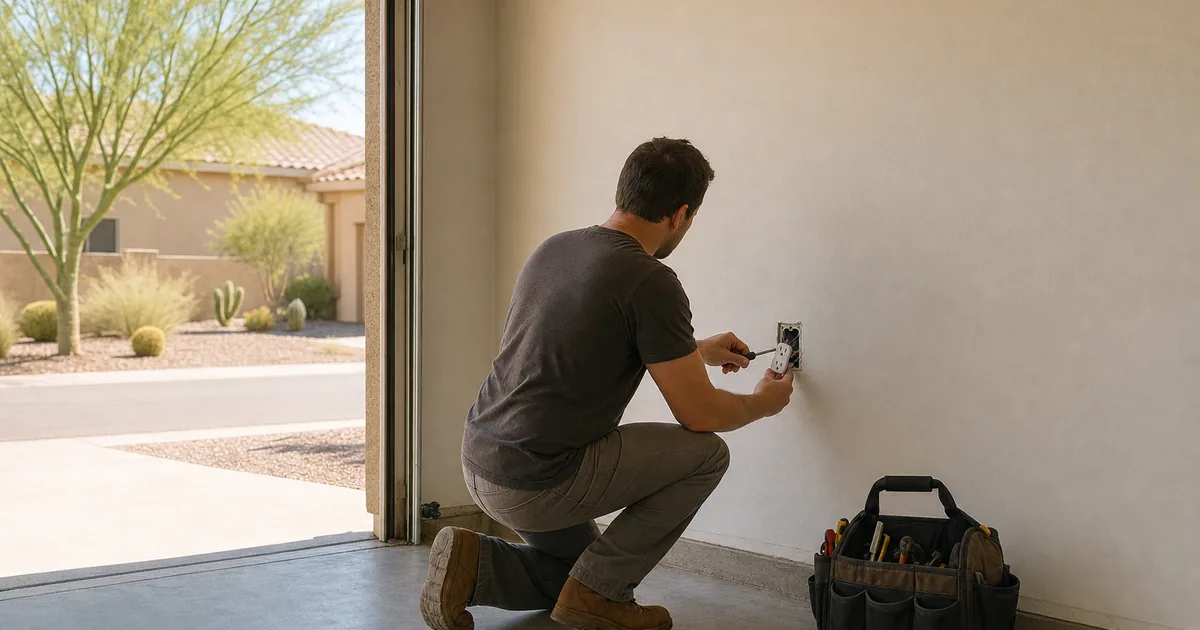
Repairing or replacing an existing outlet. The outlet is already there and fed by an existing circuit. It has worn out, stopped gripping plugs, gone dead, cracked or started running warm. The work is to find out why, correct the connection or replace the device, and confirm the circuit is sound. This is the job the City of Phoenix treats as repair or replacement in kind, covered in the permit section below.
Adding outlets. A room has too few outlets, a garage needs a workbench circuit, or a kitchen remodel calls for more counter outlets. Here the wiring system itself is being added to: either an existing circuit is extended to new boxes, or a new circuit is run from the panel.
Installing a 240 V outlet. Level 2 electric vehicle charging and some large appliances use 240 V receptacles rather than the familiar 120 V duplex outlet. That almost always means a dedicated circuit with a two-pole breaker, run from the panel to the outlet location, and it raises the question of whether the panel has the capacity and the space for it.
Knowing which job you are asking for shapes the conversation. A request to fix an outlet that turns out to need a new circuit has become a different job, and you should hear that, and why, before any work begins.
What are the signs an outlet in your Phoenix home needs repair or replacement?
Some outlets simply wear out. Others fail at the connection behind them. The warning signs overlap, and a few of them mean the outlet should be taken out of use until it has been checked.
- Plugs that fall out or feel loose. The U.S. Fire Administration advises replacing wall outlets if plugs do not fit snugly. A loose grip means the contacts inside have lost their tension, and a weak contact heats up under load.
- Heat. UL lists hot outlets or switch plates among the signs of a wiring problem. An outlet that is warm with an ordinary load plugged in has a poor connection somewhere.
- Buzzing or crackling. UL also lists buzzing. A working outlet is silent.
- Discoloration, scorch marks or a hot-plastic smell. A connection has already overheated. Stop using the outlet and switch off its breaker if you can do so safely.
- A cracked or broken face. Damaged covers and faces can leave live parts within reach.
- A dead outlet. Often the outlet itself is fine. A tripped GFCI elsewhere on the circuit, or a failed connection at the outlet before it in the chain, can leave it without power.
Two-slot outlets in older homes are a separate issue. They are not a fault on their own, but the U.S. Fire Administration advises never forcing a three-prong cord into a two-slot outlet. Bending or removing the ground pin, or plugging through an adapter, defeats the protection the third prong exists to provide. The right way to deal with two-slot outlets depends on what wiring is actually in the wall, which is something an electrician has to open the box to see. For dead outlets and other symptoms that may start somewhere else, see electrical repair and troubleshooting.
Which outlet types belong in which rooms of a Phoenix home?
A standard outlet is fine for most of a house, but not for every part of it. Rooms with water, outdoor locations, spaces children use and heavy loads each call for a different kind of receptacle. Replacing a special outlet with a standard one removes protection that the location was given for a reason. The chart and table below summarise the common types and where each is typically found.
| Outlet type | Where it is typically used | Basis |
|---|---|---|
| Standard 120 V duplex | General living areas, bedrooms | General trade practice |
| GFCI (receptacle or breaker-protected) | Kitchens, bathrooms, garages, outdoors, laundry and utility sinks | Locations listed in CPSC Publication 099 |
| Tamper-resistant | Homes with young children; new and renovated homes | USFA and ESFI advice; trade practice |
| Weather-resistant with in-use cover | Patios, yards, pool areas | General trade practice only |
| 240 V outlet (for example NEMA 14-50, NEMA 6-20) | Level 2 EV charging, large appliances | Plug types listed by APS; trade practice |
How we got this table. This is a summary of general electrical trade practice compiled by the editorial team and reviewed by the licensed contractor named on this page; it is not measured data. The GFCI locations are those the CPSC fact sheet What Is a GFCI? (Publication 099, about September 2010) lists as NEC-required. The 240 V plug types are those APS lists on its electric vehicles page, read November 25, 2026. The tamper-resistant row follows U.S. Fire Administration and ESFI advice. The weather-resistant row is trade practice only, because no Phoenix-specific source on outdoor outlets in heat, sun or dust was found. Requirements for a specific home come from the code the City of Phoenix has adopted, not from this table.
Two points follow from the table. First, an outlet's job is defined by where it is, so when an outlet in a kitchen, bathroom, garage or yard is replaced, the replacement should keep the protection that location calls for. Second, a 240 V outlet is a different device on its own circuit; it is not something that can be made by changing the outlet on an existing 120 V circuit.
How does a GFCI outlet protect kitchens, bathrooms, garages and patios?
A ground-fault circuit interrupter watches for current that leaves on one conductor and does not come back on the other. The U.S. Consumer Product Safety Commission's fact sheet What Is a GFCI? says the device cuts power when the outgoing and returning current differ by as little as 0.006 amperes. That missing current is going somewhere it should not, and in a kitchen or on a wet patio that somewhere can be a person.
The same CPSC fact sheet lists outdoors, bathrooms, garages, kitchens, and laundry and utility sinks among the locations where the National Electrical Code requires GFCI protection. The fact sheet dates from about 2010, so treat that list as the core of the requirement rather than the full current text; the City of Phoenix lists the 2023 National Electrical Code among its 2024 Building Construction Codes.
GFCI protection comes in two forms. A GFCI receptacle, which the CPSC describes as used in place of the standard duplex receptacle, has test and reset buttons on its face and protects that outlet and the outlets wired downstream of it. A GFCI breaker in the panel protects the circuit it feeds. Either way, one trip can take out several outlets at once, which is why a garage outlet, a bathroom outlet and a back patio outlet can all go dead together while their own faces show nothing wrong.
The CPSC advises testing GFCIs at least once a month. Press test and the power to the outlet should cut off; press reset to restore it. A GFCI that will not trip when tested, or will not reset with nothing plugged into its circuit, has stopped protecting and should be replaced. Around water outdoors, the same thinking extends to pool and spa equipment, covered under hot tub and pool wiring.
Why should homes with young children have tamper-resistant outlets?
Tamper-resistant outlets look almost like standard ones, but behind the slots are built-in shutters. The Electrical Safety Foundation International (ESFI) explains that the shutters open only when equal pressure is applied to both sides at once, as happens when a plug is inserted. A single object pushed into one slot meets a closed shutter.
The reason for them is a national figure: ESFI states that approximately 2,400 children are treated each year for shocks and burns from inserting items into receptacle slots. The U.S. Fire Administration advises installing tamper-resistant electrical outlets if you have young children.
In practice, tamper-resistant outlets are what crews fit in new and renovated homes, and they are the sensible choice whenever outlets are being replaced in a home where children live or visit. Because the protection is built into the outlet, it does not depend on anyone remembering to put something back after a lamp or vacuum is unplugged. A tamper-resistant outlet can feel stiffer the first few times a plug goes in. That resistance is the shutter working, not a defect.
When should you add outlets instead of using extension cords and power strips?
An outlet that always has an extension cord or power strip running from it is a sign the room was wired for less than it is now asked to do. UL recommends having an electrician add outlets if you consistently need extension cords, and the U.S. Fire Administration advises against overloading outlets.
Power strips are not a cure for a shortage of outlets. In March 2026 the CPSC warned consumers to stop using CCCEI brand power strips sold on Amazon, saying they do not contain supplementary overcurrent protection, which creates a risk of fire if the power strips are overloaded. The warning concerns one product, but the lesson is general: a strip adds places to plug in, not capacity on the circuit behind the wall outlet.
Adding outlets can solve two different problems, and an electrician should tell you which one you have. If the problem is only where the outlets are, an existing circuit can sometimes be extended to new boxes. If the problem is how much the circuit carries, as in a home office, a garage workshop or a kitchen running several countertop appliances, the answer is a new circuit, because more outlets on an already busy circuit only move the overload around. A breaker that trips whenever several things run together is the usual clue; see circuit breaker repair and replacement for what that trip is telling you.
Either way, adding outlets changes the wiring system, and that puts it in permit territory in Phoenix.
Do you need a permit to replace or add an outlet in Phoenix?
It depends on which of the three jobs it is.
Like-for-like replacement. The 2024 Phoenix Building Construction Code, in its amendments to Chapter 1 of the International Building Code, exempts from permit the repair or replacement in kind of a switch (other than a service disconnect), receptacle, contactor, control device or other utilization equipment rated 60 amperes or less. A receptacle is an outlet, so replacing a worn outlet with the same kind falls within that exemption. The City says the 2024 codes took effect on August 1, 2025.
A City of Phoenix Planning and Development handout, Work Exempt from Permit (revised July 2014), explains that the exemption covers only like-for-like replacement and that, to be exempt, the work must not include, or cause to be necessary, any additions or modifications to the premises wiring. Being exempt from a permit does not lower the standard the work has to meet.
Adding or extending. New outlets and new circuits fall outside that exemption. The City's online permits document says residential permits allow residents and contractors to do minor electrical remodel work, including adding or extending circuits and upgrading the electrical service, and its online residential permits include an Electrical Service Upgrade of up to 200 amps. Permitted work is inspected against the codes Phoenix has adopted.
The grey area. Phoenix code text does not say whether replacing a standard outlet with a GFCI or tamper-resistant outlet counts as replacement in kind, and this page does not guess. Ask the electrician how they treat it and, where it is unclear, ask the City. The City's Field Consultation permit lets a resident meet an inspector on site to ask technical questions or get advice about work done without a permit, which is useful if opening an outlet box reveals earlier work nobody can account for.
What does installing a 240 V outlet for an EV charger or large appliance involve in Phoenix?
A 240 V outlet is a dedicated circuit job, not an outlet swap. The U.S. Department of Energy's Alternative Fuels Data Center describes Level 2 home charging as 240 V equipment, says a qualified electrician can add circuits for the capacity needed, and notes that appropriate permits may be required from local building and permitting authorities. No City of Phoenix document found for this guide addresses EV or 240 V outlets specifically, but the City's residential permits cover adding circuits, which is what this work is.
Both utilities that serve parts of Phoenix point customers toward professional installation. SRP says Level 2 charging uses a 240-volt outlet and usually needs an electrician to install a dedicated circuit, and it advises: 'Work with a licensed electrician to make sure your home has a two-pole 30- to 50-amp electrical circuit breaker panel.' APS lists home charging plug types ranging from a standard three-prong outlet for Level 1 charging to a NEMA 14-50 plug or NEMA 6-20 outlet, and directs customers who need installation to its Qualified Technology Installers list. Your bill shows which utility serves your home.
The work usually runs in this order:
- Confirm what the equipment needs. The charger or appliance instructions set the outlet type and circuit it is designed for.
- Check the panel. Is there room for a two-pole breaker, and can the service carry the new load on top of everything else, including summer air conditioning?
- Plan the route. The circuit runs from the panel to the outlet, often in the garage, through walls, the attic or along the exterior.
- Permit and inspection. A new circuit is permitted work in Phoenix and is inspected once installed.
- Utility contact if the service changes. APS asks customers to contact it before a service is changed or upgraded.
If the panel is full or the service is at its limit, the outlet becomes a capacity question, covered under electrical panel upgrades. For the charger side of the job, see EV charger installation. SRP also offers instant savings on qualifying Level 2 smart chargers through SRP Marketplace, or a rebate on an eligible new charger bought elsewhere; secondhand chargers do not qualify. Check SRP's current terms, as this page does not state amounts.
How do monsoon storms affect outdoor outlets and plugged-in electronics in Phoenix?
Monsoon storms bring wind-driven rain, dust and lightning, and outlets feel all three. The City of Phoenix Fire Department's monsoon guidance advises unplugging computers, televisions and other delicate electronic equipment during storms and attaching surge protectors to such equipment. That advice is about what is plugged in; an ordinary wall outlet is not a surge protector.
Outdoor outlets are the other storm casualty. What follows is trade practice rather than a sourced Phoenix finding, because no Phoenix-specific source on outdoor outlets in heat, sun and dust was found for this guide. Crews working on Valley patios routinely find outdoor outlet covers that have cracked or no longer close, letting rain and fine dust reach the contacts. Where something stays plugged in outdoors, such as a fountain pump or a pool timer, the trade standard is a weather-resistant outlet under an in-use cover, which stays closed with the plug in place.
After a storm, a dead patio, garage or yard outlet is very often a GFCI that tripped when moisture reached the wiring. Let things dry, then press reset. If it will not reset, or trips again straight away, the outlet, its cover or the wiring in the box has likely been damaged and should be checked before it goes back into use. Lighting on outdoor circuits is covered under landscape lighting.
What are the most common mistakes with outlet installation and repair?
- Replacing a dead outlet before checking every GFCI and the panel. The dead outlet is often downstream of the real trip point.
- Swapping a GFCI, tamper-resistant or weather-resistant outlet for a standard one. The location still needs the protection it had.
- Forcing a three-prong plug into a two-slot outlet. USFA advises against it, and removing the ground pin defeats the protection it provides.
- Living with a permanent extension cord or power strip. It adds places to plug in, not circuit capacity.
- Treating a 240 V outlet as an outlet swap. It is a new circuit and often a panel question.
- Keeping a warm, buzzing or loose outlet in use because it still works. A failing connection gets worse each time it carries load.
Who installs and repairs outlets for Your Phoenix Electrician customers?
Outlet work is electrical work, and in Arizona electrical contractors are licensed by the Registrar of Contractors. Before anyone opens an outlet box or runs a new circuit, ask for the license number and classification, ask whether a permit applies and who will obtain it, and expect to be told what was found as well as what was done.
Outlet installation and repair requested through Your Phoenix Electrician is performed by Alvey Electric LLC, Arizona Registrar of Contractors license ROC 364723, R-11 Electrical (residential). The work is residential only.
Frequently asked questions
Do I need a permit to replace an outlet in Phoenix?
Usually not, if it is a like-for-like replacement. The 2024 Phoenix Building Construction Code exempts from permit the repair or replacement in kind of a receptacle. A City of Phoenix handout explains that exempt work must not add to or modify the premises wiring, so anything beyond a same-kind swap falls outside the exemption. Phoenix code text does not say whether changing to a GFCI or tamper-resistant outlet counts as in kind, so ask the electrician or the City.
Do I need a permit to add a new outlet in Phoenix?
Adding outlets or circuits is not covered by the like-for-like exemption, because it adds to the wiring system. The City of Phoenix says its residential permits allow residents and contractors to do minor electrical remodel work, including adding or extending circuits. Permitted work is then inspected against the codes Phoenix has adopted, which include the 2023 National Electrical Code.
Why is my outlet warm?
A warm outlet or cover plate with an ordinary load plugged in usually means a connection is failing, either inside the outlet or at the wires behind it. UL lists hot outlets or switch plates among the signs of a wiring problem. Unplug what is in it, stop using it, switch off its breaker if you can do so safely, and have it checked before it goes back into use.
Why won't plugs stay in my outlet?
The contacts inside the outlet have worn and lost their grip. The U.S. Fire Administration advises replacing wall outlets if plugs do not fit snugly, because a loose contact heats up under load. This is normally a like-for-like replacement, which the 2024 Phoenix Building Construction Code exempts from permit, but the connection behind the outlet should be checked at the same time.
Why did several outlets stop working at once?
The most common reason is a tripped GFCI. The CPSC explains that a GFCI receptacle protects itself and the outlets downstream of it, so one trip can cut power to outlets in other rooms, the garage or the patio. Press reset on every GFCI and check the panel for a tripped breaker. If power does not return, a connection on the circuit has likely failed and needs to be traced.
Where are GFCI outlets required?
A CPSC fact sheet lists outdoors, bathrooms, garages, kitchens, and laundry and utility sinks among the locations where the National Electrical Code requires GFCI protection. The fact sheet dates from about 2010, so treat it as the core list; Phoenix enforces the 2023 National Electrical Code. The CPSC advises testing GFCIs at least once a month with the test and reset buttons.
What is a tamper-resistant outlet?
A tamper-resistant outlet has built-in shutters behind its slots. ESFI explains that the shutters open only when equal pressure is applied to both sides at once, as when a plug goes in, so an object pushed into one slot is blocked. ESFI states that, nationally, approximately 2,400 children are treated each year for shocks and burns from receptacle slots, and the U.S. Fire Administration advises these outlets in homes with young children.
What does installing a 240 V outlet for an EV charger involve?
It means a dedicated 240 V circuit from the panel, not an outlet swap. SRP says Level 2 charging uses a 240-volt outlet that usually needs an electrician to install a dedicated circuit, and advises checking panel capacity with a licensed electrician. APS lists NEMA 14-50 and NEMA 6-20 among home charging plug types. The work covers the panel check, the circuit route, a permit and inspection, and utility contact if the service must change.
How much does outlet installation cost in Phoenix?
This page does not quote prices, because no public source sets one for outlet work. The cost depends on which job it is: a like-for-like swap is far smaller than adding a new circuit, and a 240 V outlet can also involve panel capacity. Distance from the panel, wall and attic access, the outlet type and whether a permit applies all affect it. Ask for the scope and the price together before work starts.
Can I replace an outlet myself in Phoenix?
The City of Phoenix allows residents to do minor electrical work under a residential permit, and like-for-like receptacle replacement is exempt from permit. Being exempt does not make the work safe or lower the standard it must meet. Working on a circuit you have not confirmed is dead, or one whose wiring you cannot identify, is where people are hurt. Adding outlets or circuits is permitted work and is inspected.
What should I do with outlets during monsoon storms?
The City of Phoenix Fire Department advises unplugging computers, televisions and other delicate electronics during monsoon storms and attaching surge protectors to such equipment. Afterwards, a dead outdoor or garage outlet is often a GFCI that tripped when moisture reached the wiring. Let it dry and press reset. If it will not reset or trips again immediately, have the outlet, its cover and the box checked.
Who does outlet installation and repair through Your Phoenix Electrician?
Outlet installation and repair requested through Your Phoenix Electrician is performed by Alvey Electric LLC, Arizona Registrar of Contractors license ROC 364723, R-11 Electrical (residential). The work is residential only. Before any outlet work begins, you can ask for the license number, whether a permit applies and who will obtain it.
The short version
Start by naming the job: a same-kind outlet swap, new outlets on an extended or new circuit, or a 240 V outlet on its own dedicated circuit. Keep the protection each location needs, GFCI where there is water or the outdoors and tamper-resistant where children are, and never trade it down for a standard outlet. If an outlet is warm, buzzing or loose, take it out of use until the connection behind it has been checked.
This page is general information about residential electrical work in Phoenix, Arizona. It is not engineering, legal or code advice for a specific property. Permit rules, utility requirements, rebates and adopted codes change; confirm current requirements with the City of Phoenix and your utility before work begins.
References
- City of Phoenix, 2024 Phoenix Building Construction Code, IBC Chapter 1 amendments (Ord. G-7397), work exempt from permit, effective August 1, 2025 https://www.phoenix.gov/content/dam/phoenix/pddsite/documents/codes-ordinances/amendmentcodes/2024-ibc-ch1.pdf. Read November 25, 2026.
- City of Phoenix Planning and Development Department, Work Exempt from Permit (TRT/DOC/00618), Rev. 07/14 https://www.phoenix.gov/content/dam/phoenix/pddsite/documents/trt/external/dsd_trt_pdf_00618.pdf. Read November 25, 2026.
- City of Phoenix Planning and Development Department, Online Permits (TRT/DOC/00933): residential permits, Electrical Service Upgrade, Field Consultation https://www.phoenix.gov/content/dam/phoenix/pddsite/documents/trt/external/dsd_trt_pdf_00933.pdf. Read November 25, 2026.
- City of Phoenix Planning and Development Department, Building Construction Codes (2023 National Electrical Code in the 2024 codes, effective August 1, 2025) https://www.phoenix.gov/administration/departments/pdd/tools-resources/codes-ordinance/building-code.html. Read November 25, 2026.
- Arizona Public Service, Electric Service Requirements Manual, Section 200, 200.2-2 Upgrade Service https://www.aps.com/-/media/APS/APSCOM-PDFs/About/Construction-and-Power-Line-Siting/Construction-Services/Electric-Service-Requirements-Manual/200.pdf. Read November 25, 2026.
- U.S. Fire Administration, Appliance and electrical fire safety (last reviewed May 4, 2023) https://www.usfa.fema.gov/prevention/home-fires/prevent-fires/appliance-and-electrical. Read November 25, 2026.
- Electrical Safety Foundation International, Safety from the Inside: Tamper Resistant Receptacles (modified August 13, 2021) https://www.esfi.org/safety-from-the-inside-tamper-resistant-receptacles-trrs/. Read November 25, 2026.
- U.S. Consumer Product Safety Commission, What Is a GFCI? Publication 099 (about September 2010) https://www.cpsc.gov/s3fs-public/099_0.pdf. Read November 25, 2026.
- UL, 8 signs you may have a problem with your electrical wiring (undated) https://www.ul.com/insights/8-signs-you-may-have-problem-your-electrical-wiring. Read November 25, 2026.
- U.S. Consumer Product Safety Commission, warning to stop using CCCEI brand power strips (March 5, 2026) https://www.cpsc.gov/Warnings/2026/CPSC-Warns-Consumers-to-Stop-Using-CCCEI-Brand-Power-Strips-Immediately-Due-to-Risk-of-Serious-Injury-or-Death-from-Fire. Read November 25, 2026.
- U.S. Department of Energy, Alternative Fuels Data Center, Charging Plug-In Electric Vehicles at Home (undated) https://www.afdc.energy.gov/fuels/electricity-charging-home. Read November 25, 2026.
- Salt River Project, Get your home EV ready (undated) https://srpnet.com/electric/home/cars/GetyourhomeEVready.aspx. Read November 25, 2026.
- Arizona Public Service, Electric vehicles (undated, 2026 page) https://www.aps.com/en/About/Sustainability-and-Innovation/Technology-and-Innovation/Electric-vehicles. Read November 25, 2026.
- City of Phoenix Fire Department, Monsoon safety (undated) https://phoenix.gov/fire/safety-information/outdoor/monsoon. Read November 25, 2026.
Get your outlet work scoped
Request an estimate for an outlet repair, new outlets or a 240 V outlet in your Phoenix home.
Related pages
- Electrical repair and troubleshooting in Phoenix
- Circuit breaker repair and replacement in Phoenix
- EV charger installation in Phoenix
- Electrical panel upgrade in Phoenix
- Hot tub and pool wiring in Phoenix
- Home electrical inspections in Phoenix
- Phoenix neighborhoods and villages we serve
- Your Phoenix Electrician home
About this page
Written by the Your Phoenix Electrician editorial team from the sources listed above. Reviewed by Robert "Bob" Lira, licensed Arizona electrical contractor, ROC 338369. Your Phoenix Electrician, 4315 E Thunderbird Rd #120, Phoenix, AZ 85032, phone 602-900-0593, serves homes in the City of Phoenix. Electrical work is performed by Alvey Electric LLC, Arizona Registrar of Contractors license ROC 364723 (residential electrical).
Updated .