Residential electrical service - Phoenix, Arizona
Landscape Lighting in Phoenix, AZ: Safe, Shielded and Monsoon-Ready (2026 Guide)
How a low-voltage yard system is fed and protected, what the monsoon does to it, why Arizona 811 comes first, and how Phoenix rules shape where the light goes.
Quick answer
Landscape lighting in Phoenix is usually a low-voltage system: a transformer plugged into a GFCI-protected, weather-resistant outdoor receptacle feeds cable and fixtures in the yard. Under the 2023 National Electrical Code that Phoenix enforces, outdoor outlets at a home need GFCI protection. Arizona 811 must be contacted before any digging. Phoenix City Code sets outdoor lighting standards to protect adjacent property, so fixtures are aimed down and switched by a photocell or timer.
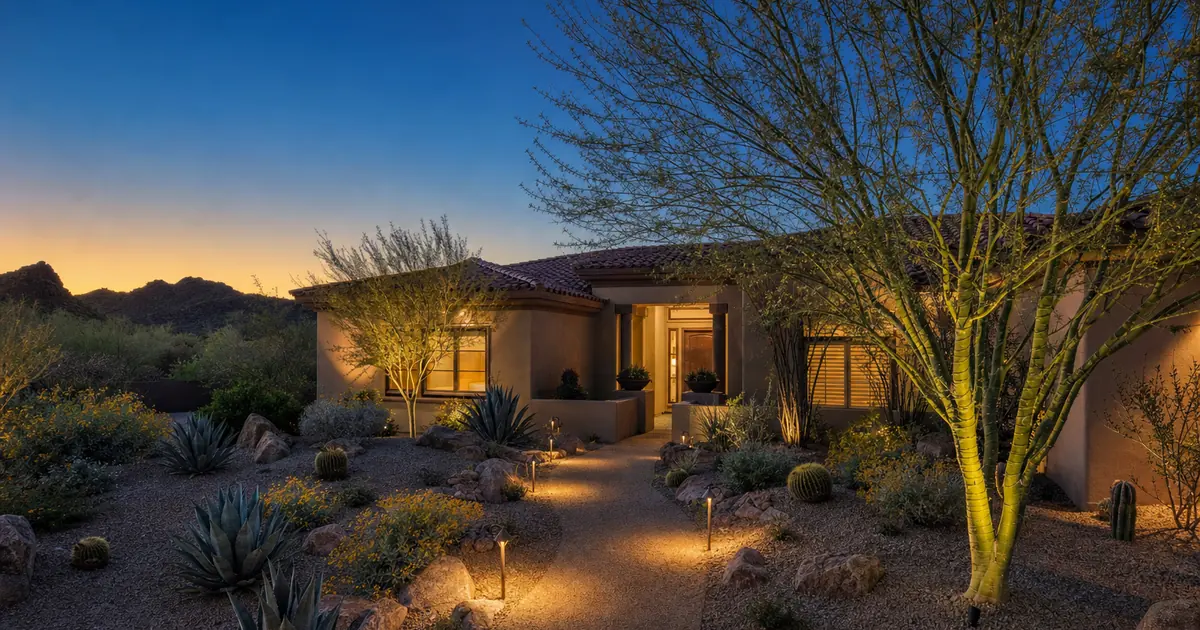
Good landscape lighting in Phoenix is easy to miss in daylight and quiet at night: a few fixtures that light a path, a step or a tree, fed from an outdoor outlet that is protected the way the code expects, and switched off by a sensor or timer when nobody needs it. Poor landscape lighting is the opposite: glare into the street, fixtures knocked flat by monsoon wind, and an outdoor outlet that trips every time it rains.
This guide covers how a low-voltage system is put together, what the outdoor outlet needs under the 2023 National Electrical Code that Phoenix has adopted, what the monsoon does to yard wiring, why Arizona 811 comes before the shovel, and what Phoenix City Code and Arizona law say about shielding and glare.
Key takeaways
- Phoenix lists the 2023 National Electrical Code among its 2024 building codes, effective August 1, 2025, and 2023 NEC section 210.8(F) requires GFCI protection for outdoor outlets at a dwelling on circuits rated 150 volts to ground or less and 50 amperes or less.
- The City of Phoenix residential inspection checklist calls for GFCI protection, weather-resistant receptacles and protective enclosures for outdoor outlets in wet locations.
- The City of Phoenix says the monsoon runs from June 15 to September 30, with storms peaking between mid-July and mid-August.
- The Arizona Corporation Commission says Arizona 811 is free statewide, utilities have two full working days to respond, and only hand tools may be used within 24 inches of marked facilities.
- Phoenix City Code section 23-100 sets outdoor lighting standards so that lighting does not interfere with reasonable use and enjoyment of adjacent property, and its definition of outdoor fixtures includes lights used for landscaping.
- The U.S. Department of Energy says photosensors sense ambient light conditions, which makes them useful for all types of outdoor lighting.
What does landscape lighting in Phoenix usually involve?
Most residential landscape lighting is a low-voltage system with four parts. An outdoor receptacle on the house supplies ordinary household power. A transformer, mounted beside that receptacle, steps the power down to a low voltage. Low-voltage cable runs from the transformer through the planting beds and along the paths. Fixtures on that cable light a walkway, the steps to the front door, a tree, a garden wall or the house number. A photocell or timer decides when the whole system is on.
That arrangement splits the job into two halves. The line-voltage half, meaning the outdoor outlet and the circuit behind it, is household wiring and is held to the same code as any other outlet on the house. The low-voltage half, meaning the cable and fixtures in the yard, carries far less energy, which is why it can lie in a planting bed at all. An electrician's attention goes first to the line-voltage half, because that is where shock and fire protection live, and then to layout, aiming and control, because those decide whether the system looks right and behaves well toward the neighbors.
Not every yard light is low voltage. Floodlights on the eaves, security lights over the garage and wall lanterns beside the door are usually line-voltage fixtures wired into the house. Phoenix City Code treats them all as outdoor light fixtures: its definition includes search, spot and flood lights used for buildings, recreation areas, landscaping and security, whether permanent or portable. Fixture work on the house itself is covered under lighting installation, and lights near a pool or spa raise separate questions covered under hot tub and pool wiring.
How does a low-voltage landscape lighting system work?
The key part is the transformer. A 2001 Electrical Contractor magazine article, written by a UL engineering associate about the National Electrical Code of that period, describes the low-voltage lighting systems covered by NEC Article 411 as systems whose power supply operates at 30 volts or less (42.4 volts peak). It explains that the secondary circuits, the low-voltage side, must be insulated from the branch circuit by an isolating transformer, and that each secondary circuit is limited to 25 amperes. That article is background on how these systems are defined, not a citation of the current code text; the current edition is the one Phoenix enforces.
In practice the isolating transformer is what makes the yard side safer to work around. A spade that nicks a low-voltage cable in a flower bed is not touching household voltage, because the transformer separates the two. That protection only holds if the transformer is a proper isolating power supply intended for the job and is installed as its instructions require.
The same article's subject is whether low-voltage lighting is installed as a listed system or assembled in the field from individual components. The practical point for a homeowner is consistency: a transformer, cable, connectors and fixtures intended to work together are easier to inspect and maintain than a mix of parts from different sources joined with whatever connectors were on hand.
Low-voltage systems also behave differently along their length. Current flowing through a long run of cable loses some voltage on the way, so a run that is too long or carries too many fixtures leaves the farthest lights dimmer than the nearest. Crews plan the runs from the transformer outward, splitting a large yard into several shorter runs instead of one long loop, so the lights at the back wall look like the lights at the front door.
What outdoor outlet does landscape lighting need in Phoenix?
The transformer plugs into, or is wired to, an outdoor receptacle, and that receptacle is where the code requirements concentrate. The City of Phoenix lists the 2023 National Electrical Code among its 2024 City of Phoenix Building Construction Codes, effective August 1, 2025. Under section 210.8(F) of the 2023 NEC, as summarized by Eaton, outdoor outlets at a dwelling unit supplied by single-phase branch circuits rated 150 volts to ground or less and 50 amperes or less require ground-fault circuit interrupter (GFCI) protection.
The City's building code page notes one deferral: full enforcement of the GFCI requirement for HVAC equipment takes effect on March 1, 2027. That deferral concerns air-conditioning equipment. It is not a deferral for the ordinary outdoor receptacle a landscape transformer uses.
The City's residential inspection checklist (Rev. 09/25) spells out what an inspector looks for at outdoor receptacles: GFCI protection, weather-resistant receptacles outdoors, and protective enclosures for outdoor outlets in wet locations. It also states that all receptacles shall be tamper resistant. A landscape transformer stays plugged in all year, through dust storms and monsoon rain, so the enclosure has to keep the receptacle protected with the cord in place, not only when nothing is plugged in.
Many existing homes have an outdoor receptacle that predates these rules, with a cover that cracked in the sun years ago or no GFCI protection at all. Before a transformer goes on the wall, crews check that the receptacle is GFCI protected, that the GFCI trips and resets, and that the box and cover are sound. If there is no receptacle where the transformer needs to be, adding one is a new outlet and possibly a circuit extension, which is covered on the outlet installation and repair page.
How does the monsoon affect landscape lighting in Phoenix?
For most of the year the yard is dry. Then the monsoon arrives. The City of Phoenix says the monsoon runs from June 15 to September 30, with storms peaking between mid-July and mid-August. Normal rainfall figures show the pattern: June is the driest month of the year, and July and August are the wettest.
| Month | Normal rainfall (inches) | Within monsoon season (June 15 to September 30) |
|---|---|---|
| January | 0.87 | No |
| February | 0.87 | No |
| March | 0.83 | No |
| April | 0.22 | No |
| May | 0.13 | No |
| June | 0.02 | From June 15 |
| July | 0.91 | Yes, peak period |
| August | 0.93 | Yes, peak period |
| September | 0.57 | Yes |
| October | 0.56 | No |
| November | 0.57 | No |
| December | 0.74 | No |
| Annual total | 7.22 | - |
How we got this table. The monthly figures are the 1991-2020 normals in the Arizona State Climate Office sheet "Phoenix, Arizona Normals, Means, and Extremes", which uses NOAA Regional Climate Center data and labels the normals preliminary; read November 25, 2026. The monsoon-season column uses the dates the City of Phoenix gives for the monsoon and its mid-July to mid-August peak. Normals are 30-year averages, so a single year can be much wetter or drier than the figure shown.
The rain is only part of it. The National Weather Service in Phoenix says outflow boundaries from strong monsoon thunderstorms can produce winds of 50 mph or greater, and that a severe downburst can cause damage equivalent to an EF-0 or EF-1 tornado. Wind of that kind flattens stake-mounted fixtures, snaps fixture stems, drops branches onto cable runs and drives dust into every gap in an outdoor box. The rain that follows lands on soil and fittings that have been dry since spring.
Three things follow for a landscape system. First, the outdoor receptacle and its GFCI will see water, so a trip after a storm is normal, and a GFCI that will not reset once things dry out needs attention; see electrical repair and troubleshooting. Second, connections in the yard need to be made with connectors intended for burial and wet conditions, because a connection that corrodes leaves a run dark or dim. Third, fixtures should be set firmly enough to stay upright and aimed after a windy night.
After a storm, the City of Phoenix warns that standing water may be electrically charged from underground or downed power lines, and advises not touching electrical equipment when wet. Check a dark landscape system once the yard has dried, not while water is standing around the transformer or the outlet.
Do you need to call Arizona 811 before installing landscape lighting?
Yes, if anything is going into the ground. The Arizona Corporation Commission says Arizona 811's services are free and available statewide, and that the legal locate requirement covers any operation in which earth or material in the ground is moved. Burying landscape cable, setting fixture stakes and trenching for conduit all move earth.
The Commission says utilities have two full working days to respond to a locate request, and that only hand tools may be used within 24 inches of marked facilities. That shapes the schedule: the locate request goes in before installation day, and cable that has to pass near a marked line is laid by hand there.
Yards in established Phoenix neighborhoods often hold more underground than the homeowner remembers: service lines, older irrigation, lines to a pool equipment pad or a detached garage. Crews ask the homeowner what they know of, look for clues on the surface such as valve boxes and equipment pads, and route cable away from them where the layout allows.
Calling 811 is not only about safety. A cut line during a lighting job means a repair and a delay that have nothing to do with lighting, and the locate service itself is free.
What rules limit glare from landscape lighting in Phoenix?
Phoenix City Code section 23-100 sets outdoor lighting standards. Its stated aim is that outdoor lighting be used so that its use does not interfere with reasonable use and enjoyment of adjacent property, while limiting the scattering of light into the atmosphere. Its definition of outdoor light fixtures includes flood and spot lights used for landscaping, so yard lighting is within its reach.
The section defines a fully shielded fixture as one whose emitted light, direct or indirect, is projected below a horizontal plane running through the fixture's lowest light-emitting point. In plain words, a fully shielded fixture does not send light upward or out above itself. The code requires shielding or filtration for certain lamp types named in a table, which lists high pressure sodium, metal halide, incandescent over 150 watts and low pressure sodium, unless the fixture has an automatic shutoff device and is not used from 11:00 p.m. until sunrise. It prohibits the installation of mercury vapor fixtures for outdoor lighting after January 1, 1985, and notes that other outdoor lighting rules are in the City's Zoning Ordinance, which this page does not cover.
Arizona also has its own statute. A.R.S. 49-1102 says all outdoor light fixtures shall be fully or partially shielded, with exemptions for incandescent fixtures of 150 watts or less and other sources of 70 watts or less. This page does not describe how that statute is applied in any particular place; the point for a homeowner is that the City code and the state statute aim in the same direction.
The practical reading is simple. Light the thing you mean to light, keep the bright part of the beam aimed down and away from property lines, and do not let a fixture throw light into a neighbor's windows or yard. Whatever table a given fixture does or does not fall into, a layout that follows that rule is the one that avoids complaints.
How should landscape lights in Phoenix be aimed and controlled?
DarkSky International publishes five principles for responsible outdoor lighting: light should be useful, targeted, low level, controlled and warm-colored. Two of its lines describe most of good landscape design: "Direct light so it falls only where it is needed," and "Use light only when it is needed."
- Useful. Every fixture has a job: a step, a path edge, a gate latch, a tree you want to see from the patio. A fixture with no job is glare.
- Targeted. Path lights that throw light down onto the walk; uplights set close to the trunk or wall they light, so the beam lands on it and not on the sky beyond.
- Low level. Desert yards with pale gravel and light stucco walls reflect a lot of light, so less output often looks better than more.
- Controlled. The system switches itself on and off instead of relying on someone to remember.
- Warm-colored. DarkSky lists warm-colored light among its principles.
For control, the U.S. Department of Energy says photosensors sense ambient light conditions, which makes them useful for all types of outdoor lighting. It notes that timers alone are used less outdoors because they may need frequent resetting, and that combining a motion sensor with a photosensor is likely the best control for utility and some security lights. For a landscape system that usually means a photocell to turn the lights on at dusk, with a timer or set run time to turn them off later in the evening. Under Phoenix City Code, an automatic shutoff that keeps the listed lamp types off from 11:00 p.m. until sunrise is the condition that exempts them from shielding or filtration, so an evening shutoff fits the way the City approaches outdoor light.
Aiming is done at night. Fixtures are placed in daylight, but the beam angle, the brightness and whether light reaches the neighbor's window can only be judged after dark, from the street and, where possible, from the far side of the property line.
Does landscape lighting need a permit in Phoenix?
We did not find a City of Phoenix document that says whether a low-voltage landscape lighting system on its own needs a permit, so this page does not say that it does or does not. What the City does say applies to the parts of the job that touch household wiring. Its Online Permits document says residential permits allow residents and contractors to do minor electrical and plumbing remodel work, including upgrading the electrical service and adding or extending circuits.
So the question usually turns on the outdoor receptacle. A transformer plugged into an existing GFCI-protected outdoor receptacle is a different job from one that needs a new receptacle, a new circuit or an extension of an existing circuit to reach the right spot in the yard. Work that adds or extends a circuit is the kind of work those residential permits cover, and permitted work is inspected against the code the City has adopted.
Where it is unclear, the City offers a residential field consultation permit that lets a resident meet an inspector on site to ask technical questions or get advice about work done without a permit. That is useful when a yard has old lighting wiring of unknown origin. If an older system is part of a wider worry about the wiring, a home electrical inspection can look at the outdoor circuits along with the rest of the house.
What are the most common mistakes with landscape lighting in Phoenix?
- Plugging the transformer into an outdoor receptacle with no working GFCI. The 2023 NEC and the City's inspection checklist both expect GFCI protection outdoors.
- Leaving the receptacle cover cracked or open. A cord left in place all year needs an enclosure that protects the outlet in a wet location.
- Digging before an 811 request. The locate is free, required when earth is moved, and utilities have two full working days to respond.
- Aiming for daytime looks. Glare toward the street or a neighbor's window only shows at night, and Phoenix City Code is written to protect adjacent property.
- Running the whole yard on one long cable. The far fixtures end up dim; shorter runs from the transformer keep the light even.
- Leaving the lights on all night. A photocell with an evening shutoff uses light only when it is needed.
Who is licensed to install landscape lighting wiring in Arizona?
Arizona licenses contractors through the Registrar of Contractors. The Arizona Administrative Code describes the R-11 Electrical classification as allowing the licensee to install and repair residential electrical systems, and the outdoor receptacle and circuit that feed a landscape system are part of a home's electrical system. Ask for the license number and classification before work begins.
Landscape lighting requested through Your Phoenix Electrician is performed by Alvey Electric LLC, Arizona Registrar of Contractors license ROC 364723, R-11 Electrical (residential). The work is residential only.
Frequently asked questions
Does landscape lighting need a GFCI outlet in Phoenix?
Yes, the outdoor receptacle a landscape transformer plugs into should be GFCI protected. Phoenix enforces the 2023 National Electrical Code, and section 210.8(F) requires GFCI protection for outdoor outlets at a dwelling supplied by circuits rated 150 volts to ground or less and 50 amperes or less. The City's residential inspection checklist also calls for GFCI protection and weather-resistant receptacles outdoors. The City's deferral to March 1, 2027 applies to HVAC equipment, not to an ordinary outdoor receptacle.
Does landscape lighting need a permit in Phoenix?
We found no City of Phoenix document that says whether low-voltage landscape lighting alone needs a permit. The City says residential permits allow residents and contractors to do minor electrical work including adding or extending circuits, so a project that needs a new outdoor receptacle or circuit is that kind of work. Where it is unclear, ask the contractor, or use the City's residential field consultation permit to meet an inspector on site.
Do I have to call 811 before installing landscape lights?
Yes, if any digging is involved. The Arizona Corporation Commission says the locate requirement covers any operation where earth or material in the ground is moved, which includes burying cable and setting fixture stakes. Arizona 811 is free and statewide, utilities have two full working days to respond, and only hand tools may be used within 24 inches of the marked facilities.
What is low-voltage landscape lighting?
It is a lighting system in which a transformer steps household power down to a low voltage for the cable and fixtures in the yard. A 2001 Electrical Contractor magazine article describes these systems, under NEC Article 411 as it then stood, as running at 30 volts or less, with the low-voltage side separated from the household circuit by an isolating transformer. That separation is why the yard cable does not carry household voltage.
Are there rules about landscape lighting shining into a neighbor's yard in Phoenix?
Yes. Phoenix City Code section 23-100 sets outdoor lighting standards so that lighting does not interfere with reasonable use and enjoyment of adjacent property, and its definition of outdoor fixtures includes lights used for landscaping. Arizona statute A.R.S. 49-1102 also says outdoor fixtures shall be fully or partially shielded, with wattage-based exemptions. Aiming fixtures down and away from property lines is the practical way to respect both.
Should landscape lights be on a timer or a photocell?
A photocell, usually paired with a timer or set run time that turns the lights off later. The U.S. Department of Energy says photosensors sense ambient light and are useful for all types of outdoor lighting, while timers alone are used less outdoors because they may need frequent resetting. DarkSky International's principles add that light should be used only when it is needed, which argues for switching the system off late in the evening.
Why does my landscape lighting stop working after a monsoon storm?
The most common reason is that the GFCI protecting the outdoor receptacle tripped when water or dust reached it. Once the area is dry, press reset on the GFCI. If it will not reset, or the lights come back dim or only partly, a connection in the receptacle, the transformer or the yard cable may be wet, corroded or damaged by wind. The City of Phoenix advises not touching electrical equipment when wet.
How much does landscape lighting cost in Phoenix?
This page does not quote a price, because no public source sets one. The cost depends on how many fixtures the yard needs, how long the cable runs are, whether the existing outdoor receptacle is GFCI protected and properly enclosed or a new receptacle or circuit is needed, how hard the ground is to trench, and which controls are used. Ask for the layout and the price together so you can see what each part covers.
Can I install low-voltage landscape lighting myself?
The low-voltage side carries far less energy than household wiring, so the main risks sit at the outdoor receptacle and in the ground. The transformer should plug into a GFCI-protected outdoor receptacle with a proper enclosure, and Arizona 811 should mark the yard before any digging. Adding a receptacle or extending a circuit is different: the City of Phoenix says residential permits allow residents and contractors to do that work, and permitted work is inspected.
What color of light is best for landscape lighting?
DarkSky International lists warm-colored light among its five principles for responsible outdoor lighting, alongside light that is useful, targeted, low level and controlled. This page does not give a specific color temperature, because none of the sources it relies on sets one. In practice, choose fixtures described as warm and judge them at night against the stucco, gravel and plants they will light.
Who installs landscape lighting requested through Your Phoenix Electrician?
Landscape lighting requested through Your Phoenix Electrician is performed by Alvey Electric LLC, Arizona Registrar of Contractors license ROC 364723, R-11 Electrical (residential). The Arizona Administrative Code describes the R-11 Electrical classification as allowing the licensee to install and repair residential electrical systems. The work is residential only.
The short version
Plan a Phoenix landscape lighting system from the outlet outward. If the outdoor receptacle is not GFCI protected and enclosed for a wet location, fix that first; if anything will be dug, make the Arizona 811 request well before the install date; and judge every fixture after dark from the property line. A system that passes those three checks will light the yard, ride out the monsoon and keep its light off the neighbors.
This page is general information about residential electrical work in Phoenix, Arizona. It is not engineering, legal or code advice for a specific property. Permit rules, utility requirements, rebates and adopted codes change; confirm current requirements with the City of Phoenix and your utility before work begins.
References
- Phoenix City Code section 23-100, Outdoor lighting (purpose, definitions, shielding or filtration, mercury vapor prohibition), via Code Publishing https://www.codepublishing.com/AZ/Phoenix/23-100. Read November 25, 2026.
- Arizona Revised Statutes 49-1102, Shielding of outdoor light fixtures; exemptions https://www.azleg.gov/ars/49/01102.htm. Read November 25, 2026.
- DarkSky International, Lighting Principles (updated September 2023) https://darksky.org/resources/guides-and-how-tos/lighting-principles/. Read November 25, 2026.
- U.S. Department of Energy, Energy Saver, Lighting Controls https://www.energy.gov/energysaver/lighting-controls. Read November 25, 2026.
- Eaton, NEC 2023 updates: GFCI 210.8(F) outdoor outlets https://ssl-uk.eaton.com/us/en-us/markets/residential/nec-2023-updates/gfci-210-8f-outdoor-outlets.html. Read November 25, 2026.
- City of Phoenix Planning and Development Department, Building Construction Codes (2023 NEC, effective August 1, 2025; HVAC GFCI enforcement March 1, 2027) https://www.phoenix.gov/administration/departments/pdd/tools-resources/codes-ordinance/building-code.html. Read November 25, 2026.
- City of Phoenix Planning and Development Department, Residential Inspection Checklist TRT/DOC/00081 (Rev. 09/25) https://www.phoenix.gov/pddsite/Documents/TRT/dsd_trt_pdf_00081.pdf. Read November 25, 2026.
- City of Phoenix Planning and Development Department, Online Permits TRT/DOC/00933 (residential permits; field consultation) https://www.phoenix.gov/content/dam/phoenix/pddsite/documents/trt/external/dsd_trt_pdf_00933.pdf. Read November 25, 2026.
- Electrical Contractor magazine, Low-voltage Lighting: Listed Systems or Individual Field-assembled Components? (July 15, 2001) https://www.ecmag.com/magazine/articles/article-detail/codes-standards-low-voltage-lighting-listed-systems-or-individual-field-assembled. Read November 25, 2026.
- City of Phoenix, Storms and Monsoon Information https://www.phoenix.gov/storms-and-monsoon-information. Read November 25, 2026.
- National Weather Service Phoenix, Monsoon Awareness Week https://www.weather.gov/psr/MonsoonAwarenessWeek. Read November 25, 2026.
- Arizona State Climate Office, Phoenix, Arizona Normals, Means, and Extremes (1991-2020 normals, preliminary) https://globalfutures.asu.edu/azclimate/wp-content/uploads/sites/35/2025/06/Phoenix.pdf. Read November 25, 2026.
- Arizona Corporation Commission, Call Before You Dig (AZ 811) https://azcc.gov/customer-assistance/call-before-you-dig-(az-811). Read November 25, 2026.
- Arizona Administrative Code R4-9-103, Residential Contractor License Classifications and Scopes of Work (R-11 Electrical) https://www.law.cornell.edu/regulations/arizona/Ariz-Admin-Code-SS-R4-9-103. Read November 25, 2026.
Plan your yard lighting
Request an estimate for landscape lighting at your Phoenix home.
Related pages
- Outlet installation and repair in Phoenix
- Lighting installation in Phoenix
- Hot tub and pool wiring in Phoenix
- Electrical repair and troubleshooting in Phoenix
- Circuit breaker repair and replacement in Phoenix
- Home electrical inspections in Phoenix
- Phoenix neighborhoods and villages we serve
- Your Phoenix Electrician home
About this page
Written by the Your Phoenix Electrician editorial team from the sources listed above. Reviewed by Robert "Bob" Lira, licensed Arizona electrical contractor, ROC 338369. Your Phoenix Electrician, 4315 E Thunderbird Rd #120, Phoenix, AZ 85032, phone 602-900-0593, serves homes in the City of Phoenix. Electrical work is performed by Alvey Electric LLC, Arizona Registrar of Contractors license ROC 364723 (residential electrical).
Updated .