Residential electrical service - Phoenix, Arizona
Pool, Spa and Hot Tub Wiring in Phoenix: What a Pool Electrician Checks (2026 Guide)
How bonding, GFCI protection, the City pool permit and overhead lines shape the electrical work around a Phoenix pool or hot tub.
Quick answer
Pool and hot tub wiring in Phoenix covers the circuits for the pump, heater, lights and spa, the sub-panel that feeds them, the bonding that ties nearby metal together, and the GFCI protection that cuts power when current leaks. The City of Phoenix pool permit asks for the sub-panel rating and requires electrical plans for sub-panels over 60 amps. City barrier rules require bonding of metal parts within 5 feet of the pool wall with at least 8 AWG wire. CPSC advises GFCIs on pool and spa equipment, tested monthly.
A backyard pool or hot tub puts water, people and electrical equipment within a few feet of each other: the pump, the heater, underwater lights, the spa's controls, the patio outlets and sometimes a power line overhead. The wiring that serves them is held to stricter rules than the rest of the house because the margin for error is smaller and the consequence of a fault is a shock in the water.
This guide explains what a pool electrician in Phoenix actually works on, what bonding and GFCI protection do, what the City of Phoenix pool permit asks about the electrical side, how overhead lines enter the picture, and what to do if anyone is ever shocked in a pool or spa. Every rule quoted comes from a City of Phoenix document or from the U.S. Consumer Product Safety Commission (CPSC), and each is attributed where it appears.
Key takeaways
- The City of Phoenix Pool and Spa Residential Permit Application asks for the pool electrical sub-panel rating and states that sub-panels over 60 amps require electrical plans.
- Phoenix's Pool Barrier Requirements say metal parts within 5 feet of the pool wall require bonding with at least 8 AWG wire, checked at the pre-plaster inspection.
- CPSC advises ground-fault circuit interrupters (GFCIs) on pumps and other electrical equipment used with pools, spas and hot tubs, and testing them monthly.
- According to a CPSC fact sheet, a GFCI trips when it detects a current difference as small as 0.006 amperes.
- CPSC says it is aware of 33 electrocution deaths in U.S. swimming pools and spas since 2002, a national figure rather than a Phoenix one.
- The City of Phoenix's overhead utility line waiver states that overhead line clearances over a pool property must comply with all City codes and ordinances.
What does a pool electrician in Phoenix work on, and why does it matter here?
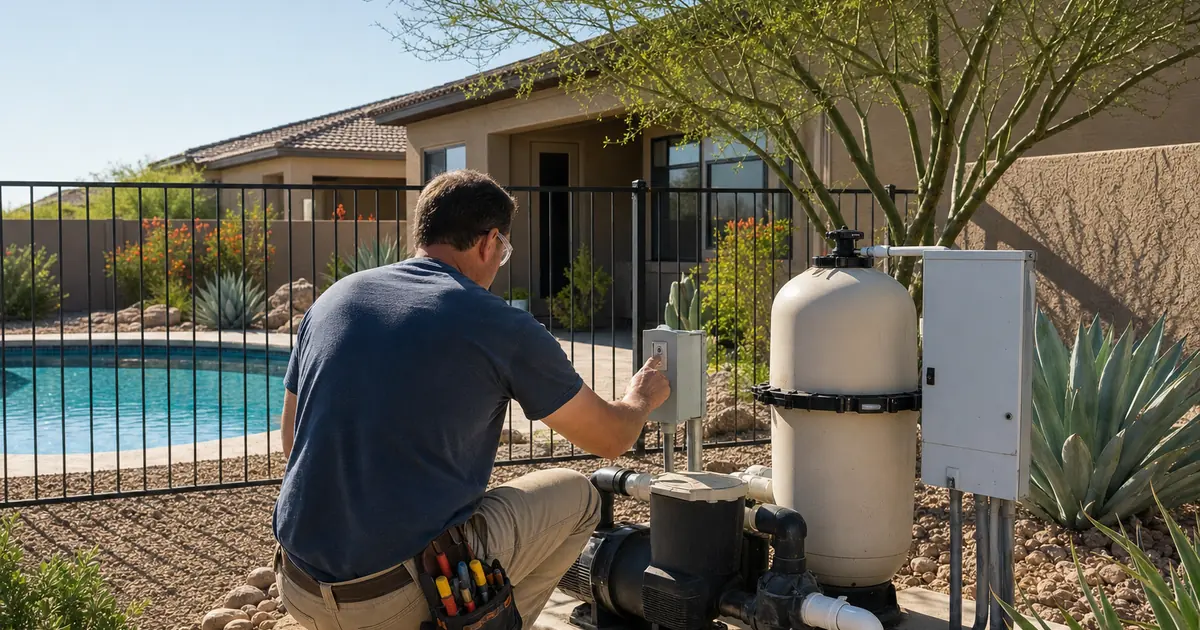
Pool and spa wiring covers every circuit and connection that serves the water and the yard around it. On a typical backyard that means the circuits feeding the pump and filter, the heater, underwater and landscape lights, the spa's blower and controls, and the outlets on the patio. Often it also means a sub-panel at the equipment pad that takes power from the home's main panel and splits it among the pool loads. Around all of that sit three safety systems: the bonding that ties nearby metal together, the GFCI protection that cuts power when current leaks, and the disconnecting means that lets the equipment be switched off safely for service.
The City of Phoenix treats this wiring as part of the pool. Its Pool and Spa Residential Permit Application asks for the pool electrical sub-panel rating in amps and for the wattage or horsepower of the pump, the heater, the lights and the spa. That list is a fair map of what a pool electrician looks at on any visit, whether the pool is new or decades old.
Scale is the reason this matters so much here. A 2025 analysis by Vexcel, a commercial aerial-imagery company, counted 257,983 properties with swimming pools out of 933,745 properties it identified within City of Phoenix boundaries, using AI pool detection on its own imagery. By our arithmetic that is about 28 percent, a little more than one property in four. Vexcel's count is a private estimate, not a government survey, but even as an estimate it means pool equipment is one of the most common heavy outdoor electrical loads in the city.
Age matters as much as numbers. In a 2003 news release, CPSC said "Older pools are the biggest concern" and advised having a qualified electrician inspect older pools, spas and hot tubs and upgrade them to local code and the National Electrical Code (NEC). A pool shell lasts for decades, while its pump, heater and lights are replaced several times over that life. Each replacement is a chance for the wiring to be brought up to date, or to be left as it was.
How often do electrical shocks cause deaths in U.S. pools and spas?
CPSC says that since 2002 it is aware of 33 fatalities that involved electrocutions in swimming pools and spas. Its yearly table, charted below, shows how those deaths are spread across the years from 2002 to 2018. These are national numbers; no Phoenix-specific count was found, and none is implied here.
| Year | Deaths |
|---|---|
| 2002 | 2 |
| 2003 | 2 |
| 2004 | 2 |
| 2005 | 3 |
| 2006 | 1 |
| 2007 | 2 |
| 2008 | 1 |
| 2009 | 1 |
| 2010 | 2 |
| 2011 | 1 |
| 2012 | 2 |
| 2013 | 2 |
| 2014 | 2 |
| 2015 | 1 |
| 2016 | 2 |
| 2017 | 7 |
| 2018 | 0 |
| 2002-2018 (our sum) | 33 |
How we got this table. The yearly figures are copied from the table of shock-related pool and spa incidents on the U.S. Consumer Product Safety Commission page "Don't Swim with Shocks" (undated; read November 25, 2026). The 33 total is our own sum of those years; it matches CPSC's statement that it is aware of 33 electrocution deaths in pools and spas since 2002. The figures are national, cover deaths CPSC is aware of, and are not a Phoenix count.
The numbers are small, but they appear in almost every year, and 2017 alone had seven. CPSC lists where the electricity comes from: underwater lights, pool pumps, filters, vacuums, extension cords, outlets, switches, electronics and overhead power lines. Every item on that list is something a homeowner installs, plugs in or lives beneath. The purpose of bonding, GFCI protection and correct equipment wiring is to stop any single failure among them from becoming a shock in the water.
What is pool bonding, and what does Phoenix require for metal near the pool?
Bonding and grounding are often confused. Bonding connects the metal parts in and around a pool, such as handrails, ladders, equipment housings and nearby fence sections, with a heavy copper conductor so that they stay at the same electrical potential. When every metal surface a swimmer can touch sits at the same voltage, there is no difference for current to push through a body that bridges two of them. Bonding does not switch anything off; it works alongside GFCI protection, which does.
Phoenix writes part of this into its pool barrier rules. The City's Pool Barrier Requirements (TRT/DOC/00144, Rev. 01/26) say metal parts within 5 feet of the pool wall require bonding with wire no smaller than 8 AWG, and that this is checked at the pre-plaster inspection. The same document explains that pools receive a pre-gunite and a pre-plaster inspection, with barrier items checked at pre-plaster. Phoenix's amended 2024 International Swimming Pool and Spa Code adds, in Section 305.1, that "All barriers shall be installed, inspected, and approved prior to plastering or filling with water."
The practical consequence is timing. On a new pool, the bonding for a metal fence or gate near the water has to be in place before plaster, which means the fence installer, the pool builder and the electrician need to be working from the same schedule. Once the deck is poured, reaching a bonding conductor is much harder than it was with the ground open.
Later changes count too. The City says barriers may not be removed once installed, and that altering a barrier requires a new permit. Replacing a run of metal fence or adding a metal gate within five feet of the pool wall is a change to the barrier, and the bonding goes with it. Crews working on Phoenix backyards look for the bonding conductor wherever metal has been added or replaced, such as a new gate, a new handrail or new equipment, because that is where a connection is easiest to miss.
Why do pool pumps, lights and hot tubs need GFCI protection?
A ground-fault circuit interrupter compares the current going out on a circuit with the current coming back. If some is missing, it is leaking somewhere it should not, possibly through water or a person, and the device cuts the power. According to CPSC's GFCI fact sheet (Pub. 099, September 2010), a GFCI trips at a current difference as small as 0.006 amperes and "interrupts power faster than a blink of an eye to prevent a lethal dose of electricity." The same fact sheet says the NEC has required GFCI protection for underwater pool lighting since 1968 and for outdoor receptacles since 1973.
CPSC advises having GFCIs on pumps and other electrical equipment used with pools, spas and hot tubs, and testing them monthly. The test takes seconds: press the TEST button and the protected equipment should stop; press RESET and it should run again. A GFCI that does not cut the power when tested has failed and is no longer protecting anyone, even though the pump still runs. See outlet installation and repair for how GFCI outlets are replaced, and circuit breaker repair for GFCI breakers in a panel or sub-panel.
A GFCI that trips again and again is not the problem. It is reporting current leaking from somewhere on the circuit: water inside a pump motor, a damaged cord, a failing light fixture or a corroded connection at the equipment pad. Replacing it with a standard breaker so that it stops tripping removes the protection and leaves the leak in place, right beside the water.
Hot tubs and spas follow the same logic. Their heater, blower, pump and control panel all sit within reach of the water and of wet hands. CPSC lists extension cords among the sources of electricity near pools, so neither a hot tub nor pool equipment should be powered through one; each should be on its own properly protected circuit.
What does the City of Phoenix pool permit ask about the electrical work?
The City's Pool and Spa Residential Permit Application (TRT/DOC/00916, Rev. 10/17) asks for the pool electrical sub-panel rating in amps and states plainly: "Sub-panels over 60amps require electrical plans." It also asks for the wattage or horsepower of the pump, the heater, the lights and the spa, for the contractor's state license class and ROC number, and whether an Overhead Utility Line and Property Line Survey waiver is included with the application.
That makes the equipment list an electrical decision as much as a pool design decision. More equipment means a larger sub-panel, and once its rating passes 60 amps the City wants electrical plans with the application. If the home's main panel or service cannot supply the pool loads, the service itself may need to grow; the City says its residential permits allow residents and contractors to upgrade the electrical service, and its online residential permits include an electrical service upgrade of up to 200 amps. That step is covered under electrical panel upgrades.
On codes, Phoenix lists the 2023 National Electrical Code among its 2024 City of Phoenix Building Construction Codes, effective August 1, 2025. The City also adopted the 2024 International Swimming Pool and Spa Code with its own amendments (Ordinance G-7397, effective August 1, 2025). The amendments we read address barriers, safety covers and alarms; we found no City amendment to the pool wiring rules themselves, so the electrical side of a pool is governed by the base code and the 2023 NEC as adopted.
Exemptions are narrow. The City's Work Exempt from Permit guidance (TRT/DOC/00618, Rev. 07/14) exempts certain above-grade prefabricated pools at single-family homes from a pool permit, but still requires a permit for the pool barrier. The same guidance says: "Repair or replacement of a switch used as a service disconnect shall require a permit."
Portable, self-contained hot tubs are a gap. We found no City of Phoenix document stating whether a separate electrical permit is required for one, so this page does not say either way. A resident who wants a clear answer can use the City's residential field consultation permit, which lets a resident meet an inspector on site to ask technical questions about an upcoming project.
How do overhead power lines affect a pool or hot tub in Phoenix?
CPSC lists overhead power lines among the sources of electricity near pools, and Phoenix builds them into the pool permit. The City's Pool Property Overhead Utility Line and Survey Waiver (TRT/DOC/00279, Rev. 10/17) states that "overhead utility line clearances must comply with all City of Phoenix codes and ordinances," and the person who signs it takes responsibility for verifying the locations of property lines and overhead lines before construction begins. The permit application asks whether that waiver is included.
We found no City document that states a specific clearance distance between overhead lines and a pool or spa, so this page does not give one. The responsible step is to look up before the layout is fixed: note every line that crosses or runs beside the yard, mark it on the plan, and settle its clearance with the pool designer, the electrician and the City before any digging. In its 2003 release, CPSC also advised that new installations position overhead lines and junction boxes safely, which is far easier to do on paper than after the shell is in the ground.
What should you do if someone is shocked in a pool or hot tub?
CPSC's guidance is direct: "Immediately turn off all power. If the power is not turned off, rescuers can also become victims." After the power is off, call 9-1-1. A swimmer who feels a shock should get out of the water while avoiding metal ladders, because a metal ladder may be part of the path the current is taking.
That advice only works if everyone in the household knows where to turn the power off. Find the breaker or switch that controls the pool and spa equipment now, label it clearly, and show it to anyone who uses the pool. If the equipment is fed from a sub-panel at the pad, know where both that sub-panel and the breaker that feeds it in the main panel are. Never jump into the water to pull someone out while the power may still be on.
After any shock, however mild, nobody should use the pool or spa until the cause has been found. A tingle in the water is the same warning as a shock from an appliance: current is reaching a place it should never reach. The source might be a light, a pump, a cord or a failed connection, and finding it is a diagnostic job of the kind described under electrical repair and troubleshooting.
When should the wiring on an older pool or spa in Phoenix be checked?
CPSC's 2003 advice to have older pools, spas and hot tubs inspected and upgraded by a qualified electrician applies with force in a city where so many homes have one. Certain moments make a check especially worthwhile:
- Buying a home with a pool. A general home inspection notes visible problems; a look at the pool circuits, GFCI protection and bonding answers a narrower question. See home electrical inspections.
- Replacing a pump, heater or light. New equipment on old wiring is a common mismatch, and the replacement is the natural moment to confirm GFCI protection and bonding.
- Adding lighting or features. New underwater or yard lighting adds circuits near the water; outdoor fixtures are covered under landscape lighting.
- Changing the fence or gate. The City requires a new permit to alter a barrier, and metal within 5 feet of the pool wall needs bonding.
- A young child joining the household. For single-family homes, Phoenix requires the barrier between the house and the pool when children under six live on the property, and the City says this applies retroactively, including to pools built before 1990.
That last trigger has an electrical side. Phoenix's amended pool code, Section 305.4, says door alarms used as a barrier option must be listed and labeled as a water hazard entrance alarm under UL 2017. For spas and hot tubs, Section 305.9 allows a latched or locked hard safety cover as a barrier option under the conditions the code sets out. Anyone choosing between those options should read the City's requirements in full before buying equipment.
Can pool equipment wiring help lower energy use in Phoenix?
The pump is usually the largest steady load in a pool system, so how it is chosen and wired affects the electric bill. APS's energy tips say ENERGY STAR in-ground pool pumps use 18% less energy than standard versions, and suggest that customers on its time-of-use plans run the pool pump in winter during super off-peak hours, 10am to 3pm. Running a pump on a schedule depends on a timer or controller wired into the pump circuit, which is part of the electrician's work when equipment is changed.
Rebates are a separate question. SRP's residential rebates page says, "SRP offered a pool pump rebate in the past, but it's no longer available." We found no current APS pool pump rebate either; its page gives tips, not a rebate. Your electric bill shows which utility serves your home, and that utility's own pages are the place to check before buying.
What are the most common mistakes with pool and hot tub wiring?
- Swapping a tripping GFCI for a standard breaker. The GFCI is reporting leaking current beside the water; removing it removes the warning and the protection.
- Never pressing the test button. CPSC advises monthly testing because a failed GFCI gives no sign until it is needed.
- Adding metal near the water without bonding. Phoenix requires bonding of metal parts within 5 feet of the pool wall with at least 8 AWG wire.
- Running a hot tub or pump off an extension cord. CPSC lists extension cords among the sources of electricity near pools.
- Designing the pool before checking overhead lines. The City's waiver makes the signer responsible for verifying line locations before construction.
- Growing the equipment list without checking the sub-panel. Sub-panels over 60 amps require electrical plans, and the home's service has to carry the added load.
Who does pool and hot tub electrical work for Phoenix homes?
Arizona licenses electrical contractors through the Registrar of Contractors, and the City's pool permit application asks for the contractor's state license class and ROC number. The Arizona Administrative Code describes the R-11 Electrical classification as allowing the licensee to install and repair residential electrical systems. Ask for the license number and classification before work begins.
Pool, spa and hot tub electrical work requested through Your Phoenix Electrician is performed by Alvey Electric LLC, Arizona Registrar of Contractors license ROC 364723, R-11 Electrical (residential). The work is residential only.
Frequently asked questions
Do I need an electrician to install a hot tub in Phoenix?
A hot tub needs its own properly protected circuit, and CPSC advises GFCI protection on spa and hot tub equipment, so the connection is electrical work. We found no City of Phoenix document stating whether a portable, self-contained hot tub needs a separate electrical permit, so this answer does not say either way. The City's residential field consultation permit lets a resident meet an inspector on site to ask that question before the tub arrives.
What is pool bonding and why does it matter?
Pool bonding connects the metal parts in and around a pool, such as handrails, ladders, equipment and nearby fence sections, with a heavy copper conductor so they stay at the same electrical potential. When every metal surface a swimmer can touch is at the same voltage, current has no difference to push through a body bridging two of them. Bonding works alongside GFCI protection, which is the device that cuts the power.
Does Phoenix require bonding for a metal pool fence?
Yes, for metal close to the water. The City of Phoenix Pool Barrier Requirements say metal parts within 5 feet of the pool wall require bonding with at least 8 AWG wire, and this is checked at the pre-plaster inspection. The City also says altering a barrier requires a new permit, so replacing metal fence or a gate near the pool brings the bonding back into question.
Do pool pumps need GFCI protection?
CPSC advises GFCIs on pumps and other electrical equipment used with pools, spas and hot tubs. A GFCI cuts power when it detects current leaking, and CPSC's fact sheet says it trips at a difference as small as 0.006 amperes. The same fact sheet says the National Electrical Code has required GFCI protection for underwater pool lighting since 1968 and for outdoor receptacles since 1973.
How often should I test the GFCI on my pool or spa?
CPSC advises testing GFCIs monthly. Press the TEST button and the protected equipment should stop; press RESET and it should run again. If pressing TEST does not cut the power, the device has failed and is not protecting anyone, even though the pump still runs. A GFCI that trips by itself again and again is reporting leaking current and the cause should be found.
Do I need a permit for pool electrical work in Phoenix?
New pools and spas go through the City of Phoenix pool permit, which asks for the electrical sub-panel rating and requires electrical plans for sub-panels over 60 amps. The City says altering a pool barrier requires a new permit, and that repairing or replacing a switch used as a service disconnect requires a permit. Upgrading the electrical service is also permitted work under the City's residential permits.
What should you do if someone is shocked in a pool or hot tub?
Turn off all power first, then call 9-1-1. CPSC warns that if the power is not turned off, rescuers can also become victims. A swimmer who feels a shock should get out while avoiding metal ladders. Know and label the breaker that controls the pool equipment ahead of time, and keep everyone out of the water until the cause is found.
Can a pool be built under overhead power lines in Phoenix?
Overhead lines have to be addressed before construction. The City's Pool Property Overhead Utility Line and Survey Waiver states that overhead utility line clearances must comply with all City of Phoenix codes and ordinances, and the signer takes responsibility for verifying line and property-line locations. We found no City document giving a specific clearance distance, so settle the layout with the City and your contractors before digging.
Are there APS or SRP rebates for pool pumps?
Not that we found. SRP's residential rebates page says its pool pump rebate is no longer available, and the APS page we read gives energy tips rather than a rebate. APS says ENERGY STAR in-ground pool pumps use 18% less energy than standard versions and suggests winter pump running during super off-peak hours, 10am to 3pm, on its time-of-use plans.
How much does pool or hot tub wiring cost in Phoenix?
This page does not quote a price, because no public source sets one and the work varies widely. The cost depends on the equipment being powered, the size of the sub-panel, the distance from the main panel, whether bonding or GFCI protection has to be added to an older pool, whether the service needs upgrading, and whether plans and permits are required. Ask for a written scope that lists each item.
Who does pool and hot tub electrical work for Your Phoenix Electrician?
Pool, spa and hot tub electrical work requested through Your Phoenix Electrician is performed by Alvey Electric LLC, Arizona Registrar of Contractors license ROC 364723, R-11 Electrical (residential). The Arizona Administrative Code describes the R-11 Electrical classification as allowing the licensee to install and repair residential electrical systems. The work is residential only.
The short version
Around water, the wiring has to fail safe, so judge any pool or spa installation by three questions: is every nearby metal part tied into the bonding, does every circuit near the water have GFCI protection that passes its monthly test, and does everyone in the house know which breaker shuts it all off. If the answer to any of them is no or unknown, that is the first thing to settle, before new equipment, lighting or a fence change. On a new pool, put the sub-panel size and the overhead lines into the plan before the layout is fixed.
This page is general information about residential electrical work in Phoenix, Arizona. It is not engineering, legal or code advice for a specific property. Permit rules, utility requirements, rebates and adopted codes change; confirm current requirements with the City of Phoenix and your utility before work begins.
References
- Vexcel, How Many Pools are in Phoenix? Elements AI Gave Us the Answer, July 16, 2025 https://vexceldata.com/stories/how-many-pools-are-in-phoenix-elements-ai-gave-us-the-answer/. Read November 25, 2026.
- City of Phoenix Planning and Development Department, Pool and Spa Residential Permit Application, TRT/DOC/00916, Rev. 10/17 https://www.phoenix.gov/content/dam/phoenix/pddsite/documents/trt/external/dsd_trt_pdf_00916.pdf. Read November 25, 2026.
- City of Phoenix Planning and Development Department, Pool Property Overhead Utility Line and Survey Waiver, TRT/DOC/00279, Rev. 10/17 https://www.phoenix.gov/content/dam/phoenix/pddsite/documents/trt/external/dsd_trt_pdf_00279.pdf. Read November 25, 2026.
- City of Phoenix Planning and Development Department, Pool Barriers - Requirements, TRT/DOC/00144, Rev. 01/26 https://www.phoenix.gov/content/dam/phoenix/pddsite/documents/trt/external/dsd_trt_pdf_00144.pdf. Read November 25, 2026.
- City of Phoenix, 2024 International Swimming Pool and Spa Code as amended (Ord. G-7397, effective August 1, 2025) https://web-prod.phoenix.gov/content/dam/phoenix/pddsite/documents/codes-ordinances/amendmentcodes/2024-ispcs.pdf. Read November 25, 2026.
- City of Phoenix Planning and Development Department, Work Exempt from Permit, TRT/DOC/00618, Rev. 07/14 https://www.phoenix.gov/content/dam/phoenix/pddsite/documents/trt/external/dsd_trt_pdf_00618.pdf. Read November 25, 2026.
- City of Phoenix Planning and Development Department, Online Permits, TRT/DOC/00933 (residential permits, service upgrade, field consultation) https://www.phoenix.gov/content/dam/phoenix/pddsite/documents/trt/external/dsd_trt_pdf_00933.pdf. Read November 25, 2026.
- City of Phoenix Planning and Development Department, Building Construction Codes (2023 National Electrical Code, effective August 1, 2025) https://www.phoenix.gov/administration/departments/pdd/tools-resources/codes-ordinance/building-code.html. Read November 25, 2026.
- U.S. Consumer Product Safety Commission, Don't Swim with Shocks: Electrical Safety In and Around Pools (undated; incident table 2002-2018) https://www.cpsc.gov/safety-education/safety-guides/pools-and-spas/dont-swim-shocks-electrical-safety-and-around-pools. Read November 25, 2026.
- U.S. Consumer Product Safety Commission, news release, Don't Swim With Shocks, May 20, 2003 https://www.cpsc.gov/Newsroom/News-Releases/2003/Dont-Swim-With-Shocks-CPSC-American-Red-Cross-Warn-of-Electrocutions-in-Swimming-Pools-Hot-Tubs-and-Spas. Read November 25, 2026.
- U.S. Consumer Product Safety Commission, What Is a GFCI? (Pub. 099), September 2010 https://www.cpsc.gov/s3fs-public/099_0.pdf. Read November 25, 2026.
- Salt River Project, Residential rebates (pool pump rebate no longer available) https://www.srpnet.com/energy-savings-rebates/home/rebates/residential-rebates. Read November 25, 2026.
- Arizona Public Service, Energy Saving Tips https://www.aps.com/en/Residential/Save-Money-and-Energy/Your-Energy-Your-Options/Energy-Saving-Tips. Read November 25, 2026.
- Arizona Administrative Code R4-9-103, Residential Contractor License Classifications and Scopes of Work (R-11 Electrical) https://www.law.cornell.edu/regulations/arizona/Ariz-Admin-Code-SS-R4-9-103. Read November 25, 2026.
Have your pool or spa wiring checked
Request an estimate for pool, spa or hot tub electrical work at your Phoenix home.
Related pages
- Electrical panel upgrade in Phoenix
- Circuit breaker repair and replacement in Phoenix
- Outlet and GFCI installation and repair in Phoenix
- Landscape lighting in Phoenix
- Home electrical inspections in Phoenix
- Electrical repair and troubleshooting in Phoenix
- Phoenix neighborhoods and villages we serve
- Your Phoenix Electrician home
About this page
Written by the Your Phoenix Electrician editorial team from the sources listed above. Reviewed by Robert "Bob" Lira, licensed Arizona electrical contractor, ROC 338369. Your Phoenix Electrician, 4315 E Thunderbird Rd #120, Phoenix, AZ 85032, phone 602-900-0593, serves homes in the City of Phoenix. Electrical work is performed by Alvey Electric LLC, Arizona Registrar of Contractors license ROC 364723 (residential electrical).
Updated .