Residential electrical service - Phoenix, Arizona
Electrical Repair and Troubleshooting in Phoenix, AZ (2026 Guide)
What the symptom is telling you, which problems should not wait, how an electrician finds the cause, and where permits come in.
Quick answer
Electrical repair in a Phoenix home starts with diagnosis: reproducing the symptom, checking the circuit at the panel and at the affected outlets or fixtures, and testing the connections between them. Heat, a burning smell, buzzing, shocks and a breaker that keeps tripping should be checked promptly. Most faults turn out to be at a connection. Like-for-like repairs are routine; the City of Phoenix issues residential permits for work that adds or extends circuits or upgrades the service.
Electrical problems rarely announce what they are. A dead outlet, a light that flickers, a breaker that trips on hot afternoons: each has several possible causes, and the cheap fix for one is the wrong fix for another. This guide explains what the common symptoms usually point to, which ones should not wait, how a fault is actually traced, and what Phoenix conditions add to the picture.
Key takeaways
- A breaker that trips again after being reset is doing its job; the cause has to be found, not overridden.
- Heat, a burning smell, buzzing, crackling or a shock from a fixture or appliance should be checked promptly.
- Most electrical faults are found at a connection: an outlet, a switch, a splice or a lug in the panel.
- The City of Phoenix says residential permits allow residents and contractors to do minor electrical work including adding or extending circuits.
- The City of Phoenix offers a residential field consultation permit that lets a resident meet an inspector on site to ask technical questions.
- Phoenix lists the 2023 National Electrical Code among its 2024 City of Phoenix Building Construction Codes.
What does electrical repair actually involve?
Repair is two jobs, and the first one matters more. Diagnosis finds the cause. The repair corrects it. Replacing the part that shows the symptom, without finding why it failed, is how the same problem comes back in a month.
A home's wiring is a set of circuits. Each starts at a breaker in the panel, runs out through cable in the walls and attic, and passes through a chain of outlets, switches and fixtures. Wherever a wire is joined or attached there is a connection, and connections are where nearly all faults live. A cable resting undisturbed inside a wall almost never fails by itself.
So an electrician's working assumption on most calls is simple: somewhere on this circuit, a connection has loosened, corroded, overheated or been damaged, or a device at the end of its life has stopped doing its job. The work is to find which one.
What do common electrical symptoms usually mean?
The same symptom can come from several causes, which is why a description over the phone gives a list of suspects and not an answer. The chart and table below sort the common ones by how soon they should be looked at.
| Symptom | Urgency | What it usually points to |
|---|---|---|
| Burning smell or scorch marks | Stop using it, check now | A connection overheating under load |
| Hot outlet or cover plate | Stop using it, check now | Loose or worn connection at the device |
| Buzzing or crackling from a panel, switch or outlet | Stop using it, check now | Arcing, or a loose breaker or connection |
| Shock or tingle from an appliance or fixture | Stop using it, check now | Grounding or wiring fault |
| Breaker trips again after reset | Have it checked soon | Overload, short circuit, ground fault or worn breaker |
| Lights flicker or dim across several rooms | Have it checked soon | Loose connection at the panel or service |
| GFCI outlet will not reset | Have it checked soon | Moisture, a real ground fault, or a failed device |
| Single dead outlet, no heat or smell | Routine | Tripped GFCI upstream, or a failed outlet |
| One flickering bulb or fixture | Routine | The bulb, the socket or an unsuitable dimmer |
| Loose or worn outlet that no longer grips a plug | Routine | Outlet at the end of its life; replace before it overheats |
How we got this table. This is a summary of general electrical trade practice, compiled by the editorial team and reviewed by the licensed contractor named on this page. It is not measured data and it is not a diagnosis. The same symptom can have a cause that is not listed, which is why a fault is confirmed by testing and not from a chart.
Which electrical problems should not wait?
Four signs separate a fault that needs attention now from one that can be scheduled: heat, smell, sound and shock.
- Heat. An outlet, switch or cover plate that is hot to the touch means current is passing through a poor connection. That connection will keep getting worse.
- Smell. A sharp, hot-plastic smell near a device or the panel is insulation overheating. Find the circuit and switch it off.
- Sound. Buzzing or crackling is electricity jumping a gap. A panel should be silent.
- Shock. A tingle from a tap, an appliance or a metal fixture means current is finding a path it should not have.
If you see smoke or flame, leave the house and call the fire department. For the rest, stop using the affected circuit, switch off its breaker if you can do so without touching anything that is hot or damaged, and have it checked before it goes back into use.
The fifth sign is a breaker that will not stay on. A breaker that trips is a safety device working correctly. Resetting it over and over, or replacing it with a larger one so that it stops tripping, removes the protection and leaves the cause in place.
How does an electrician find the cause of a fault?
A diagnostic visit follows a sequence, and knowing it helps you judge whether the visit was thorough.
- The history. What happens, when it started, how often, and what else is running at the time. A fault that appears only on hot afternoons, or only when the microwave and the toaster run together, has already been half diagnosed by that description.
- Reproducing it. Where possible the electrician makes the fault happen, because a fault that can be triggered can be measured.
- The panel. The breaker for the circuit is checked for heat, looseness and wear, and the connections on it are tested.
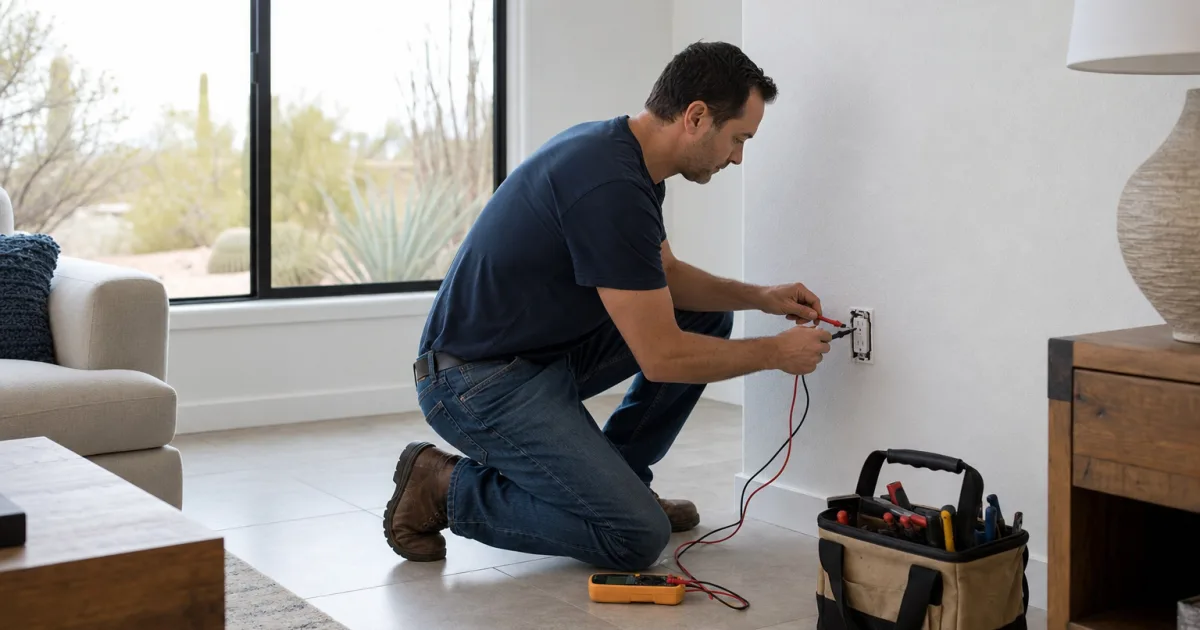
- The circuit, device by device. Outlets, switches and fixtures on the circuit are tested in order from the panel outward. A dead section begins just after the last point that still has power, and the failed connection is usually at that last working point or the first dead one.
- The finding. You are told what failed, why, what the repair is, and whether anything else on the circuit should be dealt with while it is open.
Crews who do this work in Phoenix find that the fault is at a connection in the great majority of calls: a wire that has worked loose in the back of an outlet, a splice in an attic box, a lug in an outdoor panel that years of heat have loosened. We routinely find that the device a homeowner suspected was fine, and that the trouble was one outlet earlier in the chain.
Why do Phoenix homes have their own pattern of electrical faults?
The work is the same anywhere, but the conditions here push faults in particular directions.
Long, heavy summer load. Air conditioning runs for hours at a stretch, and everything else in the house runs alongside it. Connections that are only slightly poor heat up under that sustained current, which is why so many calls about warm panels, tripping breakers and dimming lights arrive in the hottest weeks.
Outdoor service equipment. Most Phoenix homes have the meter and main panel on an outside wall. Direct sun ages insulation and plastic, and the daily swing between a hot afternoon and a cooler night loosens connections over the years.
Attic wiring. In single-story homes much of the wiring, and many of the splices, are in the attic, where summer temperatures are extreme. Attic work is done early in the day for the safety of the people doing it, and that affects when a repair can be scheduled.
Monsoon storms. Wind-driven rain and dust reach outdoor outlets, fixtures and boxes whose covers and seals have aged. Lightning and utility switching during storms send surges through the wiring. After a storm, a GFCI that has tripped and will not reset is a common and usually fixable result.
Do electrical repairs in Phoenix need a permit?
Some do. The City of Phoenix Planning and Development Department says residential permits allow residents and contractors to do minor electrical and plumbing remodel work, including upgrading the electrical service and adding or extending circuits. A repair that turns into a new circuit or an extended one is that kind of work. So is anything at the service: the City's online residential permits include an electrical service upgrade of up to 200 amps and an electric meter socket replacement.
The City also offers a residential field consultation permit, which lets a resident meet an inspector on site to ask technical questions about an upcoming project or to get advice about construction that was done without a permit. That is useful when a repair uncovers old work of uncertain origin.
Whether a particular repair needs a permit is a question for the contractor and, where it is unclear, for the City. Phoenix lists the 2023 National Electrical Code among its 2024 City of Phoenix Building Construction Codes, adopted on June 18, 2025, and permitted work is inspected against it. Work at the meter or the service also involves your utility: APS asks to be contacted before a service is changed, and SRP handles meter panel work through its construction services.
When is repair enough, and when should something be replaced?
A sound repair restores the circuit to the condition it should be in. That is enough when the failure is local: one outlet, one switch, one splice, one breaker. It is not enough when the failure is a sign of something wider.
- One worn outlet is a repair. Several worn outlets of the same age on the same circuits suggest the rest are close behind, and replacing them together costs less than a series of visits.
- One weak breaker is a repair. A panel with heat damage on its bus, or a design for which safe replacement breakers are hard to obtain, is a replacement. See circuit breaker repair and replacement.
- A circuit that trips from overload is not broken. It is being asked to carry more than it was built for, and the fix is a new circuit for the heavy load, not a larger breaker.
- A service at its limit shows up as lights dimming across the house and a main breaker that runs warm. That is a capacity question, covered under electrical panel upgrades.
The test of a good recommendation is whether it names a cause. "This outlet failed because the connection behind it loosened, and the two after it are the same age and in the same state" is a reason. "You should replace everything" without a finding is not.
What do breakers, GFCI and AFCI devices each protect against?
Three kinds of protective device sit on the circuits of a modern home, and each watches for a different problem. Knowing which one has tripped narrows the search before anyone opens a box.
- A standard breaker protects the wire. It trips when the circuit carries more current than the wire is rated for, or when a short circuit sends a sudden rush of current. It does not notice a small leak of current to ground.
- A GFCI, a ground-fault circuit interrupter, protects people. It compares the current going out with the current coming back and trips when some is missing, because the missing current is going somewhere it should not, possibly through a person. GFCI protection is found at an outlet with test and reset buttons, or at a breaker in the panel.
- An AFCI, an arc-fault circuit interrupter, protects against fire. It listens for the electrical signature of arcing, the sparking that happens at a damaged cord or a loose connection, and trips before the arc can heat its surroundings.
The practical point is that these devices trip for reasons, and the reason differs by device. A standard breaker that trips when the space heater and the vacuum run together is reporting overload. A GFCI that trips when it rains has usually detected current leaking to ground through moisture. An AFCI that trips when one particular lamp is switched on is often reporting a damaged cord on that lamp. In each case the device is a witness, and removing or bypassing it removes the witness and leaves the fault.
These devices also wear out. A GFCI outlet that will not reset with nothing plugged into the circuit, or that no longer trips when its test button is pressed, has reached the end of its life and is replaced, not repaired.
What should a repair visit leave you with?
A finished repair is more than a working outlet. Before the electrician leaves, you should have four things.
- The cause, in plain words. Which connection or device failed, and why it failed.
- What was done. What was repaired or replaced, and what was tested afterwards to confirm the circuit is sound under load.
- What else was seen. Anything on the same circuit or in the panel that is not yet a fault but is heading that way, with an honest view of how soon it matters.
- Whether a permit applies. If the repair became a new or extended circuit, or touched the service, who is obtaining the permit and when the inspection will happen.
If the fault was intermittent and could not be made to appear, you should still be told what was tested and ruled out, and what to note the next time it happens. That record shortens the second visit considerably.
What should you do before the electrician arrives?
- Note the pattern. What happens, when, and what is running. This is the most useful thing you can provide.
- Check the obvious. Look for a tripped breaker, and press reset on every GFCI outlet in the house, garage and yard.
- Stop using anything warm or smelling of burning. Switch off its breaker if you can do so safely.
- Do not keep resetting a breaker that trips immediately.
- Clear access to the panel, the affected rooms and the attic hatch.
- Know your utility. APS or SRP, from the electric bill, in case the fault turns out to be at the service.
What are the common mistakes with electrical repairs?
- Replacing the part that shows the symptom. The dead outlet is often the victim, not the cause.
- Fitting a larger breaker to stop it tripping. The breaker is sized to protect the wire. A larger one lets the wire overheat.
- Ignoring a GFCI that keeps tripping. It is detecting current leaking where it should not.
- Using a warm outlet "just for a while". A failing connection deteriorates each time it carries load.
- Treating a summer-only fault as fixed in winter. If it appeared under air-conditioning load, it will return with it.
- Accepting a repair with no explanation. You should come away knowing what failed and why.
Who is allowed to do electrical repairs in Arizona?
Arizona licenses electrical contractors through the Registrar of Contractors. The Arizona Administrative Code describes the R-11 Electrical classification as allowing the licensee to install and repair residential electrical systems. Ask for the license number and classification before work begins.
Electrical repairs requested through Your Phoenix Electrician are performed by Alvey Electric LLC, Arizona Registrar of Contractors license ROC 364723, a residential electrical contractor. The work is residential only.
Frequently asked questions
Why did half the outlets in my house stop working?
The usual causes are a tripped breaker, a tripped GFCI outlet that protects other outlets downstream of it, or a failed connection at one outlet that feeds the rest of the circuit. Check the panel and press reset on every GFCI outlet, including those in the garage, bathrooms and outside. If that does not restore power, a connection has failed and needs to be found.
Why does my breaker keep tripping?
A breaker trips when the circuit is overloaded, when there is a short circuit or ground fault, or when the breaker itself has worn out. If it trips only when certain things run together, it is likely overload. If it trips immediately on reset, stop resetting it and have the circuit checked.
Is a flickering light dangerous?
One bulb flickering is usually the bulb or a dimmer that does not suit it. Lights flickering across several rooms, or dimming deeply and staying dim, can point to a loose connection in the panel or at the service, and that should be checked promptly.
Is a warm outlet or switch a problem?
A dimmer switch runs slightly warm in normal use. An outlet that is warm, a cover plate that is hot, or any discoloration or burning smell means a connection is failing under load. Stop using it and have it repaired.
Do I need a permit for electrical repairs in Phoenix?
It depends on the work. The City of Phoenix says residential permits allow residents and contractors to do minor electrical remodel work including upgrading the electrical service and adding or extending circuits, so work of that kind is permitted work. Ask the electrician whether your repair falls into it; the City also offers a field consultation permit for residents who want to ask an inspector.
How much does an electrical repair cost in Phoenix?
This page does not quote a price, because no public source sets one and the cost depends on the fault. Diagnostic visits are generally priced by time. Once the cause is found, the repair can be priced before it is done. Ask for the cause and the price together.
Can I fix an electrical problem myself?
Resetting a breaker or a GFCI outlet and replacing a bulb are ordinary homeowner tasks. Opening a panel, or working on a circuit you have not confirmed is dead, is where people are hurt. The City of Phoenix does allow residents to do minor electrical work under a residential permit, and the work still has to pass inspection.
Why do my outdoor outlets stop working after a storm?
Outdoor outlets are protected by GFCI devices that trip when moisture reaches the wiring. After a monsoon storm, a tripped GFCI is the common cause. If it will not reset once things have dried, the outlet, its cover or the wiring in the box has likely been damaged by water or dust.
What should I do if an outlet sparks or smells of burning?
Stop using it. If you can do so safely, switch off the breaker for that circuit. If there is smoke or the smell continues, leave the house and call the fire department. Then have the outlet and its circuit checked before the breaker is turned back on.
How long does it take to find an electrical fault?
Most faults that can be reproduced are found within a single visit, because they are at a connection that can be reached and tested. Intermittent faults, which come and go, can take longer. You should be told what was tested and what was ruled out even if the cause is not found the first time.
Who does electrical repairs requested through Your Phoenix Electrician?
Electrical repairs requested through Your Phoenix Electrician are performed by Alvey Electric LLC, Arizona Registrar of Contractors license ROC 364723, a residential electrical contractor. The Arizona Administrative Code describes the R-11 Electrical classification as allowing the licensee to install and repair residential electrical systems.
The short version
Treat an electrical symptom as information. Note what happens, when, and what else is running, stop using anything that is warm or smells of burning, and have the cause traced to a connection or a device before anything is replaced. A repair that names its cause is the one that lasts.
This page is general information about residential electrical work in Phoenix, Arizona. It is not engineering, legal or code advice for a specific property. Permit rules, utility requirements, rebates and adopted codes change; confirm current requirements with the City of Phoenix and your utility before work begins.
References
- City of Phoenix Planning and Development Department, Online Permits (what residential permits allow; online residential permits list; residential field consultation permit). https://www.phoenix.gov/content/dam/phoenix/pddsite/documents/trt/external/dsd_trt_pdf_00933.pdf. Read November 25, 2026.
- City of Phoenix Planning and Development Department, Building Construction Codes (2023 National Electrical Code under the 2024 City of Phoenix Building Construction Codes). https://www.phoenix.gov/administration/departments/pdd/tools-resources/codes-ordinance/building-code.html. Read November 25, 2026.
- City of Phoenix, 2024 Phoenix Building Construction Code Implementation (adoption on June 18, 2025). https://web-prod.phoenix.gov/content/dam/phoenix/pddsite/documents/codes-ordinances/amendmentcodes/2024-building-code-implementation.pdf. Read November 25, 2026.
- Arizona Public Service, Electric Service Requirements Manual, Section 200, paragraph 200.2-2 Upgrade Service. https://www.aps.com/-/media/APS/APSCOM-PDFs/About/Construction-and-Power-Line-Siting/Construction-Services/Electric-Service-Requirements-Manual/200.pdf. Read November 25, 2026.
- Salt River Project, Power and water construction services. https://www.srpnet.com/electric/business/ccs. Read November 25, 2026.
- Arizona Administrative Code R4-9-103, Residential Contractor License Classifications and Scopes of Work (R-11 Electrical). https://www.law.cornell.edu/regulations/arizona/Ariz-Admin-Code-SS-R4-9-103. Read November 25, 2026.
Related pages
- Circuit breaker repair and replacement in Phoenix
- Outlet installation and repair in Phoenix
- Home electrical inspections in Phoenix
- Electrical panel upgrade in Phoenix: permit and utility steps
- Lighting installation in Phoenix
- Smoke and carbon monoxide detectors
- Phoenix neighborhoods we serve
- Your Phoenix Electrician home
About this page
Written by the Your Phoenix Electrician editorial team from the sources listed above. Reviewed by Robert "Bob" Lira, licensed Arizona electrical contractor, ROC 338369. Your Phoenix Electrician, 4315 E Thunderbird Rd #120, Phoenix, AZ 85032, phone 602-900-0593, serves homes in the City of Phoenix. Electrical work is performed by Alvey Electric LLC, Arizona Registrar of Contractors license ROC 364723 (residential electrical).
Updated .