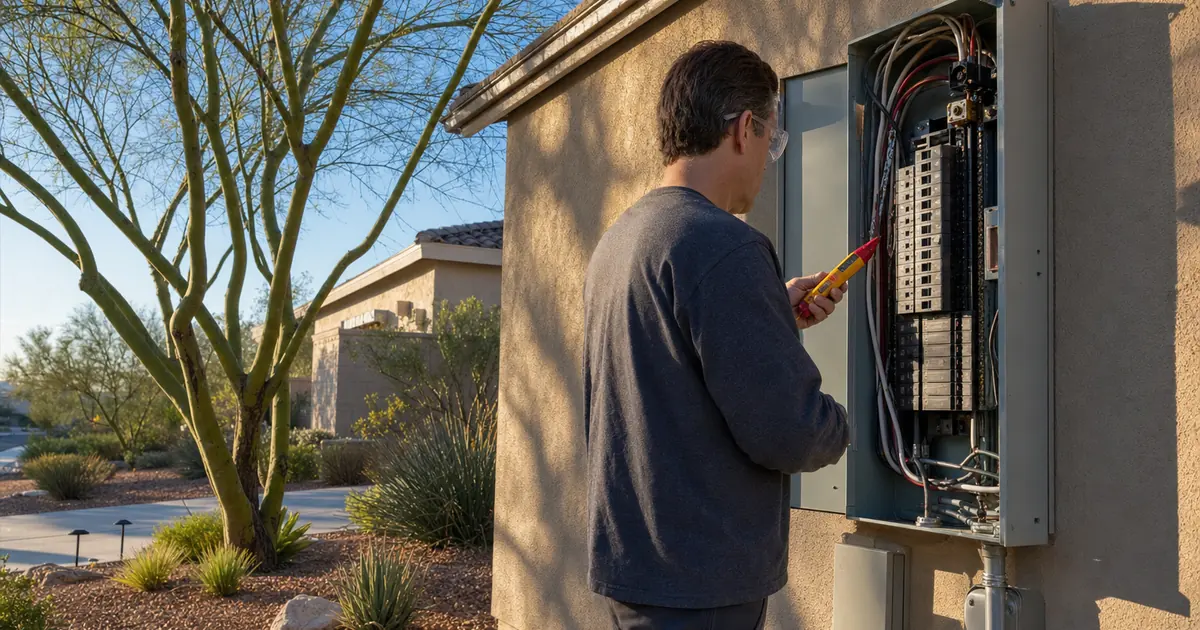
Residential electrical service - Phoenix, Arizona
Electrical Inspection in Phoenix, AZ: Code, Home and Safety Checks (2026 Guide)
What a City of Phoenix inspector checks, what an Arizona home inspector leaves out, and when an electrician's hands-on safety evaluation is the right call.
Quick answer
An electrical inspection in Phoenix can mean three different checks. The City of Phoenix inspects permitted electrical work at the rough stage before drywall and again at final, under the 2023 National Electrical Code. An Arizona-certified home inspector visually reviews the electrical system during a purchase but, under state standards, does not report on code compliance or test devices inside the panel. An electrician's safety evaluation opens the panel and tests circuits and protective devices, filling the gaps the other two leave.
Ask three people what an electrical inspection is and you may get three answers. A City inspector means the code inspection of permitted work. A buyer's agent means the home inspector's report during escrow. An electrician means opening the panel and testing the circuits. These are different checks, done by different people under different rules, and mistaking one for another leaves gaps a homeowner does not know are there.
This guide explains what each kind of inspection covers, what each leaves out by design, how the City of Phoenix schedules its inspections, and how to decide which one fits your situation: a remodel, a purchase, an older house, or a symptom you want explained.
Key takeaways
- The City of Phoenix says all permitted residential jobs require inspections, including rough electrical before drywall and a final inspection after it.
- The City's residential inspection checklist says not to insulate, drywall or cover new wiring until the rough inspection is approved.
- Phoenix offers remote video inspections for residential work such as electrical service upgrades up to 200 amps, meter socket replacement and minor electrical work.
- Arizona's home inspection standards say inspections are visual, not technically exhaustive, and do not require the inspector to report on code compliance.
- Under those standards an Arizona home inspector is not required to insert a testing device inside panels, operate breakers or AFCIs, or test smoke and carbon monoxide alarms.
- The U.S. Fire Administration estimates 23,700 residential building electrical-malfunction fires nationally in 2023, causing 305 deaths and 800 injuries.
What does "electrical inspection" mean for a Phoenix home?
In practice the phrase covers three separate things.
- A City code inspection. When work is done under a City of Phoenix permit, a City inspector checks it against the adopted code before it is approved. This inspection is about the new work, not the whole house.
- A home inspection. When a house is bought, an Arizona-certified home inspector looks over the visible parts of the electrical system, along with the roof, plumbing, cooling and the rest of the house, and writes a report for the buyer.
- An electrician's safety evaluation. A licensed electrical contractor examines the system hands-on: inside the panel, at the connections and under load. It is not a code approval and does not replace one, but it is the only one of the three built to look past what is visible.
Each answers a different question. The City asks whether permitted work meets the code. The home inspector asks what a buyer can see on the day. The electrician asks whether the system is sound and what is heading toward failure. Trouble starts when a homeowner treats one as another: assuming a clean home inspection report means the breakers were tested, or that a passed final on a kitchen remodel says anything about bedroom circuits nobody touched.
What does the City of Phoenix check at a residential electrical inspection?
The City of Phoenix Planning and Development Department says that all permitted residential jobs require inspections. The permit has to be posted on site, with the stamped plans available to the inspector. For electrical work, two of the City's critical inspection points matter most to a homeowner.
Rough electrical, at pre-drywall. This is the look at wiring while it is still exposed: boxes, cable runs and connections inside open walls and ceilings. The City's residential inspection checklist (TRT/DOC/00081) says to complete the work and call for inspection, and its wording is direct: "Do not insulate, drywall, or cover until approved."
Final, after drywall. The final inspection covers the finished outlets, lights and smoke detectors. According to the City, once the final is approved the gas and electric utilities are notified that they can turn on service.
The checklist also spells out what an inspector expects in a finished home. It calls for GFCI protection for receptacles at kitchen counters, in bathrooms, outdoors and in the garage. It calls for AFCI protection for bedroom outlets, including lighting and smoke-detector outlets. It states that "All receptacles shall be Tamper Resistant, exterior receptacles shall be Weather Resistant." At final, the City checks that every breaker in the panel is labeled, that fixtures are grounded, and that the Energy Code Compliance Certificate is posted in the electrical panel. Smoke detectors must be hard-wired with battery backup and interconnected.
The standard behind all of this is the adopted code. The City of Phoenix lists the 2023 National Electrical Code among its 2024 City of Phoenix Building Construction Codes, which City Council adopted on June 18, 2025 and which took effect on August 1, 2025.
Two limits are worth knowing. A City inspection looks at the permitted work; a permit for one new bathroom circuit does not bring an inspector into the rest of the house. And in the sources reviewed for this page, there is no City program for a stand-alone electrical safety inspection of an existing home outside a permit. The closest mechanism is the residential field consultation permit, covered below.
How do you schedule a City of Phoenix electrical inspection or a remote video inspection?
Requests go to the City by phone or online. The City's checklist says requests received before 9:00 p.m., Monday through Friday, will normally be inspected the following workday, and up to five inspections for the same permit can be requested at once online. The contractor who pulled the permit usually makes these requests; if you pulled the permit yourself as a resident, you make them.
The City also runs remote video inspections. "Remote Inspections are now available for many home projects," the Planning and Development Department says. Its list for residential work includes electrical service upgrades up to 200 amps, meter socket replacement, minor electrical work and main-breaker de-rates for solar. A remote inspection is scheduled by calling the City's inspection line and runs as a smartphone video call, with the person on site showing the inspector the work on camera.
The City asks that tools be ready before the call, including a tape measure, a level, a GFCI tester and a flashlight. That list hints at what will be checked: measurements, mounting, and whether GFCI devices actually trip. If a remote inspection fails, the comments are posted online and emailed, so the corrections can be made and the inspection requested again.
In either format the inspector can only approve what is shown. The work has to be complete and visible at the moment of the inspection, which is why crews finish and label everything before the request goes in.
What does an Arizona home inspector check on the electrical system?
Arizona rule R4-30-301.01(A) requires certified home inspectors to inspect in accordance with the Standards of Professional Practice adopted by the Arizona Chapter of ASHI on October 27, 2023, under the amended rule effective May 25, 2024.
Under section 8.1 of those standards, the inspector shall observe the service entrance conductors; the service equipment and grounding; the main and distribution panels; branch circuit conductors and overcurrent devices; a representative number of fixtures, switches and receptacles; "the presence or absence of GFCI and AFCI protection"; the operation of readily accessible GFCI devices; and the presence of smoke and carbon monoxide alarms.
That is a useful list, and it can surface things a buyer would never notice. The Arizona Board of Technical Registration describes a home inspection as "a 'picture in time' of the visible conditions of a home," and notes that inspectors are generally not licensed trade contractors, which is why reports so often recommend that a specialist look further.
Certification is a real credential. The Board says it requires passing the National Home Inspector Examination, a fingerprint clearance card, 84 hours of classroom training and 30 parallel inspections. Certifications renew annually, and inspectors must keep financial assurance under A.R.S. 32-122.02.
One conflict-of-interest rule is worth knowing. A certified Arizona home inspector may not have any financial interest in repairs to a property they inspected for 24 months after the inspection. That is why a home inspector refers electrical findings out instead of offering to fix them.
What does a home inspection leave out of the electrical system?
The Arizona standards say plainly what a home inspection is not. Inspections done under them "are visual, not technically exhaustive" and "will not identify concealed conditions or latent defects." Section 3.2 says the inspector is not required to report on "compliance or non-compliance with applicable codes or regulatory requirements." A home inspection is therefore not a code inspection, and silence about a circuit in the report is not a statement that it meets the code.
The electrical exclusions in section 8.3 are specific. The home inspector is not required to:
- insert any tool, probe or testing device inside the panels;
- test or operate disconnects or overcurrent devices, including AFCIs;
- test smoke or carbon monoxide alarms;
- evaluate low-voltage systems, or solar and other renewable energy systems.
Put together, the gaps are clear. Under the standards, breakers do not have to be operated, nothing has to be tested inside the panel, bedroom AFCIs do not have to be tripped, and a rooftop solar system does not have to be evaluated. That is not a failing of any particular inspector. It is the scope the state sets for a general inspection that covers the whole house in one visit.
For many purchases a visual check is enough to decide whether to proceed. When the report recommends further evaluation by an electrician, or the house has an older panel, circuits of unknown origin, solar, or a pool or spa, the gap matters, and it is filled by someone licensed to open the equipment and test it.
What does an electrician's electrical safety inspection in Phoenix include?
An electrician's evaluation picks up where the visual inspection stops. No City program or state standard defines it, so its scope should be agreed before the visit. Crews doing this work in Phoenix homes generally cover:
- The service and main panel. With the cover off, connections, breakers and conductors are checked for heat, looseness, corrosion and damage, and the labels are compared with what each breaker actually feeds.
- Protective devices. GFCI and AFCI devices are tested to confirm they trip, because a device can look normal and no longer work.
- Circuits in use. Outlets, switches and fixtures are tested, with attention to anything warm, loose or discolored. Worn devices are covered under outlet installation and repair.
- Alarms. Whether smoke and carbon monoxide alarms are present, powered and interconnected where the house is wired for it. See smoke and carbon monoxide detectors.
- The attic and the outside. Visible splices and boxes in the attic, outdoor outlets and their covers, and equipment on the exterior wall.
Phoenix conditions shape where the attention goes. On most homes the meter and main panel sit on an outside wall in direct sun, and the long air-conditioning season keeps circuits under heavy load for months, so the panel and the connections on the largest circuits get the closest look. Outdoor outlets take wind-driven rain and dust during monsoon storms, so their covers and the boxes behind them are checked for water and debris.
The result should be a written list of findings, each with what was seen, why it matters and how urgent it is, separating what is unsafe now from what is simply ageing. Repairs are a separate decision. A fault found during an evaluation is usually handled as electrical repair and troubleshooting or circuit breaker repair, and a service at its limit is covered under electrical panel upgrades.
When the question is about code, the City has a route. The City of Phoenix offers a residential field consultation permit, which lets a resident meet an inspector on site to ask technical questions or to get advice about work done without a permit. It is worth knowing about when an evaluation uncovers older work that was never permitted.
How often do electrical malfunctions cause house fires in the U.S.?
Electrical malfunctions are a steady cause of home fires nationally. The U.S. Fire Administration estimates 23,700 residential building electrical-malfunction fires in the United States in 2023, causing 305 deaths and 800 injuries. These are national estimates; no Phoenix or Arizona figures for electrical fires were found in the sources reviewed for this page.
| Year | Estimated fires | Estimated deaths |
|---|---|---|
| 2014 | 23,900 | 325 |
| 2015 | 24,500 | 290 |
| 2016 | 23,500 | 310 |
| 2017 | 24,100 | 200 |
| 2018 | 25,700 | 255 |
| 2019 | 24,200 | 225 |
| 2020 | 23,400 | 200 |
| 2021 | 24,200 | 295 |
| 2022 | 26,100 | 185 |
| 2023 | 23,700 | 305 |
How we got this table. The figures are copied from the U.S. Fire Administration's Residential Building Electrical Fire Estimates page (last reviewed February 14, 2025; read November 25, 2026). They are national estimates for residential buildings in the United States, not measurements for Phoenix or Arizona, and no local figures were found. The statement that the yearly estimate stayed between 23,400 and 26,100 fires is our own reading of these figures.
The point of the series is its steadiness: the national estimate did not fall below 23,400 fires in any year of the decade. An inspection cannot promise anything about a particular house. What it can do is find conditions that are recognized hazards, such as a connection running hot or a protective device that no longer trips, before a Phoenix summer of heavy load tests them.
Which electrical inspection do you need for your Phoenix home?
The right check depends on what you are trying to learn.
- You are adding or changing wiring. The City says residential permits allow residents and contractors to do minor electrical remodel work, including adding or extending circuits and upgrading the service. That work brings the City's rough and final inspections with it, and nothing substitutes for them.
- You are buying a house. The home inspection is the usual first step. If the report recommends further evaluation of the electrical system, or the house has features the standards exclude, such as solar, add an electrician's evaluation early enough to act on what it finds.
- You own an older home and nothing seems wrong. No permit is involved, and a visual inspection will not open the panel or operate the breakers. An electrician's evaluation is the one designed for this.
- You have a symptom. Flickering, warmth, a breaker that trips or a burning smell is a repair call, not an inspection.
- You found work that was never permitted. An electrician can evaluate its condition, and the City's field consultation permit lets you ask an inspector about it on site.
Some homeowners need these in sequence. A buyer may get the home inspection, then an electrician's evaluation of the panel it flagged, then a permitted repair with its own City inspection. Each step answers a question the previous one could not.
How should you prepare for an electrical inspection in Phoenix?
Preparation differs by type of inspection, and most failed or wasted visits trace back to one of these points.
- For a City inspection: post the permit and keep the stamped plans on site, as the City requires; finish the work before requesting the inspection; leave walls and ceilings open until the rough inspection is approved.
- For a remote video inspection: have a charged smartphone and the tools the City lists ready, including a tape measure, a level, a GFCI tester and a flashlight, and clear a path to everything that must be shown.
- For a home inspection: make the panel, attic hatch and outdoor equipment reachable, and note any breaker that trips or outlet that has failed so it can be mentioned.
- For an electrician's evaluation: gather the home inspection report if there is one, any permits you know of, and a list of symptoms with when they happen; clear access to the panel, garage, attic and yard.
- If the service is involved: know your utility from the electric bill. APS asks customers to contact it before a service is changed or upgraded, and SRP coordinates meter and service work through its construction services.
What are the common mistakes with electrical inspections in Phoenix?
- Reading a home inspection report as a code approval. Arizona's standards do not require the inspector to report on code compliance.
- Assuming the breakers were tested. The standards do not require a home inspector to operate overcurrent devices or AFCIs, or to put a testing device inside the panel.
- Covering wiring too soon. The City says not to insulate, drywall or cover until the rough inspection is approved; covering early can mean opening walls again.
- Calling for a final with unlabeled breakers. The City checks that every breaker is labeled and that the Energy Code Compliance Certificate is posted in the panel.
- Skipping the permit on new circuits. Without a permit there is no City inspection of the work, and the question resurfaces when the house is sold.
- Ignoring "further evaluation" notes. A home inspector recommending an electrician is pointing at something the visual scope could not resolve.
Who performs electrical safety inspections requested through Your Phoenix Electrician?
Arizona licenses electrical contractors through the Registrar of Contractors. The Arizona Administrative Code describes the R-11 Electrical classification as allowing the licensee to install and repair residential electrical systems. A home inspector's certification comes from a different board and covers a different job, so ask anyone opening your panel for a contractor license number and classification.
Electrical safety evaluations requested through Your Phoenix Electrician are performed by Alvey Electric LLC, Arizona Registrar of Contractors license ROC 364723, R-11 Electrical (residential). The work is residential only. City code inspections are performed by the City of Phoenix, and home inspections by Arizona-certified home inspectors; neither is a service this site provides.
Frequently asked questions
What does a City of Phoenix electrical inspection check?
It checks permitted electrical work against the adopted code. The City's critical points include rough electrical before drywall and a final inspection after drywall covering outlets, lights and smoke detectors. The City's checklist calls for GFCI and AFCI protection in specified locations, tamper-resistant receptacles, labeled breakers, grounded fixtures, an Energy Code Compliance Certificate posted in the panel, and hard-wired, interconnected smoke detectors with battery backup. Phoenix lists the 2023 National Electrical Code among its 2024 building codes.
Does a home inspection include an electrical inspection in Arizona?
It includes a visual review of the electrical system, not a code inspection. Under Arizona's Standards of Professional Practice the inspector observes the service equipment, panels, branch circuits, a representative number of fixtures and receptacles, GFCI and AFCI presence and smoke and CO alarms. The standards say inspections are visual, not technically exhaustive, and do not require the inspector to report on code compliance.
Does a home inspector test the breakers?
Not necessarily. Arizona's home inspection standards say the inspector is not required to test or operate disconnects or overcurrent devices, including AFCIs, and is not required to insert any tool, probe or testing device inside the panels. The inspector does observe the panels and operates readily accessible GFCI devices. If you want the breakers and AFCIs tested, that is work for a licensed electrician.
How much does an electrical safety inspection cost in Phoenix?
This page does not quote a price, because no public source sets one. The cost depends on the size of the house, the number of panels and circuits, whether the attic and outdoor equipment are included, and whether you want a written list of findings. Agree on the scope before the visit, and ask for the price of the evaluation separately from any repairs it may lead to.
How do I schedule an electrical inspection with the City of Phoenix?
Inspections are requested by phone or online for work under a City permit. The City says requests received before 9:00 p.m., Monday through Friday, will normally be inspected the following workday, and up to five inspections for the same permit can be requested at once online. The contractor who pulled the permit usually makes the request; a resident who pulled their own permit makes it themselves.
Can I get a remote video electrical inspection in Phoenix?
Yes, for many residential projects. The City of Phoenix offers remote video inspections for work including electrical service upgrades up to 200 amps, meter socket replacement, minor electrical work and main-breaker de-rates for solar. They run as a smartphone video call. The City asks you to have a tape measure, level, GFCI tester and flashlight ready, and posts and emails comments if the inspection fails.
Can the City of Phoenix inspect my existing home without a permit project?
No stand-alone City electrical safety inspection program for an existing home was found. The closest option is the residential field consultation permit, which lets a resident meet an inspector on site to ask technical questions about an upcoming project or get advice about work done without a permit. For a hands-on check of the whole system, an electrician's safety evaluation is the usual route.
When should I get an electrician to inspect my house?
Consider it when a home inspection report recommends further electrical evaluation, when you own an older home whose panel has never been opened and tested, when there is solar, a pool or spa, or work of unknown origin, or before adding a large load. A symptom such as warmth, flickering or a tripping breaker is better handled as a repair call so the cause is traced directly.
What is the difference between a home inspector and an electrician for electrical problems?
A home inspector gives a visual picture of the whole house and is not required to open panels, operate breakers or report on code compliance. The Arizona Board of Technical Registration notes inspectors are generally not licensed trade contractors. An electrician holds a contractor license, can test inside the panel and under load, and can repair what is found. Arizona also bars a home inspector from financial interest in repairs to a house they inspected for 24 months.
Do I need an electrical inspection when I buy a house in Phoenix?
A home inspection, which includes a visual electrical review, is the usual step for a purchase. Whether you also need an electrician depends on the report and the house. If the report recommends further evaluation, or the home has features the state standards exclude, such as solar, an electrician's evaluation fills the gap. Arrange it early enough to act on the findings.
Who does electrical safety inspections requested through Your Phoenix Electrician?
Electrical safety evaluations requested through Your Phoenix Electrician are performed by Alvey Electric LLC, Arizona Registrar of Contractors license ROC 364723, R-11 Electrical (residential). The Arizona Administrative Code describes the R-11 Electrical classification as allowing the licensee to install and repair residential electrical systems. City code inspections are done by the City of Phoenix, and home inspections by Arizona-certified home inspectors.
The short version
Match the inspection to the question you need answered. If wiring is being added or changed, the City's permit inspections are the check that counts; if you are buying, start with the home inspection and treat its referrals seriously; if you want to know whether an existing system is sound inside the panel and under load, that is a job for a licensed electrician. Whichever you choose, read its limits before you rely on its result.
This page is general information about residential electrical work in Phoenix, Arizona. It is not engineering, legal or code advice for a specific property. Permit rules, utility requirements, rebates and adopted codes change; confirm current requirements with the City of Phoenix and your utility before work begins.
References
- City of Phoenix Planning and Development Department, Residential Inspections (all permitted residential jobs require inspections; critical inspection points) https://www.phoenix.gov/administration/departments/pdd/residential-building/residential-inspections.html. Read November 25, 2026.
- City of Phoenix Planning and Development Department, Residential Inspection Checklist TRT/DOC/00081, Rev. 09/25 https://www.phoenix.gov/pddsite/Documents/TRT/dsd_trt_pdf_00081.pdf. Read November 25, 2026.
- City of Phoenix Planning and Development Department, Remote Video Inspections https://www.phoenix.gov/administration/departments/pdd/tools-resources/inspections/inspection-requestcancellation/remote-video-inspections.html. Read November 25, 2026.
- City of Phoenix Planning and Development Department, Online Permits TRT/DOC/00933 (residential permits; field consultation permit) https://www.phoenix.gov/content/dam/phoenix/pddsite/documents/trt/external/dsd_trt_pdf_00933.pdf. Read November 25, 2026.
- City of Phoenix Planning and Development Department, Building Construction Codes (2023 National Electrical Code; effective August 1, 2025) https://www.phoenix.gov/administration/departments/pdd/tools-resources/codes-ordinance/building-code.html. Read November 25, 2026.
- City of Phoenix, 2024 Phoenix Building Construction Code Implementation (adopted June 18, 2025) https://web-prod.phoenix.gov/content/dam/phoenix/pddsite/documents/codes-ordinances/amendmentcodes/2024-building-code-implementation.pdf. Read November 25, 2026.
- Arizona Administrative Code R4-30-301.01, Home Inspector Rules of Professional Conduct (Cornell LII), effective May 25, 2024 https://www.law.cornell.edu/regulations/arizona/Ariz-Admin-Code-SS-R4-30-301.01. Read November 25, 2026.
- Arizona Board of Technical Registration, R4-30-301.01 Home Inspector Rules of Professional Conduct (PDF), effective May 25, 2024 https://btr.az.gov/sites/default/files/2024-06/R4-30-301.01.%20Home%20Inspector%20Rules%20of%20Professional%20Conduct.pdf. Read November 25, 2026.
- Arizona Chapter of ASHI, Standards of Professional Practice, adopted October 27, 2023 (Arizona BTR) https://btr.az.gov/sites/default/files/2024-04/HI-Standards-10-27-23-clean_0.pdf. Read November 25, 2026.
- Arizona Board of Technical Registration, Home Inspections General Information https://btr.az.gov/home-inspections-general-information. Read November 25, 2026.
- U.S. Fire Administration, Residential Building Electrical Fire Estimates, last reviewed February 14, 2025 https://www.usfa.fema.gov/statistics/residential-fires/electrical.html. Read November 25, 2026.
- Arizona Public Service, Electric Service Requirements Manual, Section 200, paragraph 200.2-2 Upgrade Service https://www.aps.com/-/media/APS/APSCOM-PDFs/About/Construction-and-Power-Line-Siting/Construction-Services/Electric-Service-Requirements-Manual/200.pdf. Read November 25, 2026.
- Salt River Project, Power and water construction services https://www.srpnet.com/electric/business/ccs. Read November 25, 2026.
- Arizona Administrative Code R4-9-103, Residential Contractor License Classifications and Scopes of Work (R-11 Electrical) https://www.law.cornell.edu/regulations/arizona/Ariz-Admin-Code-SS-R4-9-103. Read November 25, 2026.
Have your electrical system evaluated
Request a hands-on electrical safety evaluation for your Phoenix home.
Related pages
- Electrical repair and troubleshooting in Phoenix
- Circuit breaker repair and replacement in Phoenix
- Electrical panel upgrade in Phoenix
- Smoke and carbon monoxide detectors in Phoenix
- Outlet installation and repair in Phoenix
- Hot tub and pool wiring in Phoenix
- Phoenix neighborhoods and villages we serve
- Your Phoenix Electrician home
About this page
Written by the Your Phoenix Electrician editorial team from the sources listed above. Reviewed by Robert "Bob" Lira, licensed Arizona electrical contractor, ROC 338369. Your Phoenix Electrician, 4315 E Thunderbird Rd #120, Phoenix, AZ 85032, phone 602-900-0593, serves homes in the City of Phoenix. Electrical work is performed by Alvey Electric LLC, Arizona Registrar of Contractors license ROC 364723 (residential electrical).
Updated .