Residential electrical service · Phoenix, Arizona
Electrical Panel Upgrade in Phoenix, AZ (2026 Guide)
What the job involves, who pulls the City of Phoenix permit, where APS or SRP comes in, and how to tell whether your home needs more capacity at all.
Quick answer
An electrical panel upgrade in Phoenix replaces a home's service equipment so it can safely carry more load, most often moving from 100 amps to 200 amps. The job needs a City of Phoenix electrical permit and an inspection, and the serving utility, APS or SRP, must be contacted before the service is changed. Phoenix lists the 2023 National Electrical Code among its 2024 Building Construction Codes. A licensed residential electrical contractor sizes the service with a load calculation before any equipment is ordered.
Most people start reading about panel upgrades because something specific happened: a breaker that will not stay on in July, an electrician who said the panel is full, a solar or electric-vehicle quote with a line item nobody explained. This guide covers what a panel upgrade is, when a Phoenix home needs one and when it does not, and the order of work between the electrician, the City and the utility. It is written for single-family homes inside the City of Phoenix.
Key takeaways
- A service upgrade replaces the meter section, service conductors, main breaker and panel together; a panel replacement swaps only the panel at the same amperage.
- The City of Phoenix offers an online residential permit for an electrical service upgrade of up to 200 amps.
- Phoenix lists the 2023 National Electrical Code among its 2024 City of Phoenix Building Construction Codes, adopted on June 18, 2025.
- The APS Electric Service Requirements Manual says to contact APS before a service is changed or relocated.
- SRP lists service entrance section meter panel upgrades, replacement and revisions among its construction services.
- Arizona's R-11 Electrical classification allows a licensee to install and repair residential electrical systems.
- A load calculation, not the age of the panel alone, decides whether a home needs more amperage.
What is an electrical panel upgrade?
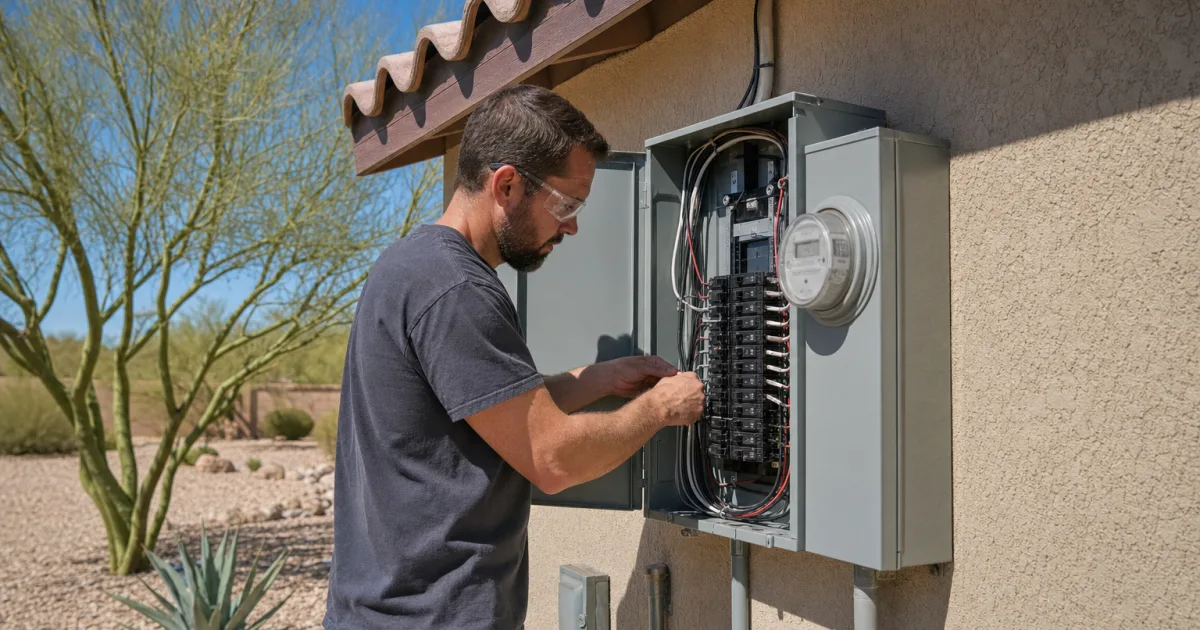
The electrical service is the set of equipment that brings utility power into a house and divides it into circuits. On most Phoenix homes it sits on an outside wall: a meter, a main breaker, and a panel of branch breakers, often combined in one enclosure that electricians call the service entrance section. The size of the service is stated in amps, and that number is the ceiling on how much the house can draw at once.
People use "panel upgrade" for three different jobs, and the difference decides the cost and the paperwork.
- Panel replacement. The old breaker panel is replaced with a new one at the same amperage. This is done when the panel is damaged, obsolete or out of breaker spaces, and the service itself is large enough.
- Service upgrade. The capacity of the whole service is raised, for example from 100 amps to 200 amps. The meter section, the service conductors, the main breaker, the grounding and the panel are all addressed. This is the job that involves the utility.
- Subpanel. A second, smaller panel is fed from the main one to add breaker spaces in a garage, addition or casita. It adds room for circuits; it does not add capacity.
This page is mainly about the second one, because it is the one that raises real questions about permits, utilities and timing.
When does a Phoenix home need a panel upgrade?
A home needs more service capacity when the calculated load of everything connected to it is more than the service is rated to carry. That is a calculation, not a guess from the age of the house. The National Electrical Code sets out the method, and a contractor works through it using the size of the home, the air conditioning, the cooking and laundry appliances, the water heater, any pool or spa equipment, and whatever is about to be added.
Phoenix homes run into the limit in a recognizable way. Cooling is the largest electrical load in most Valley homes, and it runs for long stretches on the hottest afternoons, at the same hours as cooking, laundry and pool pumps. A service that was sized for the house as built can be at its limit before anything new is installed.
The additions that most often push a home over are:
- a Level 2 electric-vehicle charger, which is a large continuous load;
- a second air conditioner or a heat pump serving an addition;
- replacing gas appliances with electric ones;
- a pool, a spa, or a workshop with 240-volt equipment;
- a solar or battery system whose connection rules the existing panel cannot meet.
Some warning signs point to the equipment rather than the capacity: breakers that feel hot, a panel that buzzes, scorch marks, a burning smell, or lights that dim sharply when the air conditioner starts. Those call for a prompt inspection. They may end in a repair, a panel replacement or a service upgrade, and the inspection is what tells you which.
It is just as useful to know when a home does not need an upgrade. A single breaker that trips is usually a circuit problem. A full panel with a service that is large enough can often be solved with a subpanel. An honest assessment separates these cases before any equipment is quoted.
Do you need a permit for a panel upgrade in Phoenix?
Yes. The City of Phoenix Planning and Development Department describes residential permits as allowing residents and contractors to do minor electrical work, and it names upgrading the electrical service as part of that work. Its list of online residential permits includes an Electrical Service Upgrade of up to 200 amps, alongside an Electrical Utility Clearance permit. For a typical 200-amp upgrade on a single-family home, that online route is the normal path.
The permit is the City's record that the work will be inspected. Phoenix lists the 2023 National Electrical Code among its 2024 City of Phoenix Building Construction Codes. The City adopted the 2024 Phoenix Building Construction Code on June 18, 2025, and the amendments adopted under Ordinance G-7397 took effect on August 1, 2025. An inspector checks the finished service against that code before the utility is cleared to restore permanent power.
On Phoenix jobs the permit is rarely the slow part. Crews who file these regularly find that the online route issues quickly for a standard 200-amp upgrade; what takes planning is lining up the inspection so the house is not left without power overnight in summer.
Two practical points follow from the City's own documents. First, larger services sit outside the simple online permit, which is stated as covering upgrades up to 200 amps. Second, a service upgrade done alongside solar is not folded into the solar permit: the City's residential photovoltaic guideline states that a separate electrical permit is required for electrical service upgrades.
How do APS and SRP fit into a Phoenix panel upgrade?
The utility owns the meter and the lines up to the house, so a service cannot be upgraded without it. Both Arizona Public Service (APS) and Salt River Project (SRP) serve addresses inside the City of Phoenix. Your electric bill shows which one serves your home, and each publishes its own rules.
APS. The APS Electric Service Requirements Manual has a paragraph for upgrades, 200.2-2, which says that before a service is changed or relocated to supply new or existing load, APS is to be contacted. APS also directs residential projects to choose a meter panel or service entrance section from the pre-approved panel list in that manual. Equipment that is not on the list is a common reason a job stalls.
SRP. SRP lists service entrance section meter panel upgrades, replacement and revisions among the services its construction group assists with, and it publishes its own Electric Service Specifications for connecting to its system.
Crews who do this work in Phoenix check the utility before they check anything else, because the same house two streets over can be on the other company's lines. On service upgrades we routinely find that the delay is not the installation, which takes a day, but a meter section that was bought before anyone confirmed it against the serving utility's list.
In practice the contractor makes the utility contact, confirms the equipment against the right manual for that address, and schedules the disconnect and reconnect around the City inspection. The homeowner's part is to know which utility serves the house and to expect the power to be off for the working day.
What happens during a panel upgrade, step by step?
The order of work is the same on nearly every Phoenix service upgrade, because three parties each control one piece of it.
| Step | What happens | Who is responsible | Rule or detail |
|---|---|---|---|
| 1 | Load calculation and site check | Licensed electrical contractor | Sizes the service before equipment is chosen |
| 2 | City of Phoenix electrical permit | Contractor or resident | Online residential permit covers a service upgrade up to 200 amps |
| 3 | Utility contact | Contractor with APS or SRP | APS asks to be contacted before a service is changed; SRP handles meter panel upgrades through construction services |
| 4 | Power disconnected, equipment replaced | Utility disconnects; contractor installs | New meter section, panel, grounding and circuit reconnection |
| 5 | City inspection | City of Phoenix inspector | Work is inspected against the 2023 National Electrical Code as adopted by Phoenix |
| 6 | Permanent power restored | APS or SRP | Utility reconnects after the City clears the work |
How we got this table. Steps 2 and 5 come from City of Phoenix Planning and Development Department documents; step 3 comes from the APS Electric Service Requirements Manual and the SRP construction services page; steps 1, 4 and 6 describe standard trade practice for a residential service change. Sources are listed under References, all read on November 25, 2026. The table contains no prices because no public source sets one.
What the working day looks like
Once the permit is issued and the utility has a date, the utility disconnects the service. The contractor removes the old equipment, mounts the new service entrance section, installs the service conductors and the main breaker, brings the grounding and bonding up to the current code, and reconnects each branch circuit to a correctly sized breaker. Circuits are labeled as they go back in. Anything found in the old panel that cannot be reconnected safely, such as doubled-up conductors on one breaker or damaged insulation, is corrected at this point, because the inspector will be looking at it.
After the City inspection is passed, the utility restores permanent power. Plan for the house to be without electricity for the working day, and plan refrigeration, medical equipment and work-from-home needs around that.
Is 100 amps enough, or do you need 200 or 400?
The right size is the one the load calculation supports with room for what you plan to add. As a way of thinking about it:
| Service size | Where it is usually found | What it means for a Phoenix home |
|---|---|---|
| 100 amps | Older and smaller homes, often with gas heating and cooking | Can be adequate for a small home with one air conditioner; leaves little room for an EV charger or added electric appliances |
| 200 amps | The common size for newer single-family homes | The usual target of an upgrade; fits the City's online residential permit for service upgrades up to 200 amps |
| 400 amps | Large homes with several air conditioners, a pool and spa, or more than one EV charger | Sits outside the City's up-to-200-amp online permit, so expect more review and more utility involvement |
How we got this table. The permit detail for 200 amps is from the City of Phoenix Online Permits list, read on November 25, 2026. The descriptions of where each size is found are general trade practice, not measured data, and your own home is decided by its load calculation.
Sizing once is cheaper than sizing twice. If an electric vehicle, a pool or a conversion from gas is likely in the next several years, say so before the calculation is run.
Should you repair the panel, replace it, or upgrade the service?
These are three answers to three different findings, and a good assessment names which one applies and why.
Repair fits a panel that is sound and large enough but has one failed part: a worn breaker, a loose connection, a corroded lug. Phoenix heat is hard on outdoor equipment, and a single breaker that has weakened after years on a west-facing wall is a repair, not a reason to replace the service.
Replacement at the same amperage fits a panel that is no longer trustworthy as a whole. That includes enclosures with rust or water damage, bus bars that show heat damage, panels with no spaces left when the service itself is large enough, and older panel designs for which safe replacement breakers are hard to obtain. The meter and the service size stay as they are, which keeps the work and the utility involvement smaller.
A service upgrade fits a home whose calculated load is more than the service rating, or will be once a planned addition is installed. Here a new panel alone changes nothing, because the limit is the service, not the box of breakers.
The way to tell them apart is to ask the contractor two questions. What did the load calculation show against the service rating? And what, specifically, is wrong with the existing equipment? If the first answer is "there is room" and the second is "one breaker", the job is a repair. Homeowners are sometimes sold an upgrade on the strength of the panel's age alone. Age is a reason to inspect, and the inspection is what justifies the work.
What should a written panel upgrade estimate include?
A service upgrade is one of the larger electrical jobs a homeowner buys, and estimates for it are hard to compare unless they describe the same scope. A complete written estimate for a Phoenix home states each of the following.
- The service size and the reason for it. The amperage proposed and the load calculation result behind it.
- The equipment. The make and type of the service entrance section or panel, and confirmation that it is accepted by the utility that serves the address.
- The permit. Who takes out the City of Phoenix electrical permit and whether the fee is included.
- The utility coordination. Who contacts APS or SRP and schedules the disconnect and reconnect.
- Corrections to existing wiring. What is included if the old panel reveals conductors, grounding or bonding that have to be brought up to the current code, and how extra work is priced if more is found.
- Wall and finish repair. A larger enclosure can mean cutting stucco. The estimate should say who patches and paints it.
- The license. The contractor's Arizona Registrar of Contractors license number and classification.
Two estimates that differ widely usually differ in scope, most often on the wiring corrections and the stucco. Asking each contractor to price the same list is the quickest way to see what you are actually comparing.
What are the common mistakes with panel upgrades in Phoenix?
- Ordering equipment before the utility rules are checked. APS points residential projects to a pre-approved panel list. A panel that is not accepted by the serving utility has to be replaced before power is restored.
- Treating the upgrade as part of another permit. The City states that a service upgrade needs its own electrical permit when it is done with solar, and its SolarAPP express route excludes projects with panel upgrades or derating.
- Upgrading capacity to fix a circuit problem. A larger service does not stop one overloaded circuit from tripping. Diagnose first.
- Skipping the permit. Unpermitted service work is not inspected, and it tends to surface later, at a home sale or when the utility is asked to reconnect.
- Replacing the panel and leaving the rest. Grounding, bonding and deteriorated conductors are part of the job. A new panel on old faults is not an upgrade.
- Not planning for the outage. The power is off for the working day. In summer that means arranging somewhere cool to be.
How does a panel upgrade connect to EV chargers and solar?
These three projects are usually discussed separately and decided together. An electric-vehicle charger adds a large continuous load. A solar system adds a source that the panel's bus has to be rated to accept. Either one can be the reason a service that worked for years is no longer adequate on paper.
The useful order is: run one load calculation that includes everything planned, decide the service size once, then file the permits. If a charger is the only addition, a load-management device that limits the charger when the house is drawing heavily can sometimes avoid a service upgrade altogether, and a contractor should price both routes. If solar is involved, remember that the City treats the service upgrade as its own electrical permit.
More on each: EV charger installation in Phoenix and home electrical inspections in Phoenix.
Who is allowed to do panel upgrade work in Arizona?
Arizona licenses electrical contractors through the Registrar of Contractors. The Arizona Administrative Code describes the R-11 Electrical classification as allowing the licensee to install and repair residential electrical systems. A commercial classification and a dual classification exist for other work.
Before you hire anyone for a service upgrade, ask for the license number and the classification, ask who will take out the City of Phoenix permit, and ask which utility manual the proposed equipment was checked against. A contractor who does this work regularly can answer all three without looking anything up.
Panel upgrades requested through Your Phoenix Electrician are performed by Alvey Electric LLC, Arizona Registrar of Contractors license ROC 364723, a residential electrical contractor. The work is residential only.
Frequently asked questions
Do I need a permit to upgrade an electrical panel in Phoenix?
Yes. The City of Phoenix Planning and Development Department lists upgrading the electrical service as residential permit work, and it offers an online residential permit for an electrical service upgrade of up to 200 amps. The permit is followed by a City inspection before the utility restores permanent power.
How much does it cost to upgrade an electrical panel in Phoenix?
There is no single published price, and this page does not quote one because no public source sets it. The cost depends on the amperage, whether the meter and service entrance are replaced, whether the panel must move, and how much of the old wiring has to be corrected to pass inspection. A written estimate after a site visit is the reliable number.
Who do I call first, the electrician or the utility?
Call the electrician first. The contractor confirms what the home needs with a load calculation, and then the utility is contacted before the service is changed. The APS Electric Service Requirements Manual says to contact APS before a service is changed or relocated, and SRP lists service entrance section meter panel upgrades among its construction services.
Is my Phoenix home served by APS or SRP?
Both utilities serve addresses inside the City of Phoenix, so it depends on the address. The name on your electric bill is the answer. It matters because each utility publishes its own equipment requirements for the meter and service entrance.
Why does my breaker trip when the air conditioner starts?
A breaker that trips when the air conditioner starts can point to an overloaded circuit, a failing breaker, a problem in the air conditioner itself, or a service that is too small for the home. It is not automatically a reason to replace the panel. The cause has to be diagnosed before any equipment is ordered.
Can I upgrade my own electrical panel in Phoenix?
The City of Phoenix describes residential permits as allowing residents and contractors to do minor electrical work, including upgrading the electrical service. A service upgrade still involves the utility connection, a permit and an inspection, and the conductors feeding the panel stay energized until the utility disconnects them. Most homeowners hire a licensed electrical contractor for that reason.
Do I need a panel upgrade to install an EV charger?
Not always. It depends on the spare capacity shown by a load calculation for your home. If the existing service cannot carry a Level 2 charger with everything else, the options are a service upgrade or a load-management device, and the City of Phoenix handles a service upgrade under its own electrical permit.
Do I need a panel upgrade for solar panels?
Sometimes. The City of Phoenix states that a separate electrical permit is required for electrical service upgrades done with a solar installation, and its SolarAPP express route excludes projects with panel upgrades or derating. Ask the solar installer and the electrician to agree on the service size before either permit is filed.
What electrical code does Phoenix use for a panel upgrade?
Phoenix lists the 2023 National Electrical Code among its 2024 City of Phoenix Building Construction Codes. The City adopted the 2024 Phoenix Building Construction Code on June 18, 2025, and its amendments under Ordinance G-7397 took effect on August 1, 2025.
What is the difference between a panel replacement and a service upgrade?
A panel replacement swaps the breaker panel for a new one at the same amperage. A service upgrade raises the capacity of the whole service, which usually means a new meter section, new service conductors and a larger main breaker as well as the panel. A service upgrade is the job that involves the utility.
Who performs panel upgrades requested through Your Phoenix Electrician?
Panel upgrades requested through Your Phoenix Electrician are performed by Alvey Electric LLC, Arizona Registrar of Contractors license ROC 364723, a residential electrical contractor. The Arizona Administrative Code describes the R-11 Electrical classification as allowing the licensee to install and repair residential electrical systems.
The short version
Decide the service size from a load calculation that includes what you plan to add, not from the age of the panel. Confirm which utility serves the address and that the equipment meets its manual before it is ordered. Then let the permit, the disconnect, the inspection and the reconnect happen in that order.
This page is general information about electrical work in Phoenix, Arizona. It is not engineering, legal or code advice for a specific property. Permit rules, utility requirements and adopted codes change; confirm current requirements with the City of Phoenix and your utility before work begins.
References
- City of Phoenix Planning and Development Department, Building Construction Codes (lists the 2023 National Electrical Code under the 2024 City of Phoenix Building Construction Codes). https://www.phoenix.gov/administration/departments/pdd/tools-resources/codes-ordinance/building-code.html. Read November 25, 2026.
- City of Phoenix, 2024 Phoenix Building Construction Code Implementation (adoption on June 18, 2025). https://web-prod.phoenix.gov/content/dam/phoenix/pddsite/documents/codes-ordinances/amendmentcodes/2024-building-code-implementation.pdf. Read November 25, 2026.
- City of Phoenix, Building Construction Code Change Proposals, 2024 IECC (Ordinance G-7397, effective August 1, 2025). https://web-prod.phoenix.gov/content/dam/phoenix/pddsite/documents/codes-ordinances/amendmentcodes/2024-iecc.pdf. Read November 25, 2026.
- City of Phoenix Planning and Development Department, Online Permits (residential permits include upgrading the electrical service; online residential permit for Electrical Service Upgrade up to 200 AMP). https://www.phoenix.gov/content/dam/phoenix/pddsite/documents/trt/external/dsd_trt_pdf_00933.pdf. Read November 25, 2026.
- City of Phoenix, residential photovoltaic guideline, TRT/DOC/00292 (separate electrical permit required for electrical service upgrades). https://www.phoenix.gov/pddsite/Documents/TRT/dsd_trt_pdf_00292.pdf. Read November 25, 2026.
- City of Phoenix, SolarAPP+ photovoltaic permits (no panel upgrades or derating). https://www.phoenix.gov/administration/departments/pdd/residential-building/resident-plan-reviews/solarapp-photovoltaic.html. Read November 25, 2026.
- Arizona Public Service, Electric Service Requirements Manual, Section 200, paragraph 200.2-2 Upgrade Service (contact APS before service is changed or relocated). https://www.aps.com/-/media/APS/APSCOM-PDFs/About/Construction-and-Power-Line-Siting/Construction-Services/Electric-Service-Requirements-Manual/200.pdf. Read November 25, 2026.
- Arizona Public Service, Getting Your Project Started (residential pre-approved panel list in the Electric Service Requirements Manual). https://www.aps.com/en/About/Construction-and-Power-Line-Siting/Construction-Services/Getting-Your-Project-Started. Read November 25, 2026.
- Salt River Project, Power and water construction services (service entrance section meter panel upgrades, replacement and revisions). https://www.srpnet.com/electric/business/ccs. Read November 25, 2026.
- Arizona Administrative Code R4-9-103, Residential Contractor License Classifications and Scopes of Work (R-11 Electrical). https://www.law.cornell.edu/regulations/arizona/Ariz-Admin-Code-SS-R4-9-103. Read November 25, 2026.
Have your service checked
Request a load calculation and a written estimate for your Phoenix home.
Talk it through first
Call 602-900-0593 to describe what is happening with your panel.
Related pages
- Circuit breaker repair and replacement in Phoenix
- EV charger installation in Phoenix
- Electrical repair and troubleshooting in Phoenix
- Home electrical inspections in Phoenix
- Home generator installation in Phoenix
- Outlet installation and repair, including 240-volt outlets
- Phoenix neighborhoods we serve
- Your Phoenix Electrician home
About this page
Written by the Your Phoenix Electrician editorial team from the City of Phoenix, APS, SRP and Arizona Administrative Code sources listed above. Reviewed by Robert "Bob" Lira, licensed Arizona electrical contractor, ROC 338369. Your Phoenix Electrician, 4315 E Thunderbird Rd #120, Phoenix, AZ 85032, phone 602-900-0593, serves homes in the City of Phoenix. Electrical work is performed by Alvey Electric LLC, Arizona Registrar of Contractors license ROC 364723 (residential electrical).
Updated .