Residential electrical service - Phoenix, Arizona
Home Generator Installation in Phoenix, AZ (2026 Guide)
Standby or portable, the transfer switch both utilities require, the permits and approvals involved, and how to keep carbon monoxide out of the house.
Quick answer
Generator installation in a Phoenix home means connecting a standby or portable generator through a permanently installed transfer switch that isolates the house from the grid. APS and SRP both prohibit a generator that can backfeed utility lines and require a break-before-make transfer switch. APS also requires generator systems to be approved through its online portal before they are energized. A natural-gas standby unit usually adds a City of Phoenix gas-piping permit, and CPSC says portable units must run outdoors, at least 20 feet from the house.
When the power goes out in a Phoenix summer, the house starts warming quickly, and for anyone who relies on powered medical equipment an outage is more than an inconvenience. A home generator can carry the household through it, but only if it is connected the right way. Both electric utilities that serve Phoenix, APS and SRP, have written rules about how a generator may connect to a home, and the City of Phoenix has its own rules for the gas piping that feeds a standby unit.
This guide explains the difference between standby and portable generators, what a transfer switch does and why the utilities insist on one, where permits and utility approval come in, how a system is sized for Phoenix loads, and why carbon monoxide is the hazard that kills the most people who use portable generators.
Key takeaways
- APS says a standby generator system must be designed so that it never electrically interconnects or operates in parallel with the APS system.
- APS requires generators that supply house wiring to connect through a permanently installed, double-throw, break-before-make transfer switch that isolates the generator from the utility.
- SRP says standby generators must not be interconnected with its system because the resulting backfeed is a hazard, and it requires an open-transition, break-before-make transfer scheme.
- APS requires any customer on-site or temporary generator system to be submitted and approved through its online portal before it is energized.
- The City of Phoenix requires a permit with inspection and clearance for any new gas piping or alteration of existing gas piping other than an appliance connector.
- CPSC says an average of about 100 consumers die in the U.S. each year from carbon monoxide poisoning from portable generators.
Why do Phoenix homeowners install a home generator?
Three things make an outage in Phoenix different from one in a milder climate: heat, storms and medical need.
Heat. Air conditioning is what keeps a Phoenix house livable for much of the year, and an outage stops it. A generator that can run the cooling equipment, or at least part of it, is the reason many homeowners look into standby power in the first place.
Monsoon storms. The City of Phoenix says the monsoon officially runs from 15 June to 30 September, and its storms and monsoon page lists outage-reporting numbers for both APS and SRP. Wind, dust and lightning during that season are the conditions under which many households first think seriously about backup power.
Medical equipment. APS advises customers who use life-sustaining medical equipment to register for its Medical Care Program, which, in APS's words, alerts the utility to their needs in the event of an outage. Registration tells the utility about the need; it does not keep the power on. A household that cannot be without that equipment for any length of time is the clearest case for a generator.
It is worth keeping the risk in proportion. SRP reports that its 2024 SAIDI score, the average number of outage minutes per customer, was 58 minutes against a benchmark median of 291 minutes, across a system serving more than 1.1 million customers. That is a system-wide figure, not a Phoenix-only one, and no comparable public figure for APS in Phoenix was found for this page. Most homes see little outage time in a typical year, so the decision usually rests on what an outage would cost a particular household, not on how often outages happen.
What is the difference between a standby generator and a portable generator?
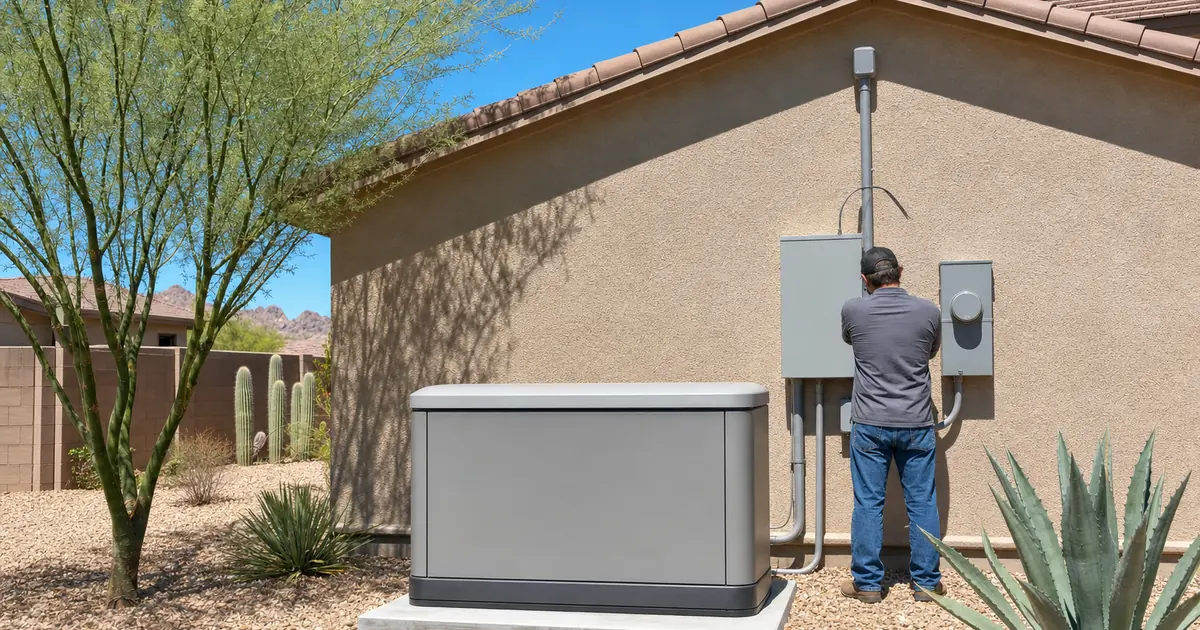
A standby generator is a permanently installed unit, set outside the house and connected to the home's wiring through a transfer switch. It usually runs on a fixed fuel supply, natural gas from the utility meter or propane from a tank, and with an automatic transfer switch it can start and move the house onto generator power when the utility supply fails. Once installed, nobody has to set anything up during an outage.
A portable generator is a smaller engine-driven unit, most often fueled by gasoline, that is wheeled out and started by hand when the power goes off. It can power appliances through extension cords plugged into its own outlets, or it can feed selected house circuits, but only through a permanently installed transfer switch with an inlet on the outside wall.
The practical differences come down to four questions.
- Who has to be home? A standby unit with an automatic transfer switch works whether anyone is home or not. A portable unit has to be set up, fueled and started by someone.
- How much can it run? A standby unit can be sized for the loads that matter, including cooling. A portable unit is usually limited to a few essential circuits.
- What fuel does it need? A standby unit draws from a gas supply that keeps flowing. A portable unit needs fuel stored and refilled, often in the middle of a storm.
- What permits and approvals apply? Both need a proper transfer switch if they feed house wiring. A natural-gas standby unit also involves gas piping, which has its own City permit.
Neither type is safe if it is connected the wrong way, which is where the transfer switch comes in.
What is a transfer switch, and why do APS and SRP require one?
A transfer switch decides where the house gets its power: from the utility or from the generator, never from both at once. Its whole job is isolation. When the house is on generator power, the switch has disconnected the house wiring from the utility lines.
That matters because a generator connected to house wiring without isolation can send power backwards through the service and out onto the utility's lines. This is called backfeed. Line crews working on a line they believe is dead can be exposed to it, and the generator and house wiring are put at risk when utility power returns.
Both Phoenix utilities put this in writing.
- APS says, in its Electric Service Requirements Manual, that a standby generator system must be designed so as never to electrically interconnect or operate in parallel with the APS system.
- APS requires emergency or standby generators that supply premises wiring to connect through a permanently installed transfer switch that is double-throw, break-before-make, and provides positive isolation between the generator source and the utility source.
- APS states that portable generators shall not be connected to premises wiring unless a permanently installed transfer switch is used.
- SRP's Electric Service Specifications say standby generators must not be interconnected with the SRP system because the resulting backfeed is a hazard, and that an open-transition, break-before-make transfer scheme is required.
- SRP lists approved transfer methods that include a UL 98 listed double-throw safety switch or a UL 1008 listed transfer switch specifically designed for that purpose.
Break-before-make means the switch breaks the connection to one source before it makes the connection to the other, so there is no moment when the generator and the grid are joined. APS treats a closed-transition transfer switch, one that briefly joins the two sources, as interconnected generation: a potential backfeed source that APS reviews case by case and that requires an Interconnection Agreement. For an ordinary home backup system, the open-transition switch is the approach both utilities describe.
Both utilities also want the arrangement marked. APS requires a warning sign at the service entrance section for standby generator installations, and its sample wording states that the automatic transfer switch shall prevent the generator from backfeeding the electric service. SRP says signage shall be permanently affixed to the exterior of the service entrance equipment. That sign is what tells a utility worker, years later, that a second source of power is connected to the house.
Why is carbon monoxide the biggest danger with portable generators?
The transfer switch protects line workers. Carbon monoxide is the hazard that falls on the household. CPSC says an average of about 100 consumers die in the U.S. each year from carbon monoxide poisoning from portable generators, and that one portable generator can produce the same amount of carbon monoxide as hundreds of cars. The chart below, from CPSC's national estimates, shows how generators compare with other consumer products in non-fire carbon monoxide deaths.
| Product | Group | Estimated deaths per year |
|---|---|---|
| Gasoline generators | Generator | 76 |
| Unspecified-fuel generators | Generator | 21 |
| LP generators | Generator | 3 |
| Other engine-driven tools | Other engine-driven tool | 12 |
| Portable heaters | Heating or household | 29 |
| Furnaces (including boilers) | Heating or household | 23 |
| Charcoal or charcoal grills | Heating or household | 12 |
| Water heaters | Heating or household | 8 |
| Unspecified heater or heating system | Heating or household | 6 |
| Room or space heaters | Heating or household | 5 |
| Ranges or ovens | Heating or household | 5 |
| All consumer products (total) | All | 227 |
How we got this table. The figures are taken from Table 1 of the U.S. Consumer Product Safety Commission report Non-Fire Carbon Monoxide Deaths Associated with the Use of Consumer Products, 2021 Annual Estimates (February 2025). They are national estimates averaged over 2019 to 2021, not Phoenix figures, and CPSC notes that the 2019 to 2021 data are partially complete and may change. The total of 227 covers all consumer products, including some not listed here. The generator subtotal of 100 used in the text is our own addition of the three generator rows.
CPSC's rules for safe use are plain. Never operate a portable generator inside a home, garage, basement, crawlspace, shed or other enclosed space. Run it outside, at least 20 feet from the house, with the exhaust directed away. During a monsoon storm the temptation is to run the generator in the garage, or just inside an open garage door, to keep it out of the rain and dust. That is exactly the placement CPSC warns against.
CPSC also recommends carbon monoxide alarms on every level of the home and outside sleeping areas, with interconnected alarms preferred. A home that keeps a portable generator should treat working CO alarms as part of the generator setup; see smoke and carbon monoxide detectors. A permanently installed standby unit sits outside in a fixed location, which removes the storm-time decision about where to run it, though its position still has to keep exhaust away from windows and doors.
Does generator installation in Phoenix need a permit?
Usually yes, for at least part of the work, although no City of Phoenix document found for this page addresses residential standby generators directly. The answer is built from the rules that cover each piece of the job.
The electrical work. The City of Phoenix Planning and Development Department says residential permits allow residents and contractors to do minor electrical remodel work, including upgrading the electrical service and adding or extending circuits. Installing a transfer switch at the service and running a feeder to a generator means new wiring and work at the service equipment, which is the kind of work the permit system covers. The City lists the 2023 National Electrical Code among its 2024 City of Phoenix Building Construction Codes, effective 1 August 2025, and permitted work is inspected against it.
The gas piping. The City of Phoenix says any new gas piping installation, or alteration of existing gas piping other than an appliance connector, requires a permit with City inspection and clearance; replacing a gas appliance in kind with no piping changes does not. A natural-gas standby generator normally needs new piping from the meter, so it falls under that rule. The City's residential over-the-counter permits guideline lists gas-line repairs, replacement or new installation for exterior gas appliances from a natural gas meter as an express permit, and it says all propane installations are reviewed by Residential Plan Review staff.
An older City interpretation. The City also has a citywide interpretation, first issued in 1989 and revised in December 2019, that permits off-site utility-supplied natural gas as the fuel for an emergency generator under the electrical code's emergency-systems rules, with an independent, clearly identified valve that can be locked open, ahead of the building's main gas valve. That document is written for emergency systems, not for a homeowner's optional standby unit, so treat it as background rather than as a home rule.
Where the requirements are unclear for a particular house, the City offers a residential field consultation permit that lets a resident meet an inspector on site to ask technical questions.
Do I have to tell APS or SRP before connecting a generator?
Yes, in different ways. APS says any customer on-site or temporary generator system shall be submitted and approved through APS's online portal before it is energized. For a home on APS, that approval is part of the job, not an afterthought.
SRP says installations must follow the authority having jurisdiction, which for a Phoenix home is the City, and that SRP reserves the right to inspect and approve all installations. SRP also says customer-owned generation that is interconnected with the grid must comply with its Distributed Generation Interconnection Handbook and needs a signed interconnection agreement. A standby generator with an open-transition switch is designed not to be interconnected, which is exactly why SRP requires that kind of switch.
Your electric bill shows which utility serves your home. If the generator work goes along with changes to the service itself, APS asks to be contacted before a service is changed or upgraded, and SRP coordinates meter and service work through its construction services. See electrical panel upgrades for how those utility steps fit around a job.
How is a standby generator installed in a Phoenix home?
The order of work matters more than any single step. A typical installation runs like this.
- Decide what it must power. The loads come first, because they set the size of the generator, the transfer switch and the wiring.
- Check the service and panel. The transfer switch connects at or near the service equipment. An older or crowded panel may need attention before a transfer switch can be added cleanly; see home electrical inspections.
- Choose the location. The unit sits outside on a stable base, with room for service access and its exhaust directed away from windows and doors.
- Plan the fuel. Natural gas from the meter means new gas piping under a City permit; propane means a tank and a review by the City's residential plan review staff.
- Obtain approvals. City permits for the electrical and gas work, and the utility submission where the utility requires it, before the unit is energized.
- Install the transfer switch and wiring. A double-throw, break-before-make switch, the feeder to the generator, and the warning signage the utility asks for at the service entrance.
- Inspect, test and hand over. The City inspects the permitted work, the system is tested by simulating an outage, and the homeowner is shown how it operates and what upkeep it needs.
Crews doing this work in Phoenix plan the outdoor work around the heat. Transfer-switch work at a sun-facing service wall is scheduled early in the day where possible, and the time the house is without power during the cutover is kept as short as the work allows.
How do you decide what a home generator should power in Phoenix?
Sizing is the decision that most affects how well a generator serves a Phoenix household, and it starts with a list of loads, not with a catalogue.
- Must run: life-sustaining medical equipment, refrigeration, some lighting, and the circuits that keep communications and the garage door working.
- Should run: cooling for at least part of the house. In a Phoenix summer this is the load that changes the size of the system most.
- Can wait: loads that can stay off for the length of an outage, such as a pool pump, a spa heater or an electric dryer.
Two approaches follow from that list. A whole-house system is sized to carry the house as it normally runs, cooling included. A selected-circuit system carries only the must-run and should-run circuits through the transfer switch or a dedicated subpanel and leaves the rest off. The second is smaller; the first asks less of the household during an outage.
Cooling equipment is the hard part. Air-conditioning compressors draw a surge of current when they start, so a generator that carries the house comfortably at steady load can still struggle each time a compressor comes on. That starting load has to be part of the sizing from the beginning. When utility power returns, APS advises waiting 5 to 10 minutes before turning on major appliances, and a generator system that brings large loads back in stages follows the same logic. Pool and spa equipment is often the first load left off; see hot tub and pool wiring for how those circuits are arranged.
What are the common mistakes with home generator installation in Phoenix?
- Backfeeding through a dryer outlet or a double-ended cord. Feeding house wiring without a permanently installed transfer switch is what APS and SRP prohibit, and it can energize the utility lines.
- Running a portable generator in the garage. CPSC says never in a garage or other enclosed space; outside, at least 20 feet from the house, with the exhaust directed away.
- Skipping the utility step. APS requires generator systems to be approved through its portal before energization, and SRP reserves the right to inspect and approve installations.
- Adding gas piping without a permit. The City of Phoenix requires a permit, inspection and clearance for new gas piping or alterations.
- Sizing without the cooling load. A unit that cannot start the air conditioning will disappoint in the one season it is most needed.
- No carbon monoxide alarms. CPSC recommends alarms on every level and outside sleeping areas, interconnected where possible.
Who installs home generators requested through Your Phoenix Electrician?
Arizona licenses electrical contractors through the Registrar of Contractors. The Arizona Administrative Code describes the R-11 Electrical classification as allowing the licensee to install and repair residential electrical systems, which covers the transfer switch, feeder and service-side wiring. Before a job starts, ask who is responsible for the gas piping and who is pulling each permit, so nothing falls between trades.
Generator installations requested through Your Phoenix Electrician are performed by Alvey Electric LLC, Arizona Registrar of Contractors license ROC 364723, R-11 Electrical (residential). The work is residential only. For faults on an existing system, see electrical repair and troubleshooting.
Frequently asked questions
Do I need a transfer switch for a portable generator in Phoenix?
Yes, if the generator will power any house wiring. APS states that portable generators shall not be connected to premises wiring unless a permanently installed transfer switch is used, and SRP requires an open-transition, break-before-make transfer scheme for standby generators. Running appliances on extension cords plugged directly into the generator does not involve house wiring, but feeding a circuit, a panel or an outlet does.
What is the difference between a standby generator and a portable generator?
A standby generator is permanently installed outside the house, usually runs on natural gas or propane, and can start automatically through a transfer switch when the power fails. A portable generator is wheeled out and started by hand, usually runs on gasoline, and powers either a few appliances by cord or selected circuits through a permanently installed transfer switch. Standby units can be sized to run cooling; portable units usually cannot.
Does generator installation in Phoenix need a permit?
Usually, for at least part of the work. The City of Phoenix says residential permits cover electrical work such as adding or extending circuits and upgrading the service, and a transfer switch and generator feeder are that kind of work. Any new gas piping for a natural-gas unit needs a City permit with inspection and clearance, and all propane installations are reviewed by Residential Plan Review staff.
Do I have to tell APS or SRP before connecting a generator?
Yes. APS says any customer on-site or temporary generator system must be submitted and approved through its online portal before it is energized. SRP says installations must follow the authority having jurisdiction and that it reserves the right to inspect and approve all installations. Check your electric bill to see which utility serves your home.
Can I plug my generator into a dryer outlet?
No. Feeding a generator into a house outlet without a permanently installed transfer switch can send power backwards onto the utility lines, which SRP calls a hazard and APS prohibits. It can endanger line workers and damage equipment when utility power returns. The safe connection is a double-throw, break-before-make transfer switch that isolates the house from the grid.
How far from the house should a portable generator be?
CPSC says to run a portable generator outside, at least 20 feet from the house, with the exhaust directed away. Never run it inside a home, garage, basement, crawlspace, shed or other enclosed space, even with the door open. CPSC also recommends carbon monoxide alarms on every level of the home and outside sleeping areas.
Can a standby generator run off my home's natural gas line in Phoenix?
It can, but the gas work is regulated. The City of Phoenix requires a permit with inspection and clearance for any new gas piping or alteration of existing piping other than an appliance connector. Its over-the-counter guideline lists new gas-line installation for exterior gas appliances from a natural gas meter as an express residential permit.
What size generator do I need to run my air conditioner?
It depends on the cooling equipment and everything else the generator must carry at the same time. Air-conditioning compressors draw a surge of current when they start, so the generator has to handle that starting load as well as the steady load. Start with a list of must-run and should-run circuits and have the sizing worked out from the actual equipment in your home.
How much does generator installation cost in Phoenix?
This page does not quote a price, because no public source sets one. The cost depends on the generator type and size, whether it powers the whole house or selected circuits, the transfer switch, the distance to the service and fuel supply, any panel work needed, and the permits involved. Ask for the scope and the price together, in writing, before work starts.
Should I register with my utility if I use medical equipment?
Yes, if you are on APS and use life-sustaining medical equipment. APS advises those customers to register for its Medical Care Program, which alerts APS to their needs in the event of an outage. Registration does not keep the power on, so a household that cannot be without that equipment should also plan a backup power source.
Who installs generators requested through Your Phoenix Electrician?
Generator installations requested through Your Phoenix Electrician are performed by Alvey Electric LLC, Arizona Registrar of Contractors license ROC 364723, R-11 Electrical (residential). The Arizona Administrative Code describes the R-11 Electrical classification as allowing the licensee to install and repair residential electrical systems. The work is residential only.
The short version
Start with what an outage would cost your household, whether that is cooling, refrigeration or medical equipment, and size the system to those loads. Whatever the generator, accept only a connection through a permanently installed, break-before-make transfer switch, with the City permits and the utility approval done before it runs. If the plan involves a portable unit, it belongs outdoors and well away from the house, with working carbon monoxide alarms inside.
This page is general information about residential electrical work in Phoenix, Arizona. It is not engineering, legal or code advice for a specific property. Permit rules, utility requirements, rebates and adopted codes change; confirm current requirements with the City of Phoenix and your utility before work begins.
References
- Arizona Public Service, Electric Service Requirements Manual, Section 100, 104.11 Customer Generation (104.11-1 Emergency or Standby Generators; 104.11-2 Interconnected Generators), revision 11/15/2026 https://www.aps.com/-/media/APS/APSCOM-PDFs/About/Construction-and-Power-Line-Siting/Construction-Services/Electric-Service-Requirements-Manual/100.ashx?la=en&hash=D580D39BB527EEB362700BF0FE57854A. Read November 25, 2026.
- Salt River Project, Electric Service Specifications, Section 1 General Information (Stand-By Generators and Transfer Switches), revisions 05/12/21 and 07/22/21 https://www.srpnet.com/v3/assets/bltefc1fc708dcc94e7/blt60f0e0173eae989e/ESS-section-1-general.pdf. Read November 25, 2026.
- City of Phoenix Planning and Development Department, Gas Clearance: Requirements for Existing Structures, TRT/DOC/00930, Rev. 7/25 https://www.phoenix.gov/content/dam/phoenix/pddsite/documents/trt/external/dsd_trt_pdf_00930.pdf. Read November 25, 2026.
- City of Phoenix Planning and Development Department, Residential Over the Counter Permits Guideline, TRT/DOC/00366, Rev. 06/17 https://www.phoenix.gov/content/dam/phoenix/pddsite/documents/trt/external/dsd_trt_pdf_00366.pdf. Read November 25, 2026.
- City of Phoenix Planning and Development Department, Emergency Generators, Gas Fired (Citywide Interpretation), TRT/DOC/00496, Rev. 12/19 https://www.phoenix.gov:443/pddsite/Documents/TRT/dsd_trt_pdf_00496.pdf. Read November 25, 2026.
- City of Phoenix Planning and Development Department, Online Permits (what residential permits allow; field consultation permit), TRT/DOC/00933 https://www.phoenix.gov/content/dam/phoenix/pddsite/documents/trt/external/dsd_trt_pdf_00933.pdf. Read November 25, 2026.
- City of Phoenix Planning and Development Department, Building Construction Codes (2023 National Electrical Code; effective 1 August 2025) https://www.phoenix.gov/administration/departments/pdd/tools-resources/codes-ordinance/building-code.html. Read November 25, 2026.
- City of Phoenix, Storms and Monsoon Information https://www.phoenix.gov/storms-and-monsoon-information. Read November 25, 2026.
- U.S. Consumer Product Safety Commission, news release on winter storm carbon monoxide safety tips, 12 December 2025 https://cpsc.gov/Newsroom/News-Releases/2026/As-Winter-Storms-Threaten-Millions-in-the-US-CPSC-Issues-Safety-Tips-to-Help-Families-Prevent-Carbon-Monoxide-Poisoning-and-Fires. Read November 25, 2026.
- U.S. Consumer Product Safety Commission, Carbon Monoxide Information Center https://www.cpsc.gov/Safety-Education/safety-education-centers/Carbon-Monoxide-Information-Center. Read November 25, 2026.
- U.S. Consumer Product Safety Commission, Non-Fire Carbon Monoxide Deaths Associated with the Use of Consumer Products, 2021 Annual Estimates, February 2025, Table 1 https://www.cpsc.gov/s3fs-public/Non-Fire-Carbon-Monoxide-Deaths-Associated-with-the-Use-of-Consumer-Products-2021-Annual-Estimates-FY24.pdf. Read November 25, 2026.
- Arizona Public Service, newsroom: APS offers power outage preparedness tips for summer emergencies, 24 June 2021 https://aps.com/en/About/Our-Company/Newsroom/Articles/APS-offers-power-outage-preparedness-tips-for-summer-emergencies. Read November 25, 2026.
- Salt River Project, FY26 Grid Performance Report Executive Summary https://www.srpnet.com/assets/srpnet/pdf/grid-water-management/grid-management/improvement-projects/FY26_Grid_Performance_Report_Executive_Summary.pdf. Read November 25, 2026.
- Arizona Administrative Code R4-9-103, Residential Contractor License Classifications and Scopes of Work (R-11 Electrical) https://www.law.cornell.edu/regulations/arizona/Ariz-Admin-Code-SS-R4-9-103. Read November 25, 2026.
Plan your backup power
Request an estimate for a generator and transfer switch at your Phoenix home.
Related pages
- Electrical panel upgrade in Phoenix: permit and utility steps
- Smoke and carbon monoxide detectors in Phoenix
- Home electrical inspections in Phoenix
- Electrical repair and troubleshooting in Phoenix
- Circuit breaker repair and replacement in Phoenix
- Hot tub and pool wiring in Phoenix
- Phoenix neighborhoods we serve
- Your Phoenix Electrician home
About this page
Written by the Your Phoenix Electrician editorial team from the sources listed above. Reviewed by Robert "Bob" Lira, licensed Arizona electrical contractor, ROC 338369. Your Phoenix Electrician, 4315 E Thunderbird Rd #120, Phoenix, AZ 85032, phone 602-900-0593, serves homes in the City of Phoenix. Electrical work is performed by Alvey Electric LLC, Arizona Registrar of Contractors license ROC 364723 (residential electrical).
Updated .