Residential electrical service - Phoenix, Arizona
Recessed Lighting Installation in Phoenix, AZ: Airtight Fixtures Under a Hot Attic (2026 Guide)
How to choose, cut in, seal and insulate recessed lights in a ceiling that sits directly under a Phoenix attic, and where the energy code and City inspections come in.
Quick answer
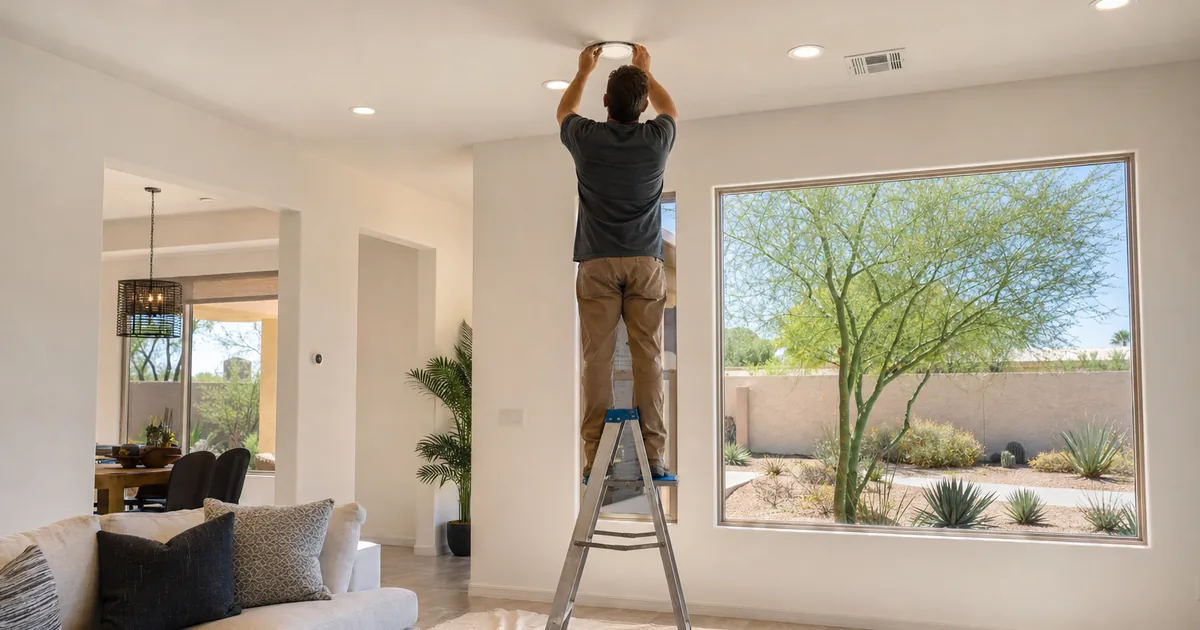
Recessed lighting installation in a Phoenix home means cutting fixtures into a ceiling that usually sits directly under a hot, insulated attic. Each housing should be insulation-contact rated and airtight (ICAT), sealed to the drywall with a gasket or caulk, and covered by insulation with no gaps. DOE guidance says airtight fixtures are labeled at no more than 2.0 cfm of leakage. Phoenix's current codes, effective August 1, 2025, include the 2023 National Electrical Code and the 2024 International Energy Conservation Code.
Recessed lights look simple from below: a neat circle of light in a flat ceiling. From above, in the attic of a typical single-story Phoenix home, each one is a hole cut through the ceiling into one of the hottest spaces in the house. How that hole is fitted, sealed and covered with insulation decides whether the light stays a clean finish or becomes a small, permanent air path between the cooled room and the attic.
This guide explains what the ratings on a recessed housing mean, what the energy code expects, how a light is sealed to the drywall, what to do about older cans, and how permits and inspections apply in the City of Phoenix.
Key takeaways
- The Arizona State Climate Office lists Phoenix's 1991-2020 normal daily high as 106.5°F in July, and recessed lights in single-story homes sit directly under the attic.
- According to DOE's Building America Solution Center, ICAT fixtures are approved for insulation contact and airtight under the ASTM E 283 test, with labels showing no more than 2.0 cfm of air leakage.
- DOE's Building America brief says up to half of the air leakage at a recessed fixture happens where the housing meets the drywall, so the housing must be sealed with a gasket or caulk.
- DOE guidance says insulation must be kept at least 3 inches from a non-IC recessed fixture, leaving roughly 1 square foot of uninsulated ceiling around each one.
- The City of Phoenix's 2024 Building Construction Codes, effective August 1, 2025, include the 2023 National Electrical Code and the 2024 International Energy Conservation Code with Phoenix amendments.
- The City of Phoenix Residential Inspection Checklist requires rough electrical to be approved before anything is insulated or covered, and its final inspection checks outlets and lights.
What does recessed lighting installation involve in a Phoenix home?
Installing a recessed light is three jobs done at one opening: an electrical job, a ceiling job and an attic job.
The electrical part is the familiar one. A circuit is chosen or added, cable is run from a switch location to each fixture position, and each housing or fixture is connected and controlled from the wall. The ceiling part is the cut itself: a round opening sized to the fixture, placed between framing members, with the housing fixed so it sits flush and square. The attic part is the one most often skipped. Once the fixture is in, the opening has to be sealed against air movement, and the insulation above it has to be put back in full contact with no gap around the fixture.
In most single-story Phoenix homes there is no floor above the living space. The ceiling drywall is the only thing separating an air-conditioned room from the attic, and the insulation lying on top of it does most of the work of keeping summer heat out. Every recessed light is therefore a penetration through the home's thermal envelope, the boundary between the conditioned inside and the unconditioned attic. Crews working in these attics treat each cut as a small envelope repair as well as a light fixture.
That changes what a good installation looks like. A row of lights that works, dims smoothly and looks even from below can still be a poor installation if the housings are not rated for insulation contact, are not airtight, or sit in a ring of bare drywall when seen from the attic.
Why does the attic above a Phoenix ceiling matter for recessed lights?
Recessed lights in a Phoenix ceiling sit under an attic that is exposed to some of the hottest outdoor conditions in the country for months at a time. The Arizona State Climate Office's 1991-2020 normals for Phoenix, compiled from NOAA regional climate center data and marked preliminary, give a normal daily high of 106.5°F in July and 104.2°F in June, and an annual mean daily high of 87.1°F. Those are outdoor air temperatures, not attic temperatures; this page does not quote an attic temperature because no government or utility source for one was found.
That heat matters in two ways. First, any air path through a recessed light connects the room to the attic. DOE's Building America Solution Center notes that recessed fixtures installed under unconditioned spaces such as attics can significantly increase the air leakage of the building envelope. Second, the insulation around the fixture matters. Where a fixture forces a gap in the insulation, that patch of ceiling has little between the room and the attic above it.
| Month | Normal daily high (°F) |
|---|---|
| January | 67.6 |
| February | 70.8 |
| March | 78.1 |
| April | 85.5 |
| May | 94.5 |
| June | 104.2 |
| July | 106.5 |
| August | 105.1 |
| September | 100.4 |
| October | 89.2 |
| November | 76.5 |
| December | 66.2 |
How we got this table. The values are the monthly mean maximum temperatures from the Arizona State Climate Office publication “Phoenix, Arizona Normals, Means, and Extremes” (copyright 2025), which uses NOAA regional climate center data for the 1991-2020 normals and marks them preliminary. They are outdoor air temperatures for Phoenix. They are not attic temperatures, and no government or utility measurement of Phoenix attic temperatures was found for this page.
Read as a calendar, the table shows that from May through September the normal daily high is at or above 94.5°F, and from June through September it is above 100°F (our reading of the table). Those are the months when a leaky or poorly insulated recessed fixture works against the air conditioner the hardest.
What do IC and ICAT ratings mean on a recessed light?
Two ratings printed on a recessed housing tell you most of what matters for a ceiling under an attic.
IC means insulation contact. An IC-rated fixture is approved to have insulation lying directly against it. DOE's Building America Solution Center describes the IC requirement as a fire-safety provision rather than an energy one, and notes that related sections of the residential code limit clearances to combustible materials and keep insulation away from fixtures that are not IC-rated.
ICAT means insulation contact and airtight. According to the Building America Solution Center, ICAT fixtures are “approved for insulation contact and are airtight as determined by the ASTM E 283 air leakage test,” and the label should show no more than 2.0 cfm (cubic feet per minute) of air movement from the conditioned space into the ceiling cavity.
Non-IC fixtures are the third case. DOE guidance says insulation must be kept at least 3 inches from a non-IC or non-ICAT fixture on all sides, which leaves roughly 1 square foot of uninsulated ceiling around each light, and that insulation touching a non-ICAT fixture is a fire hazard. A ceiling dotted with those bare patches gives summer heat a series of easy paths into the rooms below.
For a ceiling below an attic, the practical rule is that every new recessed housing should carry an ICAT label. Check it on the housing or the product listing before the fixture goes in, because once the ceiling is finished the label is hard to see.
What does the energy code say about recessed lights in Phoenix?
The City of Phoenix's current code set is the 2024 Phoenix Building Construction Code, adopted by City Council on June 18, 2025 and effective August 1, 2025. The City's Building Code page lists the 2023 National Electrical Code and the 2024 International Energy Conservation Code (IECC), with Phoenix amendments, among those codes. The electrical code governs how the fixture is wired and supported. The energy code is where recessed lights meet the thermal envelope.
The energy code's recessed-lighting provision, as quoted from the 2015 edition by DOE's Building America Solution Center, requires recessed luminaires installed in the building thermal envelope to be sealed to limit air leakage, to be IC-rated, and to be labeled as leaking “not more than 2.0 cfm” when tested to ASTM E 283 at a pressure difference of 75 pascals. The same DOE brief says recessed lighting should also be sealed with a gasket or caulk between the housing and the interior wall or ceiling covering.
This page says “the energy code” rather than citing a section number, because the numbering in the 2024 edition was not confirmed from an open copy for this guide. Phoenix publishes its amendments to the 2024 IECC in a packet adopted by Ordinance G-7397. Reading that packet, we found no amendment dealing with recessed-luminaire sealing or air leakage, which indicates the model-code recessed-lighting provisions are not locally altered. The plan reviewer and inspector have the final word on how they apply to a given job.
The same amendment packet contains text on interior lighting controls, including manual dimmers or automatic shutoff controls for permanently installed luminaires in habitable spaces. Because the packet shows that text alongside opposing justification without a clearly marked final version, this page does not state it as a settled Phoenix requirement. What can be said is that lighting controls are addressed in the energy code, and dimmers are commonly specified with recessed lighting.
How should a recessed light be sealed to the ceiling under an attic?
An ICAT label describes the housing as tested. It does not seal the gap between the housing and the drywall around it, and that gap matters: DOE's Building America brief notes that up to half of the air leakage at a recessed fixture occurs at the junction between the housing and the drywall.
The Building America Solution Center's recommended practice for fixtures below an unconditioned space comes down to four steps:
- Cut the hole close. The ceiling opening should be no more than 1 inch larger than the can, so the trim or gasket has solid drywall to seal against.
- Use an ICAT-labeled fixture. The housing itself should be rated for insulation contact and airtight.
- Seal the housing to the ceiling. In DOE's words, “Seal around the can with caulk before installing trim or install a trim kit with a gasket.”
- Restore the insulation. The insulation moved aside to make the cut goes back against the housing at full depth.
For IC-rated lights already in place between the living space and the attic, DOE's weatherization job aid (DOE/EE-2591, May 2022) describes running “a bead of caulk to seal the gap between the fixture and ceiling” and, where the fixture itself has small holes, fitting a commercially available cover from the attic side and sealing its edges.
The insulation step matters as much as the caulk. SRP's attic insulation program requires insulation improvements to be made in combination with air sealing and installed “free of gaps, voids and compression.” That is a utility program rule, not a code rule, but it describes the right finish around a new light. Crews working Phoenix attics find that the cut in the drywall is rarely what fails; the problem is the bare ring of drywall left after the insulation was pushed back and never returned.
What should be done with old recessed cans in a Phoenix house?
DOE's Building America guidance says older recessed cans are likely to be non-IC and non-ICAT, often with holes in the top that were meant to vent heat from high-output incandescent lamps. Those holes are exactly what a ceiling under an attic should not have.
The Building America Solution Center puts the effect plainly: “A non-airtight recessed can with an incandescent bulb can draw 3 to 5 times as much air as a hole the same size.” The heat of the lamp drives air through the can like a chimney, linking the cooled room to the attic.
DOE's guidance on existing non-ICAT fixtures sets out the options in order of preference:
- Replace the fixture with an ICAT-rated housing, sealed to the ceiling, with insulation restored around it.
- Replace it with a ceiling-mounted LED fixture that has no can extending into the attic, so the attic side can be sealed and insulated as plain ceiling.
- Enclose it from the attic side with a 1-hour fire-rated enclosure that keeps 3 inches of clearance from the fixture. DOE notes that rigid-foam boxes lack the needed fire rating.
Swapping the bulb alone is not the fix. DOE notes that incandescent and R-lamps use about six times the electricity of LEDs and add heat to air-conditioning loads, so an LED retrofit is worthwhile. But a new LED lamp in an old vented can still leaves the vented can in the ceiling, and insulation still has to be kept clear of a housing that is not IC-rated. A home electrical inspection is a sensible time to find out which cans in a house are which.
Are ceiling-mounted LED fixtures a good alternative to recessed cans in a Phoenix ceiling?
Not every ceiling needs a can. The Building America Solution Center lists LED surface-mount kits that look like recessed cans as an alternative in insulated ceilings, and its guidance on existing non-ICAT fixtures names a ceiling-mounted LED fixture with no can extending into the attic as one of the preferred replacements.
The appeal under a Phoenix attic is simple. A fixture that mounts at the ceiling and sits close to the drywall does not project up into the insulation the way a housing does. The attic side can be sealed and insulated as ordinary ceiling, and there is less to work around when the insulation is next topped up.
The trade-offs are mostly visual. A ceiling-mounted fixture sits slightly below the ceiling rather than inside it, and it looks different from a deep can with its trim set back. Some rooms suit one, some the other. Either way the same three questions apply: is the fixture rated for its location, is the ceiling opening sealed, and is the insulation in full contact above it.
LED fixtures also suit the climate. DOE's point that incandescent lamps add heat to air-conditioning loads carries extra weight in a house where the air conditioner already runs for long stretches through the summer. For other fixture types and room layouts, see lighting installation in Phoenix and ceiling fan installation.
Does adding recessed lighting in Phoenix need a permit or inspection?
The City of Phoenix does not publish a document specific to recessed lighting, so the question turns on the general rules. The City's Planning and Development Department says residential permits allow residents and contractors to do minor electrical and plumbing remodel work, including upgrading the electrical service and adding or extending circuits. A recessed lighting job that runs a new circuit, or extends an existing one to new fixture locations, is that kind of work. Whether a particular job needs a permit is a question for the contractor and, where it is unclear, for the City. The City also offers a residential field consultation permit, which lets a resident meet an inspector on site to ask technical questions.
Inspections follow the order of the work. The City's Residential Inspection Checklist (TRT/DOC/00081, revised September 2025) includes a pre-drywall stage at which rough electrical must be approved before anything is covered: “Do not insulate, drywall, or cover until approved.” The final inspection checks “outlets and lights.” In a remodel with the ceiling open, that sequence means the wiring to the new fixture locations is inspected before the insulation goes back.
The same checklist sets clearances for light fixtures in closets: incandescent fixtures 12 inches from closet storage areas, and fluorescent and LED fixtures 6 inches. That matters if recessed lights are planned for a walk-in closet. The checklist itself refers to the 2024 NEC, while the City's Building Code page lists the 2023 NEC; this page follows the Building Code page.
How are recessed lights planned and wired in a Phoenix home?
Good layout starts in the attic, not on the ceiling. Before a hole is marked, the positions are checked against what sits above the drywall: framing, ductwork that in many single-story homes runs through the attic, junction boxes and existing cable. A light drawn in the middle of a room that turns out to sit under a duct or a framing member gets moved, and it is better to learn that before the drywall is cut.
The circuit comes next. Whether new lights can join an existing lighting circuit or need a new one depends on what is already on that circuit, and a new or extended circuit is permitted work under the City's residential permits. A panel with no room for another circuit is a separate question, covered under electrical panel upgrades.
Controls finish the plan. Dimmers are commonly specified with recessed lighting, and the dimmer and the LED fixtures should be chosen to work together; a dimmer that does not suit its fixtures is a common cause of flicker. Location matters too: each fixture should be listed for where it is installed, and closet fixtures need the clearances in the City's checklist.
What are the most common mistakes with recessed lighting installation?
- Using housings that are not ICAT-rated in a ceiling below the attic, so insulation has to be held back or air leaks through the fixture.
- Cutting oversized holes. DOE recommends an opening no more than 1 inch larger than the can, so the trim has drywall to seal against.
- Skipping the seal between housing and drywall. Up to half of a fixture's air leakage happens there, according to DOE.
- Leaving insulation pushed back. A crater of bare drywall around each light undoes much of the ceiling insulation.
- Packing insulation against old non-IC cans, or boxing them with rigid foam, which DOE notes lacks the needed fire rating.
- Covering wiring before the rough inspection. The City's checklist says not to insulate, drywall or cover until approved.
Who installs recessed lighting for Your Phoenix Electrician?
Arizona licenses electrical contractors through the Registrar of Contractors. The Arizona Administrative Code describes the R-11 Electrical classification as allowing the licensee to install and repair residential electrical systems. Ask for the license number and classification before work begins.
Recessed lighting installation requested through Your Phoenix Electrician is performed by Alvey Electric LLC, Arizona Registrar of Contractors license ROC 364723, R-11 Electrical (residential). The work is residential only.
Frequently asked questions
What do IC and ICAT ratings mean on a recessed light?
IC means the fixture is approved for insulation contact, so insulation can lie directly against it. ICAT means it is approved for insulation contact and is airtight under the ASTM E 283 air leakage test. DOE's Building America Solution Center says an ICAT label should show no more than 2.0 cfm of air movement from the room into the ceiling cavity. For a ceiling below an attic, ICAT is the rating to look for.
Do recessed lights need to be airtight in Phoenix?
Yes, in a ceiling that forms part of the thermal envelope. The energy code's recessed-lighting provision, as quoted by DOE from the 2015 edition, requires recessed luminaires in the envelope to be IC-rated, sealed and labeled at no more than 2.0 cfm of leakage. Phoenix's 2024 code set includes the 2024 IECC, and its published amendments do not change the recessed-lighting provisions as we read them.
Can insulation touch recessed lights?
Only if the fixture is IC-rated or ICAT-rated. DOE guidance says insulation must be kept at least 3 inches from a non-IC fixture on all sides, and that insulation touching a non-ICAT fixture is a fire hazard. That clearance leaves roughly 1 square foot of uninsulated ceiling around each old fixture, which is one reason replacement with an ICAT housing is preferred.
Do I need a permit to add recessed lighting in Phoenix?
It depends on the job. The City of Phoenix says residential permits allow residents and contractors to do minor electrical remodel work, including adding or extending circuits, so recessed lighting that runs or extends a circuit is that kind of work. Permitted work is inspected: the City's checklist requires rough electrical to be approved before anything is insulated or covered. Ask the contractor, or the City, about your specific project.
How much does recessed lighting installation cost in Phoenix?
This page does not quote a price, because no public source sets one. The cost depends on the number of fixtures, whether the attic above is easy to reach and work in, whether a new circuit is needed, whether old non-IC cans are being removed, the fixture type chosen and whether a permit applies. Ask for a written scope that names the fixture rating, sealing method and insulation repair before work starts.
Are recessed lights bad for energy efficiency in a hot attic?
They can be if they leak. DOE's Building America brief says recessed fixtures under attics can significantly increase envelope air leakage, and that up to half of a fixture's leakage occurs where the housing meets the drywall. ICAT fixtures, sealed with a gasket or caulk and covered by insulation with no gaps, avoid most of that. Ceiling-mounted LED fixtures with no can are another option.
Should I replace my old recessed cans or just put in LED bulbs?
LED bulbs help, but they do not fix a leaky can. DOE notes incandescent lamps use about six times the electricity of LEDs, so switching is worthwhile. Older cans, though, are often non-IC with vent holes in the top, and DOE says a non-airtight can with an incandescent bulb can draw 3 to 5 times as much air as a same-size hole. Replacing them with ICAT or ceiling-mounted LED fixtures is the preferred fix.
Can recessed lights go in a closet in Phoenix?
They can, with clearances. The City of Phoenix Residential Inspection Checklist sets light fixture clearances in closets of 12 inches from closet storage areas for incandescent fixtures and 6 inches for fluorescent and LED fixtures. That usually means planning the fixture position around the shelving, and choosing an LED fixture gives more room to work with.
What is a ceiling-mounted LED alternative to recessed cans?
It is a fixture that mounts at the ceiling and sits close to the drywall without a can extending up into the attic. DOE's Building America Solution Center lists LED surface-mount kits that look like recessed cans as an alternative in insulated ceilings, and names ceiling-mounted LED fixtures as a preferred replacement for old non-ICAT cans. The attic side can then be sealed and insulated as plain ceiling.
Do recessed lights in Phoenix need dimmers?
Lighting controls are addressed in the energy code, and dimmers are commonly specified with recessed lighting. Phoenix's 2024 IECC amendment packet includes text on dimmer or automatic shutoff controls, but it does not show clearly marked final wording, so this page does not state a definite Phoenix requirement. Whatever control is used, choose a dimmer that suits the LED fixtures to avoid flicker.
How should a recessed light be sealed to the ceiling under an attic?
Cut the opening no more than 1 inch larger than the can, use an ICAT-labeled fixture, and seal around the can with caulk before the trim goes on or use a gasketed trim, as DOE's Building America guidance recommends. Then return the insulation against the housing at full depth. SRP's insulation program describes the right finish as free of gaps, voids and compression.
Who installs recessed lighting requested through Your Phoenix Electrician?
Recessed lighting installation requested through Your Phoenix Electrician is performed by Alvey Electric LLC, Arizona Registrar of Contractors license ROC 364723, R-11 Electrical (residential). The Arizona Administrative Code describes the R-11 Electrical classification as allowing the licensee to install and repair residential electrical systems. The work is residential only.
The short version
Judge a recessed lighting job from the attic as well as from the room. If every housing is ICAT-labeled, sealed to the drywall and buried in insulation with no gap, and the wiring was approved before the ceiling was covered, the installation is doing its job. If any of those is missing, or the ceiling still holds old vented cans, replacement or a ceiling-mounted LED fixture is the better answer than a new bulb.
This page is general information about residential electrical work in Phoenix, Arizona. It is not engineering, legal or code advice for a specific property. Permit rules, utility requirements, rebates and adopted codes change; confirm current requirements with the City of Phoenix and your utility before work begins.
References
- City of Phoenix Planning and Development Department, Building Construction Codes (2024 codes including the 2023 NEC and 2024 IECC with Phoenix amendments; effective August 1, 2025) https://www.phoenix.gov/administration/departments/pdd/tools-resources/codes-ordinance/building-code.html. Read November 25, 2026.
- City of Phoenix, 2024 Phoenix Building Construction Code Implementation (adopted June 18, 2025) https://web-prod.phoenix.gov/content/dam/phoenix/pddsite/documents/codes-ordinances/amendmentcodes/2024-building-code-implementation.pdf. Read November 25, 2026.
- City of Phoenix, 2024 IECC Phoenix amendments, adopted by Ordinance G-7397 (Council action June 18, 2025) https://www.phoenix.gov/content/dam/phoenix/pddsite/documents/codes-ordinances/amendmentcodes/2024-iecc.pdf. Read November 25, 2026.
- City of Phoenix Planning and Development Department, Online Permits (TRT/DOC/00933) https://www.phoenix.gov/content/dam/phoenix/pddsite/documents/trt/external/dsd_trt_pdf_00933.pdf. Read November 25, 2026.
- City of Phoenix Planning and Development Department, Residential Inspection Checklist (TRT/DOC/00081, Rev. 09/25) https://www.phoenix.gov/pddsite/Documents/TRT/dsd_trt_pdf_00081.pdf. Read November 25, 2026.
- Building America Solution Center (PNNL / U.S. DOE), Recessed Lighting Code Compliance Brief https://basc.pnnl.gov/code-compliance/recessed-lighting-code-compliance-brief. Read November 25, 2026.
- Building America Solution Center (PNNL / U.S. DOE), Air Sealing Recessed Light Fixtures Below Unconditioned Space (updated September 16, 2022) https://basc.pnnl.gov/resource-guides/air-sealing-recessed-light-fixtures-below-unconditioned-space. Read November 25, 2026.
- Building America Solution Center (PNNL / U.S. DOE), Insulating and Air Sealing Existing Non-ICAT Recessed Lights (updated December 3, 2022) https://basc.pnnl.gov/resource-guides/insulating-and-air-sealing-existing-non-icat-recessed-lights. Read November 25, 2026.
- U.S. Department of Energy, Job Aid 2-5: Seal Insulation-Contact Rated Recessed Lights (DOE/EE-2591, May 2022) https://www.energy.gov/sites/default/files/2022-06/job-aid-2-5_seal-insulation-contact-rated-recessed-lights.pdf. Read November 25, 2026.
- Arizona State Climate Office, Phoenix, Arizona Normals, Means, and Extremes (1991-2020 normals, NOAA RCC data, preliminary, 2025) https://globalfutures.asu.edu/azclimate/wp-content/uploads/sites/35/2025/06/Phoenix.pdf. Read November 25, 2026.
- Salt River Project, Insulation rebate page https://www.srpnet.com/energy-savings-rebates/home/rebates/insulation. Read November 25, 2026.
- Arizona Administrative Code R4-9-103, Residential Contractor License Classifications and Scopes of Work (R-11 Electrical) https://www.law.cornell.edu/regulations/arizona/Ariz-Admin-Code-SS-R4-9-103. Read November 25, 2026.
Plan your recessed lighting
Request an estimate for recessed lights in your Phoenix home.
Related pages
About this page
Written by the Your Phoenix Electrician editorial team from the sources listed above. Reviewed by Robert "Bob" Lira, licensed Arizona electrical contractor, ROC 338369. Your Phoenix Electrician, 4315 E Thunderbird Rd #120, Phoenix, AZ 85032, phone 602-900-0593, serves homes in the City of Phoenix. Electrical work is performed by Alvey Electric LLC, Arizona Registrar of Contractors license ROC 364723 (residential electrical).
Updated .