Residential electrical service - Phoenix, Arizona
Ceiling Fan Installation in Phoenix, AZ (2026 Guide)
How to get a ceiling fan installed right in a Phoenix home: the box that carries it, the height and size that move air, the rating a patio needs, and the checks before it goes up.
Quick answer
A correct ceiling fan installation in Phoenix puts the fan on an electrical box listed and marked for fan support, with the blades about 7 to 9 feet above the floor and a blade diameter matched to the room. ENERGY STAR advises a damp-rated fan for covered areas and a wet-rated fan where water can reach it, such as a patio. The U.S. Department of Energy says a fan lets you raise the thermostat about 4°F with no loss of comfort. Check the CPSC ceiling fan recall list before installing.
A ceiling fan is one of the simplest electrical additions to a Phoenix home, and one of the easiest to get slightly wrong. The fan goes up in an afternoon; the problems show up later, as a wobble that slowly loosens the mount, a fan hung so close to the ceiling that it barely moves air, or an indoor fan corroding on a patio. This guide covers what a correct installation involves: a box rated to carry a fan, blades at the right height, a blade size that suits the room, a fan rated for where it hangs, and a check that the model has not been recalled.
It also covers how to run a fan in this climate, using published guidance from the U.S. Department of Energy, ENERGY STAR, APS and SRP, and it explains where the City of Phoenix permit question stands, including what the City's documents do not say.
Key takeaways
- The U.S. Department of Energy says that with a ceiling fan running you can raise the air-conditioning thermostat about 4°F with no reduction in comfort.
- The Department of Energy says fans work best with the blades 7 to 9 feet above the floor and 10 to 12 inches below the ceiling.
- ENERGY STAR's sizing table suggests a 44-inch fan for rooms of 144 to 225 square feet and a 50- to 54-inch fan for rooms of 225 to 400 square feet.
- A trade explanation of the National Electrical Code says a box carrying a ceiling paddle fan must be listed and marked as suitable for the purpose and may not support a fan over 70 pounds.
- ENERGY STAR advises a UL damp-rated fan for covered areas and a UL wet-rated fan where it may contact water, such as a patio or front porch.
- On August 13, 2026, CPSC announced a recall of about 9,460 Hampton Bay Halwin 52-inch ceiling fans because the blades can separate from the motor flywheel.
What does a ceiling fan installation in a Phoenix home involve?
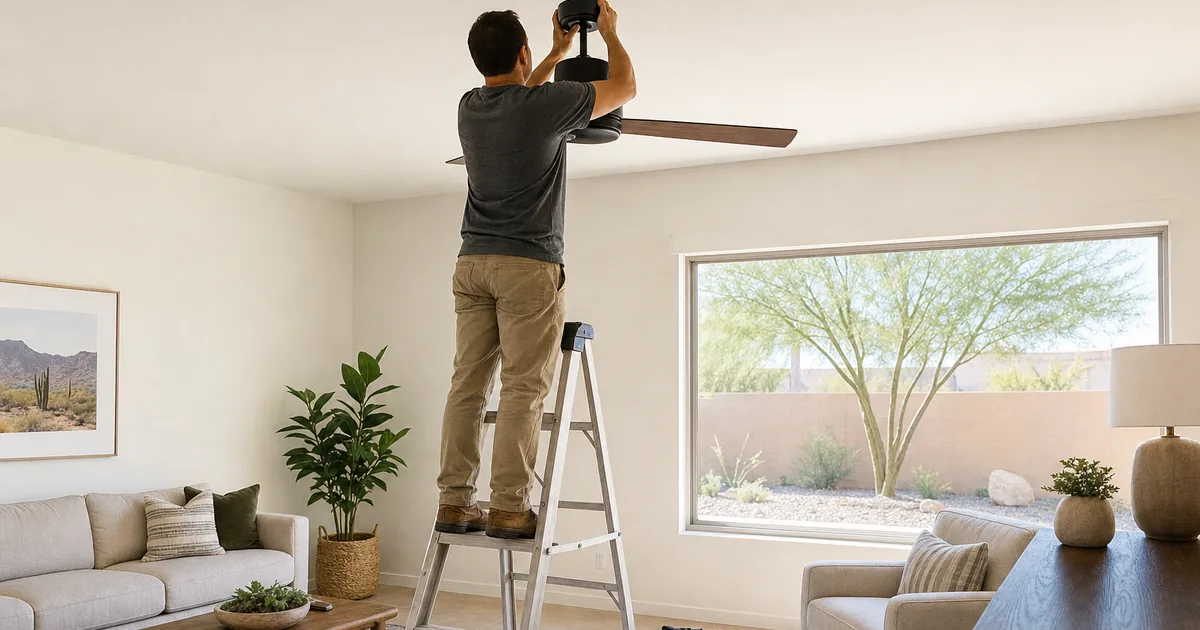
Installing a ceiling fan is three jobs done in order. First, the ceiling has to be able to carry the fan. Then the fan is wired to its switch or control. Finally, it is assembled, hung at the right height and balanced so that it runs quietly at every speed. The first job is the one most often skipped, and it is the one that causes trouble later.
Most fans go where a light fixture used to be, because that spot already has a box in the ceiling and a switch on the wall. That convenience hides the main risk. A light fixture is a still load. A fan is usually heavier and it moves, so every rotation puts a small, repeating force on the box and on whatever holds the box to the framing. A box that held a light for decades without complaint may not be built or fastened to carry that. If you are weighing a fan against a new fixture for the same spot, the lighting installation guide covers the fixture side of the choice.
A careful installation follows a sequence:
- Power off and confirmed off. The breaker for the circuit is switched off and the wires at the ceiling are tested before anyone touches them. A wall switch in the off position is not proof that the box is dead.
- The box and its support are checked. The electrician looks for the marking that says the box is suitable for fan support and checks how the box is fastened to the framing, from below and, where needed, from the attic.
- The support is corrected if needed. A light-only box is replaced with a fan-rated box, or a fan brace is installed to carry it.
- The fan is assembled to the right height. The downrod is chosen so that the blades sit where they move air best, not simply where the box happens to be.
- Wiring and controls. The fan, and any light kit, are connected to the switch, wall control or receiver the homeowner has chosen.
- Balance and test. Every speed and both directions are run, and the fan is balanced until it runs without a wobble.
If there is no box or switch where the fan is wanted, the job grows. It may need a new ceiling box, new cable through the attic and possibly a new or extended circuit. That is a different conversation, and the permit section below explains where it fits.
Why is a ceiling fan worth installing in a Phoenix home?
Because the cooling season here is long and severe. The National Weather Service office in Phoenix recorded 70 days at or above 110°F and 143 days at or above 100°F at Phoenix in 2024, a year it described as the warmest in the recorded history of Phoenix. Air conditioning carries most of that load. A ceiling fan works alongside it.
The U.S. Department of Energy says that if you use air conditioning with a ceiling fan, you can raise the thermostat setting about 4°F with no reduction in comfort. The fan does not lower the temperature of the room. It moves air across your skin, which is why APS puts it plainly: "Fans cool people, not rooms." APS advises using a ceiling fan instead of turning up the air conditioning.
Both utilities that serve Phoenix homes give the same direction. SRP's summer energy guide, published in June 2026, advises setting ceiling fans to blow down during the summer to circulate air rather than lowering the thermostat. APS also gives a timing tip, in its own words: "Raise your thermostat a few degrees from 10am-3pm, then lower it a few degrees during on-peak hours, from 4pm-7pm." Whichever schedule your plan suits, a fan in the rooms you are actually using is what makes a higher thermostat setting comfortable, according to the Department of Energy's figure.
The practical consequence for installation is that fans in Phoenix homes are asked to run for months at a time, often on high and often in every occupied room. A fan that is undersized, hung at the wrong height or loose on its mount gets found out quickly under that kind of use. Getting the installation right is what lets the fan do the job the utilities and the Department of Energy describe.
What size ceiling fan does a room in a Phoenix home need?
Blade diameter, the distance from tip to tip across the blades, should match the floor area of the room. A fan that is too small for a large living room stirs the air near the middle and leaves the edges still. One that is too large for a small bedroom crowds the space. ENERGY STAR publishes a sizing table, credited to the American Lighting Association, that matches room area to a suggested blade diameter. The chart and table below show it.
| Room floor area | Suggested blade diameter | Value drawn in the chart |
|---|---|---|
| Up to 75 sq ft | 29-36 in | 36 in |
| 76-144 sq ft | 36-42 in | 42 in |
| 144-225 sq ft | 44 in | 44 in |
| 225-400 sq ft | 50-54 in | 54 in |
How we got this table. The room sizes and blade diameters are copied from the sizing table on the ENERGY STAR Ceiling Fan Basics page (page undated, read November 25, 2026), which credits the table to the American Lighting Association, 2003. Plotting the upper end of each range is our own choice for the chart. This is published guidance, not measured data. The ranges are shown as published, so 144 square feet appears in two rows, and the table does not cover rooms larger than 400 square feet.
The Department of Energy gives a consistent rule of thumb: a 36- or 44-inch fan will cool rooms up to 225 square feet. For a bedroom or study of that size or smaller, that is the range to look for. Larger living and family rooms move into the 50- to 54-inch range in ENERGY STAR's table.
To use the table, measure the room's length and width and multiply them. Open plans, where kitchen, dining and family areas run together, are harder: the table treats a room as one space, and a single fan sized for the whole open area may hang too far from the seating to be felt. Where a fan should go in that kind of layout is worth deciding before the box is placed, because moving a box afterwards means more ceiling work. The same planning applies if the room is also getting recessed lighting, since the fan and the lights share the ceiling and should be laid out together.
How high should a ceiling fan be mounted, and how far from the walls?
Two public sources give the numbers. The Department of Energy says fans work best when the blades are 7 to 9 feet above the floor and 10 to 12 inches below the ceiling. ENERGY STAR advises mounting the fan in the middle of the room, at least 7 feet above the floor and 18 inches from the walls, or 8 to 9 feet above the floor where the ceiling height allows.
Those numbers pull in two directions, and the ceiling height decides how they are met:
- Flat ceilings with room to spare. A short downrod can put the blades inside the Department of Energy's range while leaving space above them for the fan to draw air.
- Low ceilings. ENERGY STAR says hugger fans, which mount close against the ceiling, suit ceilings under 8 feet but move less air. They meet the 7-foot clearance at the cost of airflow.
- Vaulted and high ceilings. A longer downrod brings the blades down into the working range. A sloped ceiling also needs a mount that lets the fan hang plumb, so check the fan's instructions for the slope its mount accepts before buying.
The 18-inch clearance from the walls rules out some locations in small rooms and hallways. Measure the clearances at the planned spot, including to the top of any door that swings open, a tall shelf or a bunk bed, before choosing the fan. The 7-foot figure is a minimum to the blades, not to the light kit or the canopy, so a fan with a hanging light needs the room checked with the light included.
Why does a ceiling fan need a fan-rated electrical box?
Because the box is what holds the fan up. A trade explanation of the National Electrical Code by Mike Holt, published in EC&M, sets out the requirements: outlet boxes for a ceiling paddle fan must be listed and marked as suitable for the purpose; such a box may not support a fan weighing more than 70 pounds; and for fans over 35 pounds, the box must be marked with the maximum weight it can support. A heavier fan needs support independent of the box.
That explanation was written about the 2017 edition of the code. Phoenix now uses the 2023 National Electrical Code as part of the 2024 City of Phoenix Building Construction Codes, which the City Council adopted on June 18, 2025 and which took effect on August 1, 2025. Treat the points above as the general principle, a fan needs a box marked for fan support and rated for its weight, and let the electrician apply the edition in force.
In practice the question at every fan location comes down to two checks. Is the box marked for fan support? Is the fan's weight within what the box is marked for? A box installed years ago for a light, held by a bracket meant only for a light, may fail both. The fix is a fan-rated box fastened to the framing, or a fan brace that spans between the ceiling joists and carries the box, installed from the attic or through the ceiling opening.
The fan's weight is printed on its carton or in its instructions. Large patio fans and fans with heavy light kits are the ones to check most carefully. Ask the person installing the fan to tell you what the box is rated for and how it is fastened. It takes a moment to check, and it is the single most important fact about the installation. If the check turns up scorched wiring, loose connections or old work of uncertain origin in the box, that is a repair before it is a fan job; see electrical repair and troubleshooting.
Which ceiling fan should you choose for a Phoenix patio or indoor room?
Start with where the fan will hang. ENERGY STAR advises buying a UL "damp"-rated fan for covered areas, and for fans that may come in direct contact with water, like on a patio or front porch, a UL "wet" rating. An indoor-only fan is not rated for either exposure.
The question ENERGY STAR's wording asks is whether water can reach the fan, not whether the space has a roof. A fan deep under a covered patio and a fan near the open edge of the same patio may need different ratings. If rain can blow in under the cover, or if the fan will be hosed down or sprayed by misters, the wet rating is the one that fits that guidance.
ENERGY STAR's guidance is about moisture. We did not find a public source that rates ceiling fans for desert dust, so this page makes no claim about dust resistance. If dust is a concern for an outdoor fan, ask the manufacturer what its rating covers.
Efficiency comes next. The Department of Energy says ceiling fans that are ENERGY STAR certified are up to 40% more efficient, on average, than conventional models. ENERGY STAR's own product page says certified fans use improved motors and blade designs and are up to 44% more efficient than conventional fans. The two figures come from different pages and are given here as each source states them. Either way, in a climate where fans run for months, the label is worth looking for.
Finally, controls. A fan can be run by pull chains, a wall control or a remote receiver in the canopy. The right choice depends on whether the existing wiring allows separate control of the fan and its light, and on how easy the chains will be to reach on a high ceiling. Settle that before the fan is bought, because it decides whether new wiring is needed between the switch and the ceiling.
Does installing a ceiling fan need a permit in Phoenix?
No City of Phoenix document we found answers that question for ceiling fans by name, so this page does not say either way. Here is what the City's documents do say.
A City of Phoenix Planning and Development Department handout on work exempt from permit (TRT/DOC/00618, revised July 2014) states that the replacement of an existing luminaire with a new luminaire does require a permit. A luminaire is a light fixture. The handout does not mention ceiling fans, and the City's exemption list does not name them either. Because the handout is an older document, check that it still reflects current practice.
Where a fan installation means adding a new circuit or extending an existing one, the City's online permits page says residential permits allow residents and contractors to do minor electrical remodel work, including adding or extending circuits. That is the kind of work a permit covers. If a fan is going into a room with no box, or onto a circuit that is already carrying a heavy load, this is the part of the job to ask about; a circuit that already trips is covered under circuit breaker repair.
The City also offers a residential field consultation permit, which lets a resident meet an inspector on site to ask technical questions about an upcoming project. For a straight swap from a light to a fan, ask the electrician how they read the City's rules for your job, and where it is unclear, confirm with the Planning and Development Department before work begins.
Which direction should a ceiling fan turn in a Phoenix summer and winter?
Counterclockwise in summer. The Department of Energy advises running ceiling fans counterclockwise in summer. SRP's guide puts the same idea as setting ceiling fans to blow down during the summer, so the air moving onto you is what does the cooling.
Clockwise in winter. APS advises running fans clockwise in winter. On many fans the direction is changed with a switch on the motor housing or a button on the remote; the fan's instructions show where.
Off when the room is empty. The Department of Energy says to be certain to turn off ceiling fans when you leave a room, and APS gives the same advice. A fan cools the people in the room, not the room itself, so a fan running in an empty bedroom is using electricity for no benefit.
For the installation, this means a fan should be tested in both directions and at every speed before the installer leaves. A fan that runs smoothly on low but wobbles on high, or that is noisy in one direction only, should be checked for balance and for a secure mount while the ladder is still up, not after the first summer of heavy use.
How do you check whether a ceiling fan has been recalled?
The U.S. Consumer Product Safety Commission keeps a list of ceiling fan recalls on its website. Check it before installing a fan, especially one bought some time ago or second-hand, and check fans already in the house if you are unsure about them.
A recent example shows why the check matters. On August 13, 2026, CPSC announced a recall of about 9,460 Hampton Bay Halwin 52-inch indoor/outdoor ceiling fans, model numbers AK396H-MBK and AK396H-BN. CPSC says the fan blades can separate from the fan motor flywheel, posing impact and injury hazards to consumers. It reported 11 incident reports and no injuries, and it tells consumers to stop using the recalled fans immediately. The recall notice lists a refund or store credit as the remedy.
To check a fan, find its brand and model number on its label or in its paperwork and compare them with the CPSC list. If a fan matches a recall, stop using it and follow the remedy in the notice instead of installing it. An installer who is replacing an older fan can read its label before it comes down, which is the easiest moment to check it.
What are the most common mistakes with ceiling fan installation?
- Hanging a fan on a light-only box. The box must be listed and marked for fan support and rated for the fan's weight.
- Choosing the blade size by looks. Match the diameter to the room's floor area using ENERGY STAR's table.
- Mounting at the wrong height. Blades jammed against a high ceiling, or hanging below 7 feet, miss the ranges DOE and ENERGY STAR give.
- Putting an indoor fan on a patio. ENERGY STAR advises a damp rating under cover and a wet rating where water can reach the fan.
- Trusting the wall switch. Turn off the breaker and test the wires before working at the box.
- Skipping the recall check. Compare the model number with the CPSC ceiling fan recall list before the fan goes up.
Most of these are decided before the fan comes out of its carton. The box, the size, the height and the rating are planning questions, and an hour spent on them saves the work of taking a fan back down. If the house has older wiring you are unsure about, a home electrical inspection can look at the circuits before new fans are added.
Who installs ceiling fans requested through Your Phoenix Electrician?
Arizona licenses electrical contractors through the Registrar of Contractors. The Arizona Administrative Code describes the R-11 Electrical classification as allowing the licensee to install and repair residential electrical systems. Ask for the license number and classification before any work begins.
Ceiling fan installations requested through Your Phoenix Electrician are performed by Alvey Electric LLC, Arizona Registrar of Contractors license ROC 364723, R-11 Electrical (residential). The work is residential only.
Frequently asked questions
How high should a ceiling fan be mounted from the floor?
The U.S. Department of Energy says fans work best when the blades are 7 to 9 feet above the floor and 10 to 12 inches below the ceiling. ENERGY STAR advises at least 7 feet above the floor and 18 inches from the walls, or 8 to 9 feet where the ceiling allows. On low ceilings, ENERGY STAR says hugger fans suit ceilings under 8 feet but move less air.
What size ceiling fan do I need for my room?
Measure the room and multiply length by width. ENERGY STAR's sizing table suggests 29 to 36 inches for rooms up to 75 square feet, 36 to 42 inches for 76 to 144 square feet, 44 inches for 144 to 225 square feet, and 50 to 54 inches for 225 to 400 square feet. The Department of Energy says a 36- or 44-inch fan will cool rooms up to 225 square feet.
Can I put a ceiling fan where a light fixture is now?
Often, but only if the box in the ceiling can carry it. A trade explanation of the National Electrical Code says a box supporting a ceiling paddle fan must be listed and marked as suitable for the purpose, may not support a fan over 70 pounds, and must show its maximum weight for fans over 35 pounds. A light-only box is replaced with a fan-rated box or a fan brace.
Does installing a ceiling fan need a permit in Phoenix?
No City of Phoenix document we found names ceiling fans in its permit rules, so this page does not say either way. A City handout revised in 2014 says replacing an existing light fixture with a new one does require a permit, and the City says residential permits cover adding or extending circuits. Confirm your job with the electrician and, where unclear, with the Planning and Development Department.
What kind of ceiling fan should I use on a Phoenix patio?
ENERGY STAR advises a UL damp-rated fan for covered areas and a UL wet-rated fan where the fan may come in direct contact with water, such as a patio or front porch. The deciding question is whether water can reach the fan, not whether the patio has a roof. An indoor-only fan is not rated for either exposure.
Which way should my ceiling fan spin in summer?
Counterclockwise. The U.S. Department of Energy advises running ceiling fans counterclockwise in summer, and SRP advises setting them to blow down during the summer. APS advises running them clockwise in winter. The Department of Energy and APS both advise turning the fan off when you leave the room, because a fan cools people, not rooms.
Do ceiling fans save energy in a Phoenix summer?
They let you run the air conditioning less hard. The Department of Energy says a ceiling fan lets you raise the thermostat about 4°F with no reduction in comfort, and APS advises using a fan instead of turning up the air conditioning. ENERGY STAR certified fans are up to 44% more efficient than conventional fans according to ENERGY STAR, and up to 40% on average according to the Department of Energy.
Why does my ceiling fan wobble?
A wobble usually comes from blades that are out of balance, loose blade or mounting screws, or a box and bracket that are not holding the fan firmly. Tightening screws can hide the symptom for a while. If the wobble returns, have the box checked to confirm it is marked for fan support and rated for the fan's weight, then balance the fan.
How do I know if my ceiling fan has been recalled?
Find the brand and model number on the fan's label or paperwork and compare them with the CPSC ceiling fan recall list. For example, on August 13, 2026, CPSC announced a recall of about 9,460 Hampton Bay Halwin 52-inch fans, models AK396H-MBK and AK396H-BN, because the blades can separate from the motor flywheel. CPSC says to stop using recalled fans immediately.
How much does ceiling fan installation cost in Phoenix?
This page does not quote a price, because no public source sets one and the cost depends on the job. The main factors are whether the existing box is fan-rated or needs replacing or bracing, whether new wiring or a new circuit is needed, attic access, ceiling height and downrod length, the controls chosen and how many fans are installed. Ask for the scope and the price together.
Who installs ceiling fans requested through Your Phoenix Electrician?
Ceiling fan installations requested through Your Phoenix Electrician are performed by Alvey Electric LLC, Arizona Registrar of Contractors license ROC 364723, R-11 Electrical (residential). The Arizona Administrative Code describes the R-11 Electrical classification as allowing the licensee to install and repair residential electrical systems. The work is residential only.
The short version
Before a ceiling fan goes up, settle four things: a box marked for fan support and rated for the fan's weight, a blade diameter matched to the room's floor area, blades within the published height range, and a damp or wet rating wherever water can reach the fan. Add a check of the CPSC recall list and you have covered the failures that show up after installation. If any of those four cannot be confirmed at the ceiling, fix that first and hang the fan second.
This page is general information about residential electrical work in Phoenix, Arizona. It is not engineering, legal or code advice for a specific property. Permit rules, utility requirements, rebates and adopted codes change; confirm current requirements with the City of Phoenix and your utility before work begins.
References
- U.S. Department of Energy, Energy Saver, Fans for Cooling (undated; thermostat 4°F, blade height, fan size, direction, ENERGY STAR 40% figure) https://www.energy.gov/energysaver/articles/fans-cooling. Read November 25, 2026.
- ENERGY STAR, Ceiling Fans (up to 44% more efficient; specification effective June 15, 2018) https://www.energystar.gov/products/ceiling_fans. Read November 25, 2026.
- ENERGY STAR, Ceiling Fan Basics (sizing table credited to the American Lighting Association, 2003; mounting height; damp and wet ratings) https://www.energystar.gov/products/ceiling_fans/ceiling_fan_basics. Read November 25, 2026.
- Mike Holt, Code Q&A: Boxes at Ceiling-Suspended Fan Outlets, EC&M, August 23, 2018 (2017 NEC) https://www.ecmweb.com/national-electrical-code/qa/article/20903870/code-qa-boxes-at-ceiling-suspended-fan-outlets. Read November 25, 2026.
- U.S. Consumer Product Safety Commission, Hampton Bay Halwin 52-Inch Ceiling Fans Recalled Due to Impact and Injury Hazards, August 13, 2026 https://www.cpsc.gov/Recalls/2026/Hampton-Bay-Halwin-52-Inch-Ceiling-Fans-Recalled-Due-to-Impact-and-Injury-Hazards-Manufactured-by-Youngo-Limited. Read November 25, 2026.
- U.S. Consumer Product Safety Commission, Ceiling Fans recall list https://www.cpsc.gov/Recall-Products/Ceiling-Fans. Read November 25, 2026.
- APS, Energy Saving Tips (undated) https://www.aps.com/en/Residential/Save-Money-and-Energy/Your-Energy-Your-Options/Energy-Saving-Tips. Read November 25, 2026.
- SRP blog, Your ultimate guide to summer energy savings in Arizona, June 10, 2026 https://blog.srpnet.com/the-ultimate-guide-to-summer-energy-savings-in-arizona/. Read November 25, 2026.
- National Weather Service Phoenix, 2024 Year in Review, January 5, 2025 https://www.weather.gov/psr/YearinReview2024. Read November 25, 2026.
- City of Phoenix Planning and Development Department, Work Exempt from Permit (TRT/DOC/00618, Rev. 07/14) https://www.phoenix.gov/content/dam/phoenix/pddsite/documents/trt/external/dsd_trt_pdf_00618.pdf. Read November 25, 2026.
- City of Phoenix Planning and Development Department, Online Permits (TRT/DOC/00933; residential permits; field consultation) https://www.phoenix.gov/content/dam/phoenix/pddsite/documents/trt/external/dsd_trt_pdf_00933.pdf. Read November 25, 2026.
- City of Phoenix Planning and Development Department, Building Construction Codes (2023 National Electrical Code; effective August 1, 2025) https://www.phoenix.gov/administration/departments/pdd/tools-resources/codes-ordinance/building-code.html. Read November 25, 2026.
- City of Phoenix, 2024 Phoenix Building Construction Code Implementation (adopted June 18, 2025) https://web-prod.phoenix.gov/content/dam/phoenix/pddsite/documents/codes-ordinances/amendmentcodes/2024-building-code-implementation.pdf. Read November 25, 2026.
- Arizona Administrative Code R4-9-103, Residential Contractor License Classifications and Scopes of Work (R-11 Electrical) https://www.law.cornell.edu/regulations/arizona/Ariz-Admin-Code-SS-R4-9-103. Read November 25, 2026.
Plan your ceiling fan installation
Request an estimate for ceiling fan installation in your Phoenix home.
Related pages
- Lighting installation in Phoenix
- Recessed lighting installation in Phoenix
- Electrical repair and troubleshooting in Phoenix
- Circuit breaker repair and replacement in Phoenix
- Outlet installation and repair in Phoenix
- Home electrical inspections in Phoenix
- Phoenix neighborhoods and villages we serve
- Your Phoenix Electrician home
About this page
Written by the Your Phoenix Electrician editorial team from the sources listed above. Reviewed by Robert "Bob" Lira, licensed Arizona electrical contractor, ROC 338369. Your Phoenix Electrician, 4315 E Thunderbird Rd #120, Phoenix, AZ 85032, phone 602-900-0593, serves homes in the City of Phoenix. Electrical work is performed by Alvey Electric LLC, Arizona Registrar of Contractors license ROC 364723 (residential electrical).
Updated .