Arcadia, Camelback East village - Phoenix, Arizona
Electrician for Arcadia Homes in Phoenix, AZ (2026 Guide)
What Arcadia's citrus-grove history, older houses, mature trees and flood-irrigated lots mean for the electrical work on a home there.
Quick answer
Electrical work in Arcadia, Phoenix centers on older homes, large irrigated lots and mature trees. The City says much of the housing in Camelback East, the village that includes Arcadia, was built between 1950 and 1970, and a 1993 City survey traces Arcadia to a 1919 citrus-grove plat. Where SRP is the utility, it does not trim trees around the service drop from the pole to a home. Service upgrades and new or extended circuits fall under City of Phoenix residential permits.
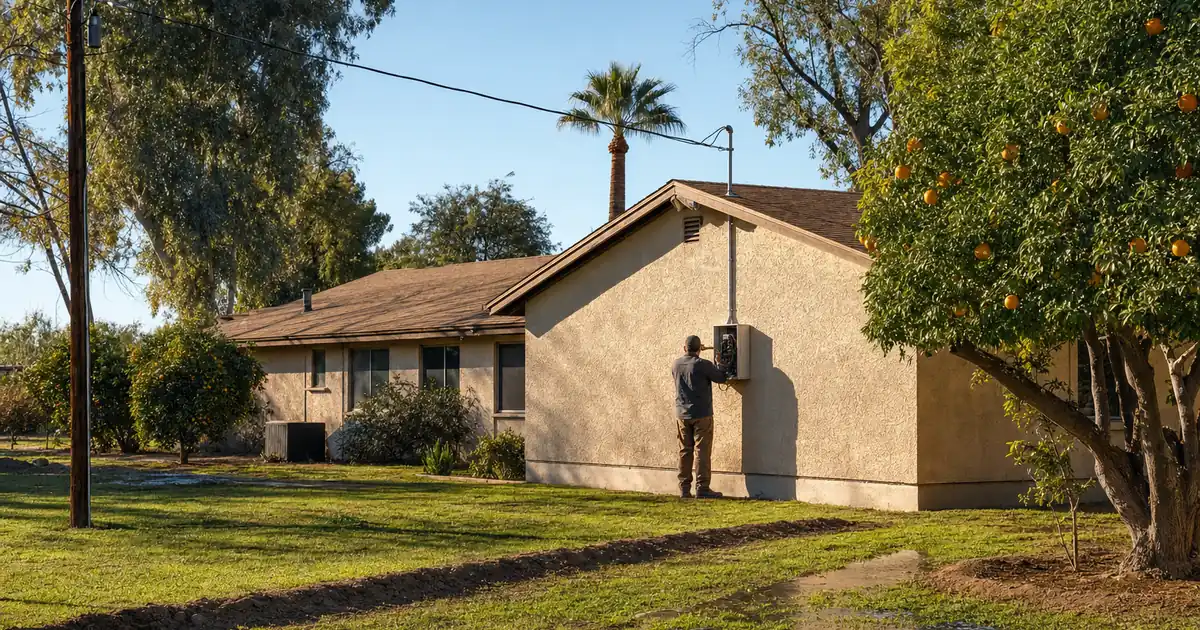
Arcadia is one of the long-established neighborhoods of Phoenix's Camelback East village, and the electrical work on its homes has a character of its own. Lots are large, many are still flood-irrigated, the trees are mature, and the houses range from buildings the City's 1993 survey dated to the 1920s and 1930s to mid-century homes that have been added to more than once. This guide explains what that history means for wiring, for the overhead line that brings power to many houses, for outdoor equipment and for permits, using City of Phoenix and SRP sources.
It does not repeat what every Phoenix home has in common. The service pages linked throughout cover panels, inspections and outdoor wiring in depth; this page is about what is particular to Arcadia.
Key takeaways
- The City of Phoenix lists the Arcadia Camelback Special Planning District Plan among the plans for Camelback East, the village that includes Arcadia.
- A 1993 City-commissioned survey records that the original Arcadia plat was filed in December 1919 as large lots of roughly 5 to 10 acres marketed as small citrus orchards.
- The City says much of Camelback East's housing was built between 1950 and 1970, which is a village-wide figure rather than an Arcadia count.
- SRP says it trims trees near overhead lines between two power poles but does not clear vegetation around the service drop that runs from the pole to a home.
- SRP says homeowners and their neighbors own, operate and maintain flood irrigation systems from the SRP delivery gate to their property and must keep the water on their property.
- The City of Phoenix says residential permits allow residents and contractors to do minor electrical work, including upgrading the electrical service and adding or extending circuits.
Where is Arcadia, and how does the City of Phoenix describe the area around it?
The City of Phoenix organizes its planning by villages, and Arcadia sits within Camelback East. The City lists an Arcadia Camelback Special Planning District Plan among the village's plans, and the Arcadia Camelback Special Planning District and Camelback Road Overlay appear in Section 652 of the Phoenix Zoning Ordinance. The City's Camelback East page describes two main cores for the village, around 24th Street and Camelback Road and around 44th Street and Van Buren, and says the village offers a range of housing types.
The landmarks the City lists for Camelback East give a sense of the setting: the 914-acre Papago Park with its 18-hole golf course and the Papago Baseball Facility, Phoenix Mountains Park and Piestewa Peak, the Phoenix Zoo and the Desert Botanical Garden. The village Character Plan also names Arcadia Park among the village's parks.
One point of honesty before going further. No City source we have read gives Arcadia's own boundaries, population or housing-age figures. The numbers on this page are for Camelback East as a whole unless a sentence says otherwise, and the Arcadia-specific history comes from a 1993 survey commissioned by the City. That matters for electrical work too: a general statement about the village tells you what is likely, while only a look at your own house tells you what is there.
How did Arcadia's citrus-grove history shape its homes and lots?
According to the Arcadia Historic Residential Property Survey, prepared for the City of Phoenix by Woodward Architectural Group in September 1993, the original Arcadia plat was filed in December 1919. It divided the land into large lots of roughly 5 to 10 acres, marketed as small citrus orchards. The Arcadia Water Company was formed the same year to supply the subdivision, and by 1924 crews had laid fifteen miles of underground concrete irrigation pipe.
The survey records that the original financing fell through in the mid-1920s and that the area was replatted between 1926 and 1931. The subdivisions it names include:
- Arcadia Estates, platted in 1926.
- The Arcadia Replat, also 1926, with lots of 4 to 6 acres south of Camelback Road.
- Glencoe Highlands, platted in 1928.
- Alta Hacienda, platted in 1929.
- Hacienda Allenada, platted in 1930.
The same survey updated records for 20 Arcadia buildings with construction dates ranging from about 1919 to 1938. Today's Camelback East Village Character Plan still describes many long-standing lots in the village as "flood irrigated lots located in areas which once were occupied by citrus groves," and lists preserving existing mature trees and maintaining shaded streetscapes among its design principles.
For an electrician, that history shows up in three ways. Houses of very different ages sit near each other, so no two panels on a street are likely to match. Large lots put real distance between the house and outdoor features such as a guest house, a pool or lighting along a drive. And trees and irrigation water are part of the landscape by design, not by accident, so electrical work has to fit around them rather than the other way around.
What does the age of Arcadia homes mean for their wiring?
The City says much of Camelback East's housing was built between 1950 and 1970, and the Character Plan describes long-standing established neighborhoods with mid-century modern design elements. That is a village-wide figure, not an Arcadia count, but it fits what electricians find in the area: most houses were wired decades ago, for the appliances and loads of their day, and many have been extended since.
Age by itself is not a fault. A circuit that was installed well and left alone can still be sound. What matters is what has happened to it since. In older Phoenix homes of this kind, crews routinely find:
- additions and casitas fed from the original panel, so one service now carries more rooms and more equipment than it was planned for;
- circuits extended by previous owners, with splices hidden in the attic or behind later finishes;
- outlets and switches worn loose after decades of use, which is where heat starts under load;
- outdoor circuits added piecemeal as the yard gained lighting, pumps and pool equipment.
The first step on an older Arcadia house is usually a look at the whole system rather than a single complaint: what the service and panel are, what has been added to them, and whether the connections that carry the heaviest summer load are tight and cool. A home electrical inspection is the structured version of that look, and it is the sensible starting point before buying, renovating or adding a major load.
When the house needs more capacity, for an addition, a pool, an EV charger or simply the load a modern household runs, the question becomes one about the service. The City of Phoenix lists an Electrical Service Upgrade of up to 200 amps and an Electric Meter Socket Replacement among its online residential permits. The electrical panel upgrade guide walks through the permit and utility steps in order.
Who trims trees around the power line to an Arcadia home?
Mature trees are part of Arcadia's character, and the City's Character Plan treats them as something to preserve. Where a home is fed by an overhead line, those trees and the line share the same space, and the responsibility for keeping them apart is split in a way many homeowners do not expect.
SRP says it trims trees near overhead lines that run between two power poles, but it does not clear vegetation around the line that runs from the pole to the home, which is called the service drop. For a service drop, SRP says it will temporarily disconnect power at a scheduled time if the customer calls at least a day ahead, so the tree work can be done with the line dead, and it reconnects the power when the customer calls back. SRP also says never to trim near power lines yourself.
Two cautions apply. First, this is SRP's rule, and it applies only where SRP is the electric utility. This page has no source confirming which utility serves any given Arcadia street; the electric bill shows which one serves your home, and APS customers should ask APS about its own process. Second, no public source we have found says how many Arcadia homes are on overhead rather than underground service. Look at your own house: a cable running from a pole to a mast or to the roofline is an overhead service drop.
For new planting, SRP's guidance is to choose a tree that will grow no taller than 20 feet within 25 feet of a power line, and to plant taller trees at least 40 feet from power lines. On a large lot there is usually room to follow that guidance, and doing so avoids the problem for the life of the tree.
How does flood irrigation affect outdoor electrical work in Arcadia?
SRP explains that in flood irrigation its zanjeros deliver water to the high point of a neighborhood, and that homeowners and their neighbors own, operate and maintain the system from the SRP delivery gate to their property, and must keep the water on their property. On an irrigated lot, the yard is designed to hold standing water for a time.
SRP's irrigation pages contain no electrical safety guidance, and we have found no public source on electrical hazards from flood irrigation. The points below are therefore general trade practice, not a published rule:
- Know where the water goes. Before trenching for a new circuit or choosing a spot for a pedestal, a lighting transformer or an outlet, crews walk the lot and look at which areas are bermed to hold irrigation water.
- Keep equipment out of the basin. Pool equipment, lighting transformers, pump controls and outdoor outlets belong on ground that stays dry when the yard is flooded.
- Treat a GFCI trip on irrigation day as information. Outdoor outlets are protected by GFCI devices that trip when they detect current leaking to ground, which moisture in the wiring commonly causes. A trip that lines up with the water is worth tracing, not bypassing.
- Find out what is buried before digging. The 1993 survey records underground concrete irrigation pipe laid in Arcadia by 1924, and later utilities share the same yards.
Large lots also mean long runs. A guest house, a pool at the back of the property or lighting along a long drive can be well away from the panel, and the cable has to be planned for that distance. The landscape lighting and hot tub and pool wiring guides cover that outdoor work in more detail.
How many people live in Camelback East, the village that includes Arcadia?
The Camelback East Village Character Plan, which uses 2015 data, reports 141,250 residents and 62,730 households in the village that year, across 36 square miles, with 165,120 residents projected for 2030. These are figures for the whole village; the plan does not break out Arcadia separately.
| Measure | Year | Figure |
|---|---|---|
| Residents | 2015 | 141,250 |
| Residents (projected) | 2030 | 165,120 |
| Households | 2015 | 62,730 |
| Village area | - | 36 square miles |
How we got this table. Every figure is taken from the City of Phoenix Camelback East Village Character Plan, an undated document that uses 2015 data, read on November 25, 2026. The figures describe the whole Camelback East village, not Arcadia alone; no City source we have read gives Arcadia's own population. The 2030 figure is the City's projection, and the growth of about 23,870 residents mentioned on this page is our own subtraction.
For a homeowner the figures are context rather than a forecast for any one street. They do confirm that Arcadia sits within a large, established village of the city, and Arcadia homes inside Phoenix city limits follow the same City of Phoenix permits and codes as any other Phoenix home.
Do electrical projects in Arcadia need a City of Phoenix permit?
For Arcadia homes inside Phoenix city limits, City permit rules apply. The City's Planning and Development Department says residential permits allow residents and contractors to do minor electrical and plumbing remodel work, including upgrading the electrical service and adding or extending circuits. Its online residential permits include Electrical Utility Clearance, Electrical Service Upgrade (up to 200 amps), Electric Meter Socket Replacement and Field Consultation.
The field consultation permit is worth knowing about in an older neighborhood. It lets a resident meet an inspector on site to ask technical questions about a project, or to get advice about work that was done without a permit. That situation comes up often when a house has been altered by several owners over several decades.
Permitted work is inspected against the City's adopted codes. The City says the 2024 City of Phoenix Building Construction Codes, which include the 2023 National Electrical Code, took effect on August 1, 2025, after City Council adopted them on June 18, 2025. Work at the meter or the service also involves the utility: APS asks customers to contact it before a service is changed or upgraded, and SRP coordinates meter and service work through its construction services.
Does the Arcadia Camelback Special Planning District affect electrical work?
We have found no source saying it regulates electrical work directly, but it is worth checking before outdoor projects near Camelback Road. The City hosts an Arcadia Camelback Special Planning District Plan, but the copy online is not machine-readable and we have not been able to verify its contents, so this page does not describe lot sizes, zoning or design rules from it.
What can be verified is Section 652 of the Phoenix Zoning Ordinance, adopted by Ordinance G-4339 in 2001. It allows wall and landscape variations along Camelback Road from 44th Street to the eastern City limits, to reduce the road's impact on adjacent homes, and it says "Landscaping may also include citrus trees for property beyond the right-of-way." That is a wall and landscape provision, not an electrical one.
The Arcadia Camelback Mountain Neighborhood Association says it worked from 1994 to 1999 to establish the district's protections, describing the area's "setting, landscape, character and uniform quality of home." If an electrical project changes a wall or the landscaping along Camelback Road, confirm with the City before work starts; the field consultation permit described above is one way to ask.
Which electrical projects suit Arcadia's large lots and older houses?
Without claiming what any particular homeowner asks for, the neighborhood's features point to a predictable set of projects, each with its own Arcadia twist.
- Capacity for additions and casitas. An older service now feeding more rooms is the classic case for a load assessment before anything new is connected.
- Outdoor lighting among mature trees. Fixtures and cable are planned around root zones, irrigation basins and any overhead service drop.
- Pool, spa and pump equipment. On a large lot it is often far from the panel and close to irrigated ground.
- EV charging. A charger adds a large, long-running load to a service that may date from the mid-century; the EV charger installation guide covers the steps.
- Repairs to worn devices and circuits. Loose outlets and tired switches in older rooms are where heat starts.
In each case the order of work matters: assess the existing service first, then plan the new load, then decide where outdoor equipment can sit dry and clear of trees.
What are the most common mistakes with electrical work on Arcadia properties?
- Trimming around the service drop yourself. SRP says never to trim near power lines yourself; where SRP is the utility, it will schedule a disconnect for service-drop trimming if called at least a day ahead.
- Assuming the utility trims every line. SRP trims between poles, not around the drop that runs from the pole to the house.
- Setting outdoor equipment where irrigation water stands. A spot that looks level and dry most of the month may sit in water on irrigation day.
- Adding a big load to an old panel without checking it. Additions, pools and chargers should follow a look at the service, not precede it.
- Bypassing a GFCI that trips when the yard is flooded. The device has detected current leaking to ground, often from moisture reaching the wiring.
- Leaving a previous owner's unpermitted work unexamined. The City's field consultation permit exists so a resident can ask an inspector about it.
Who does electrical work on Arcadia homes requested through Your Phoenix Electrician?
Arizona licenses electrical contractors through the Registrar of Contractors. The Arizona Administrative Code describes the R-11 Electrical classification as allowing the licensee to install and repair residential electrical systems. Ask for the license number and classification before any work begins.
Electrical work requested through Your Phoenix Electrician for Arcadia homes is performed by Alvey Electric LLC, Arizona Registrar of Contractors license ROC 364723, R-11 Electrical (residential). The work is residential only. For other parts of the city, see the Phoenix neighborhoods and villages we serve.
Frequently asked questions
Do you need a permit for electrical work in Arcadia, Phoenix?
Often, yes. For Arcadia homes inside Phoenix city limits, the City says residential permits allow residents and contractors to do minor electrical work, including upgrading the electrical service and adding or extending circuits. Its online residential permits include an Electrical Service Upgrade of up to 200 amps and an Electric Meter Socket Replacement. If you are unsure, the City's field consultation permit lets a resident meet an inspector on site to ask.
Who trims trees around the power line to my Arcadia house?
Where SRP is the utility, it trims trees near lines that run between two power poles but does not clear vegetation around the service drop from the pole to your home. For a service drop, SRP will temporarily disconnect power at a scheduled time if you call at least a day ahead, then reconnect it when you call back. Check your bill to confirm your utility; APS customers should ask APS.
Can I trim a tree branch near my service drop myself?
No. SRP says never to trim near power lines yourself. Where SRP is your utility, the safer route is to arrange a scheduled disconnect at least a day ahead, have the tree work done with the line dead, and call SRP back to reconnect. If APS is your utility, ask APS about its process before anyone works near the line.
Is Arcadia part of Camelback East village?
Yes. The City of Phoenix lists the Arcadia Camelback Special Planning District Plan among the plans for Camelback East village, and the district appears in Section 652 of the Phoenix Zoning Ordinance. The City's Camelback East Character Plan, using 2015 data, reports 141,250 residents and 62,730 households across the 36-square-mile village, which includes Arcadia and other neighborhoods.
How old are the homes in Arcadia?
They vary. A 1993 City-commissioned survey updated records for 20 Arcadia buildings dating from about 1919 to 1938, and traces the neighborhood to a citrus-grove plat filed in December 1919. Across the wider Camelback East village, the City says much of the housing was built between 1950 and 1970. No City source gives an age breakdown for Arcadia alone.
Does flood irrigation affect outdoor outlets and electrical equipment?
SRP's irrigation pages give no electrical safety guidance, so this is general trade practice. Irrigated yards are designed to hold standing water for a time, so pool equipment, lighting transformers, pump controls and outdoor outlets are best placed on ground that stays dry. A GFCI that trips on irrigation day has detected current leaking to ground, often because moisture reached the wiring, and should be traced, not bypassed.
Does the Arcadia Camelback Special Planning District regulate electrical work?
We have found no source saying it does. The verifiable part, Zoning Ordinance Section 652, allows wall and landscape variations along Camelback Road from 44th Street to the eastern City limits. The district plan itself could not be verified for this page. If an electrical project changes walls or landscaping along Camelback Road, confirm with the City before work begins.
Which utility serves Arcadia, SRP or APS?
This page does not say, because we have no source confirming which utility serves any given Arcadia street. Both APS and SRP serve parts of Phoenix, and your electric bill shows which one serves your home. It matters because tree-trimming, disconnect and service-change procedures are set by the utility, not the City.
Should I get an electrical inspection before buying an older Arcadia home?
It is a sensible step. Homes in the area were often wired decades ago and extended by later owners, with additions fed from the original panel and splices hidden in attics. An inspection looks at the service, the panel, what has been added and how the connections are holding up, which tells you what you are buying before you add new loads.
How much does electrical work on an Arcadia home cost?
This page does not quote prices, because no public source sets one. Cost depends on the job: the condition and capacity of the existing service, how far outdoor equipment sits from the panel on a large lot, whether a permit and inspection are needed, and whether utility coordination is involved. Ask for the scope and the price together, in writing, before work starts.
Who does electrical work on Arcadia homes requested through Your Phoenix Electrician?
Electrical work requested through Your Phoenix Electrician for Arcadia homes is performed by Alvey Electric LLC, Arizona Registrar of Contractors license ROC 364723, R-11 Electrical (residential). The Arizona Administrative Code describes the R-11 Electrical classification as allowing the licensee to install and repair residential electrical systems. The work is residential only.
The short version
Arcadia's electrical questions come from its history: older houses that have been extended, mature trees around overhead lines, and yards built to hold irrigation water. The rule that follows is to check the existing service before adding any load, to leave trimming near the service drop to the utility's process, and to place outdoor equipment where the water does not stand. Where a project adds or extends circuits or touches the service, plan for a City of Phoenix permit from the start.
This page is general information about residential electrical work in Phoenix, Arizona. It is not engineering, legal or code advice for a specific property. Permit rules, utility requirements, rebates and adopted codes change; confirm current requirements with the City of Phoenix and your utility before work begins.
References
- City of Phoenix Planning and Development Department, Camelback East Village (village cores, housing era, landmarks, plans, planning committee) https://www.phoenix.gov/administration/departments/pdd/planning-zoning/villages/camelback-east.html. Read November 25, 2026.
- City of Phoenix, Camelback East Village Character Plan (2015 population and household data; flood-irrigated lots; mature trees) https://www.phoenix.gov/content/dam/phoenix/pddsite/villagessite/documents/camelback%20east%20village%20character%20plan.pdf. Read November 25, 2026.
- City of Phoenix Historic Preservation, Arcadia Historic Residential Property Survey, Woodward Architectural Group, September 1993 https://www.phoenix.gov/content/dam/phoenix/pddsite/documents/hp/pdd_hp_pdf_00200.pdf. Read November 25, 2026.
- Phoenix Zoning Ordinance Section 652, Arcadia Camelback Special Planning District / Camelback Road Overlay (Ord. G-4339, 2001) https://phoenix.municipal.codes/ZO/652. Read November 25, 2026.
- Arcadia Camelback Mountain Neighborhood Association, Arcadia Camelback Special Planning District https://www.acmna.org/arcadia-camelback-special-planning-district. Read November 25, 2026.
- SRP, How flood irrigation works in the Phoenix area https://www.srpnet.com/grid-water-management/irrigation/how-flood-irrigation-works. Read November 25, 2026.
- SRP, Contact SRP to trim trees near power lines https://www.srpnet.com/customer-service/safety/tree-trimming-power-lines. Read November 25, 2026.
- City of Phoenix Planning and Development Department, Online Permits (TRT/DOC/00933) https://www.phoenix.gov/content/dam/phoenix/pddsite/documents/trt/external/dsd_trt_pdf_00933.pdf. Read November 25, 2026.
- City of Phoenix Planning and Development Department, Building Construction Codes (2023 National Electrical Code; effective August 1, 2025) https://www.phoenix.gov/administration/departments/pdd/tools-resources/codes-ordinance/building-code.html. Read November 25, 2026.
- City of Phoenix, 2024 Phoenix Building Construction Code Implementation (adopted June 18, 2025) https://www.phoenix.gov/content/dam/phoenix/pddsite/documents/codes-ordinances/amendmentcodes/2024-building-code-implementation.pdf. Read November 25, 2026.
- Arizona Public Service, Electric Service Requirements Manual, Section 200, 200.2-2 Upgrade Service https://www.aps.com/-/media/APS/APSCOM-PDFs/About/Construction-and-Power-Line-Siting/Construction-Services/Electric-Service-Requirements-Manual/200.pdf. Read November 25, 2026.
- Salt River Project, Power and water construction services https://www.srpnet.com/electric/business/ccs. Read November 25, 2026.
- Arizona Administrative Code R4-9-103, Residential Contractor License Classifications and Scopes of Work (R-11 Electrical) https://www.law.cornell.edu/regulations/arizona/Ariz-Admin-Code-SS-R4-9-103. Read November 25, 2026.
Plan electrical work for your Arcadia home
Request an estimate for work on your Arcadia property.
Related pages
About this page
Written by the Your Phoenix Electrician editorial team from the sources listed above. Reviewed by Robert "Bob" Lira, licensed Arizona electrical contractor, ROC 338369. Your Phoenix Electrician, 4315 E Thunderbird Rd #120, Phoenix, AZ 85032, phone 602-900-0593, serves homes in the City of Phoenix. Electrical work is performed by Alvey Electric LLC, Arizona Registrar of Contractors license ROC 364723 (residential electrical).
Updated .